4 weeks ago
31
4 weeks ago
31

Two centuries ago, a British geologist gave the world its first named dinosaur. Megalosaurus, described from a handful of fossilised bones, marked the birth of an entire scientific field.
Back then, researchers worked with little more than fragments, guesswork and imagination to picture prehistoric life. Fast forward 200 years, and palaeontology looks unrecognisable. Scientists no longer just look at bones, they scan them, digitally reconstruct brains, and map evolutionary history down to the level of nerve pathways. A newly described Cretaceous snake fossil from Brazil shows exactly how far the field has travelled, and why the next chapter of prehistoric discovery may prove even more revealing than the last.
How the first dinosaur discovery changed palaeontology forever
According to Reuters, in 1824, the description of Megalosaurus gave scientists their first formal look at what would later be called a dinosaur, decades before the term itself was even coined. At the time, understanding an extinct creature meant piecing together isolated bones and drawing conclusions largely from shape and size alone. There was no way to peer inside a skull, examine soft tissue impressions, or model how an animal might have moved, sensed its surroundings or behaved.
Every reconstruction relied heavily on comparison with living animals and no small amount of informed speculation.That limitation defined palaeontology for well over a century, shaping both its discoveries and its blind spots. Fossils were prized mainly for what their outer shape could reveal, while anything hidden within bone or rock was effectively unreachable. Entire evolutionary questions, such as how a group of animals adapted to different habitats or how their senses developed, sat well beyond the scientific tools of the day.
It is only against this backdrop that the pace of recent progress becomes clear, because the gap between simply naming a fossil and truly understanding the animal behind it has taken two centuries to narrow.
Ancient Brazil snake fossil reveals the power of modern CT scanning
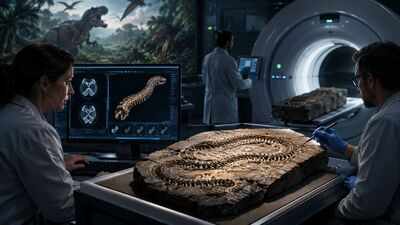
Modern palaeontology has closed many of those gaps, and a recent discovery illustrates just how dramatically. Researchers studying a newly identified Cretaceous snake, Tametara mirim, unearthed in south-eastern Brazil, used high-resolution micro-CT scanning to reconstruct its brain anatomy from fossilised skull material tens of millions of years old.
This is not simply an improved bone description; it is a working model of how an extinct animal's nervous system was structured, built entirely from mineralised remains.
According to the study published in Nature titled “Exceptional brain and ecological diversity in the earliest snakes”, the fossil preserved roughly 60% of the skull and 70% of the vertebral column, giving researchers an unusually complete window into the animal's anatomy.That level of detail would have been unthinkable to nineteenth-century naturalists, who could only estimate internal anatomy from external bone contours.
Understanding the origin of snakes has remained a century-old challenge, largely due to how rare and incomplete early fossils tend to be. Micro-CT technology sidesteps that problem almost entirely, allowing scientists to digitally separate bone from surrounding rock and rebuild structures, such as the braincase or inner ear, without physically damaging the specimen.
It is this shift from physical excavation alone to digital reconstruction that marks one of the clearest dividing lines between the palaeontology of Buckland's era and the palaeontology practised today.
How an ancient snake fossil is changing what scientists know about snake evolution
The findings go well beyond description. By comparing brain shape and skull microstructure, researchers determined that Tametara likely lived a burrowing lifestyle, while a related Cretaceous species, Dinilysia patagonica, did not, despite both belonging to the same early branch of snake evolution. According to lead researcher Tiago Simões, snakes represent one of the most extreme body plans among all vertebrates, and understanding their origins remains one of the biggest puzzles in vertebrate evolution.
That two closely related species could differ so sharply in habitat and brain structure suggests that early snake evolution was far messier, and more experimental, than a single straight line from lizard-like ancestor to modern snake.What makes this significant is the method, not just the discovery. Two centuries ago, no tool existed to compare cerebral hemispheres, optic tectum size or inner-ear structure across species separated by tens of millions of years.
Today, that comparison is not only possible, but it is reshaping long-standing theories about how and where snakes first evolved. Researchers were able to statistically classify Tametara as fossorial with a high degree of confidence, based on brain shape alone, something that would have relied purely on anatomical guesswork in the past.
The result is a far more nuanced picture: rather than one ancestral habitat giving rise to all snakes, multiple lifestyles appear to have been tested and discarded repeatedly across millions of years.
How modern technology is transforming palaeontology and fossil research
The distance between Megalosaurus in 1824 and Tametara mirim in 2026 is not just measured in years, but in capability. Palaeontology has shifted from describing what a fossil looks like to reconstructing how an extinct animal may have thought, sensed and lived, using digital imaging, statistical modelling and comparative anatomy tools that earlier scientists could not have imagined. Techniques such as geometric morphometrics and phylogenetic dating now allow researchers to place a single fossil within a family tree spanning hundreds of species and hundreds of millions of years, something that simply had no equivalent methodology two centuries ago.If two centuries produced this level of transformation, the coming decades, powered by better scanning technology, larger datasets and international collaboration, may reveal even more about the deep past than researchers currently think possible. Fossils that once sat in museum drawers as static curiosities are increasingly being revisited with new imaging tools, often yielding fresh insights decades after their original discovery.
The story of prehistoric life is still being written, and each new fossil adds detail that earlier generations of scientists could only guess at.