3 months ago
30
3 months ago
30

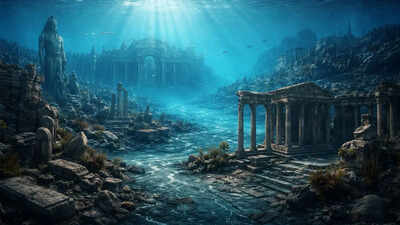
Since time immemorial, tales of cities which once existed but sank into the depths of the oceans have captivated people all over the world. Although tales of cities such as Atlantis still belong in the realm of legends, scientific evidence has shown that some actual cities do lie under the seas today.
The underwater sites are not only intriguing but are also important time capsules of ancient civilisations.According to UNESCO’s The 2001 Convention, underwater cities across the world are recognised as cultural heritage sites that offer valuable insights into ancient civilisations and the natural forces that led to their submergence.In most cases, the cities were not suddenly lost due to natural disasters such as earthquakes and changes in sea levels.
Modern technologies such as sonar maps are being used by archaeologists to unearth these sunken cities.
Ancient cities that now lie underwater
The sunken cities provide a look at some of the ancient civilisations that flourished in coastal or riverine areas. Each city is a unique narrative of human civilisation that is now underwater because of the power of nature.
Thonis-Heracleion: Egypt’s lost port city
Thonis-Heracleion is one of the greatest underwater discoveries, which is an ancient Egyptian city that used to be an important port where people engaged in business transactions.
The city was situated at the mouth of the River Nile and used to be the point through which ships from Greece entered Egypt.For several centuries, this port city was known based on writings in some historical books written by great personalities such as Herodotus. It was not until the early 1990s that archaeologists discovered the lost city.
Pavlopetri: the world’s oldest submerged city
Located off the coast of Greece, Pavlopetri is thought to have existed for more than 5,000 years.
It is special because of its incredible state of preservation. Roads, houses, and even burial sites can be seen under the water.According to UNESCO, sites like Pavlopetri are recognised as underwater cultural heritage and are protected due to their importance in understanding early human settlements.It is possible that the city sank into the ocean because of natural disasters such as earthquakes and floods. Unlike many other ancient cities, Pavlopetri gives us an idea about how ancient towns were laid out.
Port Royal: the “wickedest city” lost in a day
Once considered a thriving port city in Jamaica where trade and piracy flourished, Port Royal was famous for its rich and opulent lifestyle.However, a severe earthquake hit the area in 1692, causing most of the city to submerge beneath the waves. The ruins remained underwater in their original form for us to see what life was like back then.
Alexandria: Egypt’s submerged royal quarter
There are portions of the ancient city of Alexandria, including the royal palace and some famous landmarks, which now lie beneath the waters of the Mediterranean Sea.
It is believed that these portions are submerged in the water due to earthquakes and changes in the coastline.Several objects have been retrieved from this region by conducting explorations underwater.
Baiae: Rome’s underwater luxury resort
Baiae used to be a resort destination for the wealthy people in ancient Rome. The city had luxurious villas and public baths. However, volcanic activity led to the gradual sinking of the land where the town used to exist.Today, parts of Baiae have sunk into the sea, but divers can still see well-preserved mosaics, sculptures, and buildings beneath the water.
Why these cities disappeared
The sinking of cities did not happen in an instant in all cases. What actually happened was that a number of processes were responsible for causing this to happen. Sea levels rose following the last Ice Age, which caused coastal areas to be covered by rising waters. Earthquakes and volcanoes caused sinking and shifting of the land.This clearly illustrates just how much ancient civilisations relied on nature.
What underwater cities reveal
Underwater archaeology has brought to light a new perspective in understanding the past. Whereas on-land ruins often suffer from weather and human degradation, underwater sites tend to preserve more well than on land.Discoveries ranging from implements and ceramics to building structures allow historians to understand the past and its cultures.
The presence of these ruins also serves as a reminder that entire civilisations can disappear without a trace.
What these lost cities reveal today
It can almost seem like myth or fiction to talk about cities that have been lost under the water, but in fact they exist in many places around the world, from ancient ports built by Egyptians, to luxurious resorts created by Romans.With the continued advances in technology, even more cities will surely come to light, and every time this happens, one gets that little bit closer to knowing about the lives of people that once walked on streets that are now under the water.