1 hour ago
2
1 hour ago
2

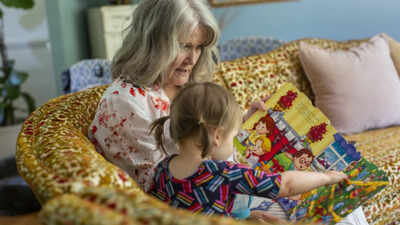
Mary Jo Galusha now spends about 30 hours each week caring for her granddaughter (NPR photo)
A 67-year-old retired schoolteacher from Idaho moved across the US to Delaware after her daughter decided to have a second child despite the high cost of childcare. Mary Jo Galusha retired from teaching and drove cross-country in her red Volkswagen Beetle to help her daughter, Stacia Bourne, and her family, WTJX NewsFeed reported.Bourne, a University of Delaware psychology professor who lives in Maryland, and her husband had been worried about the cost of raising another child. Their first child, George, was born in 2020 and started daycare at the age of two. "The cost for childcare for him is about the same as our mortgage," Bourne said.The couple had been discussing whether they could afford a second child when Galusha offered to help. She told her daughter that if they decided to have another baby, she would retire and move from Idaho to the East Coast to provide childcare.Several months later, Galusha received the call that Bourne was expecting. "I got a call that Stacia was expecting and that I better start planning on retiring," Galusha recalled with a laugh. She then retired from her job as a schoolteacher, packed her belongings and made the long drive to Delaware.Galusha, who is now the grandmother of five, lives in Newark, Delaware. Her granddaughter Robin was born in late 2024 and spends about 30 hours a week in Galusha's care while her parents work.
Galusha has also replaced her Volkswagen Beetle with an SUV so that two car seats can fit more easily in the back row. "It's a joy," Galusha said. "It's like magic to watch them grow up."
Rising costs push families to grandparents
Galusha's decision comes as more families in the US are relying on grandparents for childcare. Grandparents have always helped look after grandchildren, but rising childcare costs have made that support more important for families who cannot easily afford daycare.According to Child Care Aware of America, the average annual cost of childcare for children under five in the US was $13,184 in 2025. In some cases, childcare costs can be close to the cost of rent or college tuition.Nicole Jorwic, chief programme officer at Caring Across Generations, said families are turning to older relatives because of gaps in the childcare system."The reality is that because this country hasn't invested in a childcare infrastructure that is flexible and affordable and reliable, grandparents are filling in the gaps that the service system leaves behind," she said.Madonna Harrington Meyer, a Syracuse University sociology professor who studies ageing and grandparenting, said several factors have increased the need for childcare. More households now have both parents working full-time, while the number of single mothers has also increased over the decades.Families raising children with disabilities can face another challenge because they may need childcare providers who can offer specialised care.
"All of these things are reasons people turn to grandparents," Harrington Meyer said.
Millions of grandparents provide regular care
Galusha is one of millions of grandparents who help care for grandchildren. One poll found that nearly half of respondents with grandchildren under 18 looked after them at least once every few months.An AARP report from June found that the main reasons grandparents provide childcare include parents being busy or working and grandparents wanting to spend time with their grandchildren.The median amount of time grandparents spent caring for grandchildren, excluding those who are primary caregivers or provide no care, was 200 hours a year, or about 3.8 hours a week, according to the data.
Having grandparents provide childcare can also offer greater flexibility than formal daycare. Harrington Meyer said grandparents may care for children at their own homes or at the children's homes and can adjust arrangements around the family's needs."They are so flexible," Harrington Meyer said. "Unlike a formal daycare situation, often grandparents will come to your house, or they'll alternate between watching the children at their own house and at the grandparent's house."Grandparents can also benefit from spending time with their grandchildren. One study found higher scores on memory and verbal fluency tests among grandparents who provided care.
Sacrifice for grandparents
However, providing regular childcare can be demanding, particularly for older people who have already raised their own children.
It can affect their physical health, social lives and careers. Grandparents who move to be closer to their grandchildren may also leave behind friends and familiar surroundings.Jerry Larkin, 66, a former machinist, moved in with his daughter's family in Tulsa, Oklahoma, during the Covid-19 pandemic to help care for his twin grandsons. One of the children requires additional medical care."Being raised in the '60s, there were a lot of stay-at-home moms and everything, so this wasn't really a thing," Larkin said.
"But now that everybody's got to work two jobs, it's become a thing."Yalanda Lattimore, 59, also provides regular care for her one-year-old granddaughter, Mavee. She looks after her for one and a half days each week. Lattimore said the arrangement has reduced the time she can spend on her handmade soap business and media work."I felt like I could make the sacrifice more than they could, and it truly has been a sacrifice," she said.
"You just put things on hold, because your priorities are different."
Galusha plans to care until kindergarten
For Galusha, her pension from her years as a schoolteacher in Idaho makes it possible to provide unpaid childcare after retirement. Her home in Newark has a bedroom for her grandchildren, a playroom filled with Legos and a crafting area for George.Galusha and Bourne use a shared Google Calendar to organise the children's care. The current plan is for Galusha to look after Robin until she starts kindergarten, although the two review the arrangement every six months.Bourne said having her mother provide the care gives the family a sense of security, but there is little backup if the arrangement changes."I'd much prefer to have my mom take care of Robin, but then you always worry, like if in six months she decides that she wants to move and be near another grandbaby, then we'll have to scramble and figure out something else," Bourne said. Galusha responded from across the table, "No plans for that."For Lattimore, the time spent caring for her granddaughter is also about being present for her family. "What you really want is somebody to say you were there, that you were there for them," she said. "Those are the memories that I want."She said parents should not have to choose between paying for childcare and giving up work. After raising four children herself, she wanted her daughter to have a different experience."When my daughter got ready to start her family, I just didn't want her to go through that," Lattimore said. "I wanted her to have the balance. If work-life balance exists for somebody, I wanted it for my daughter," she added.