1 hour ago
2
1 hour ago
2

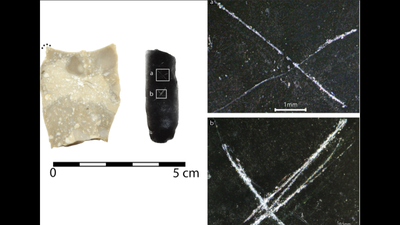
PC: Intentional incisions on Neolithic Obsidian arrowheads from Central Anatolia: A techno-functional and iconographic approach
For nearly nine thousand years, a set of Anatolian arrowheads has been quietly guarding a secret. Archaeologists working at Tepecik-Ciftlik, a Neolithic settlement in Cappadocia, central Turkey, have identified eleven newly recognised obsidian points bearing deliberate, hand-cut incisions, bringing the site's total to twelve and the wider regional count to 54.
According to the study published in PLOS One, titled ‘Intentional incisions on Neolithic Obsidian arrowheads from Central Anatolia: A techno-functional and iconographic approach’, these markings were made on purpose, not left by accident during manufacture or centuries buried in the ground. Yet despite careful microscopic analysis, experimental replication and comparison with dozens of similar finds across Central Anatolia, the arrowheads' meaning remains stubbornly out of reach. Were they hunters' signatures, decorative flourishes, or something closer to ritual? No two designs match, and the practice never spread beyond this one corner of the ancient world, leaving researchers with more questions than answers.
9,000-year-old Neolithic arrowheads in Turkey show mysterious incised symbols
These arrowheads are not distinguished by their shape or size, which match the ordinary points found alongside them, but by the presence of small, hand-cut lines etched into their ventral faces, crosses, chevrons, wavy lines, squares, and an occasional letter-like form. Microscopic examination ruled out accidental scratching. The researchers established three criteria for genuine incisions, namely visibility to the naked eye, clear removal of material, and evidence of repeated, controlled strokes, and on that basis confirmed intentional marks on ten of the twelve pieces, with two remaining ambiguous.
No two designs are identical, and the number of strokes required ranges from a single cut to twenty on the most elaborate specimen, arrowhead 4, whose three linked squares took repeated passes to complete. The corpus shows "no correlation with raw material, chaîne opératoire, typology, or use-wear." In other words, whatever drove someone to mark a particular point, it wasn't linked to how the tool was made or used.
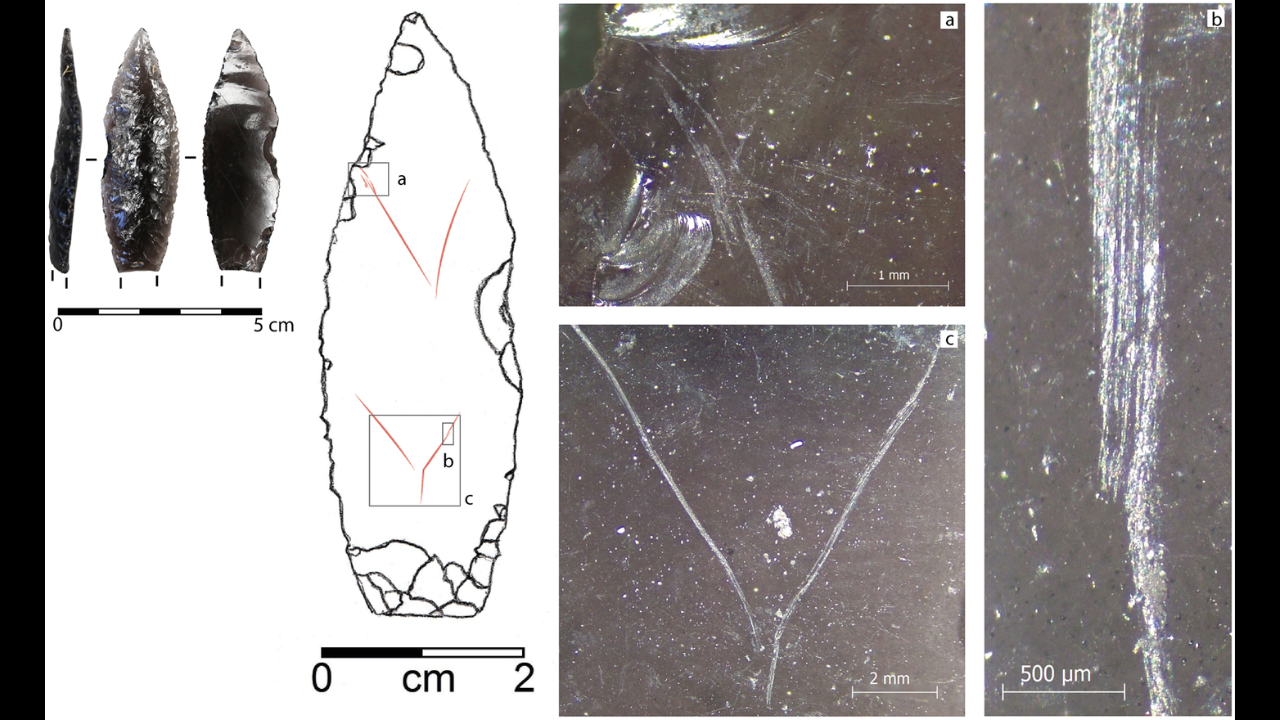
PC: Intentional incisions on Neolithic Obsidian arrowheads from Central Anatolia: A techno-functional and iconographic approach
Flint tools were used to carve markings into obsidian arrowheads
To understand the technique, the team ran an experiment, attempting to incise a fresh obsidian blade with both a flint tool and another piece of obsidian. Obsidian proved too soft to mark obsidian effectively, whereas a flint edge, harder on the Mohs scale, cut clean, deliberate lines. That is notable because flint makes up under one per cent of the site's stone tools, suggesting its use here was a considered choice rather than convenience.The timing of the incisions relative to each arrowhead's shaping proved just as inconsistent as everything else. In three cases the cuts were made before the final retouching, in three others afterwards, and in six the sequence could not be determined at all. Functionally, the picture is similarly murky: only one incised point, arrowhead 11, showed a fracture consistent with having struck a target, while the rest bore no clear signs of use as projectiles, ruling neither hunting nor purely symbolic purposes in or out.
Why Neolithic communities in Turkey carved mysterious markings into arrowheads
The mystery isn't confined to Tepecik-Ciftlik. Similar incised arrowheads have turned up at Çatalhöyük, Can Hasan III, Kömürcü-Kaletepe and a handful of other Cappadocian and Konya Plain sites, and the study notes intriguing formal echoes between them, such as a cross at Tepecik-Ciftlik resembling one from Çatalhöyük, and wavy-line motifs matching pieces from Can Hasan III. Yet Cappadocian obsidian itself travelled far beyond the region, as far as the southern Levant, without carrying the incising tradition with it, which the authors argue points to "specific cultural practices confined to certain Neolithic communities.
"The leading theory, first proposed by archaeologist Kathryn Ataman in 1988 after studying arrowheads from Can Hasan III, was that the marks functioned as hunters' signatures, a way of claiming a kill, drawing loosely on ethnographic parallels from Inuit hunting groups. Comparing the Anatolian finds against incised projectiles from Iron Age Phoenicia, Bronze Age Mesopotamia and Palaeolithic Europe turned up no close parallel, leading the pair to conclude only that decoration, ownership marks and something closer to ritual or magical practice all remain plausible.