1 month ago
30
1 month ago
30

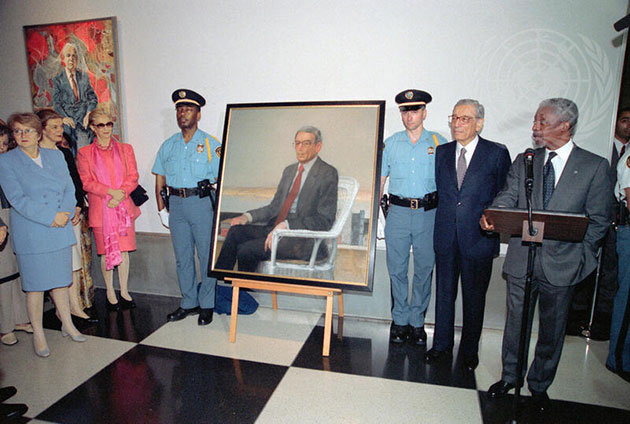 Secretary-General Kofi Annan speaks at a ceremony to unveil the official portrait of his predecessor, Boutros Boutros-Ghali. Credit: UN Photo/Eskinder Debebe
UNITED NATIONS, June 22 (IPS) - When Egypt’s onetime Foreign Minister Boutros Boutros-Ghali was running for the post of U.N. Secretary-General in late 1991, he had to contend with the rival candidature of Bernard Chidzero, then foreign minister of Zimbabwe.
As the campaign began to intensify, Boutros-Ghali recounted a brief encounter with Chidzero, a longstanding friend, at a conference in Africa, a continent which at that time claimed the job of U.N. chief on the basis of geographical rotation.
Chidzero, who hailed from an English-speaking country and was backed by the UK and the 54-member Commonwealth of mostly ex-British colonies, was in conversation with Boutros-Ghali when he suddenly switched from English to French.
Having picked up the subtle message, Boutros-Ghali said he put his arms around Chidzero and jokingly remarked, “Bernard, if you want the approval of France, you must not only speak French, but also speak English with a French accent.”
France, a veto-wielding permanent member of the Security Council, has been so passionately protective of its language that it may well have exercised its veto on any candidate who did not speak French.
And no one who aspires to be the Secretary-General of the United Nations can expect to be elected to office if he or she does not have a working knowledge of French – or at least promises to eventually master the language – because France considers it the “language of international diplomacy”.
Which triggers the question: How many of the candidates, both male and female, now running for the next UN Secretary-General are fluent both in English and French?
Over the last 81 years, the two working languages of the United Nations have been primarily English and French, although there are four other official languages recognized by the world body: Chinese, Arabic, Spanish and Russian.
Boutros-Ghali, who was fluent in English, Arabic and French, held “the world’s most impossible job” from January 1992 through December 1996. Asked at a briefing with reporters about his fluency in three languages, Boutros-Ghali jokingly said his primary language was Arabic “because when I fight with my wife, I fight in Arabic.”
The independence of the Secretary-General, he pointed out, is a longstanding myth perpetuated mostly outside the United Nations. As an international civil servant, he is expected to shed his political loyalties when he takes office, and more importantly, never seek or receive instructions from any governments.
But virtually every single Secretary-General—nine at last count– has played ball with the world’s major powers in violation of Article 100 of the UN charter. Boutros-Ghali, the only Secretary-General to be denied a second term because of a negative US veto, unveiled the insidious political maneuvering that goes inside the glass house.
The US, which preaches the concept of majority rule to the outside world, exercised its veto even though Boutros-Ghali had 14 of the 15 votes in the Security Council, including the votes of the other four permanent members of the Council, namely the UK, France, Russia and China.
In such circumstances, tradition would demand the dissenting US abstain on the vote and respect the wishes of the overwhelming majority in the Security Council. But the US refused to acknowledge the vibrant political support that Boutros-Ghali had garnered in the world body.
Unlike most of his predecessors and successors, Boutros-Ghali refused to blindly play ball with the US despite the fact that he occasionally caved into US pressure at a time when Washington had gained a notoriety for trying to manipulate the world body to protect its own national interests.
Going down memory lane, Samir Sanbar, a former UN Assistant Secretary-General, told Inter Press Service last week when Boutros-Ghali met Bernard Chidzero after leaving his post, his former competitor for the SG office asked how come the U.S. insisted on blocking his re-election although he was perceived to be “America’s Yes Man”. With his sense of humor intact, Boutros-Ghali responded that the U.S. Administration did not want just a “Yes, Man but a “Yes Sir, Man”
In his 368-page book titled “Unvanquished: A US-UN Saga” (Random House, 1999), he provided an insider’s view of how the United Nations and its chief administrative officer (CAO) were manipulated by the Organization’s most powerful member: the United States.
Although he was accused by Washington of being “too independent” of the US, he eventually did everything in his power to please the Americans. But still the US was the only country to say “no” to a second five-year term for Boutros-Ghali.
In his book, Boutros-Ghali recalls a meeting in which he tells the then Secretary of State Warren Christopher that many Americans had been appointed to UN jobs “at Washington’s request over the objections of other UN member states.” “I had done so, I said, because I wanted American support to succeed in my job (as Secretary-General”), Boutros-Ghali says. But Christopher refused to respond.
When he was elected Secretary-General in January 1992, Boutros-Ghali noted that 50 percent of the staff assigned to the UN’s administration and management were Americans, although Washington paid only 25 percent of the UN’s regular budget.
When the Clinton administration took office in Washington in January 1993, Boutros-Ghali was signaled that two of the highest-ranking UN staffers appointed on the recommendation of the outgoing Bush administration– Under-Secretary-General Richard Thornburgh and Under-Secretary-General Joseph Verner Reed — were to be dismissed despite the fact that they were theoretically “international civil servants” answerable only to the world body.
They were both replaced by two other Americans who had the blessings of the Clinton Administration. Just before his election in November 1991, Boutros-Ghali remembers someone telling him that John Bolton, the US Assistant Secretary of State for International Organizations, was “at odds” with the earlier Secretary-General Javier Perez de Cuellar because he had “been insufficiently attentive to American interests.”
“I assured Bolton of my own serious regard for US policy.” “Without American support” Boutros-Ghali told Bolton, “the United Nations would be paralyzed.”
The former UN chief recalls a meeting in which he tells the then Secretary of State Warren Christopher that many Americans had been appointed to UN jobs “at Washington’s request over the objections of other UN member states.” “I had done so, I said, because I wanted American support to succeed in my job (as Secretary-General”), Boutros-Ghali says. But Christopher refused to respond.
Boutros-Ghali also recounted how Secretary of State Warren Christopher had tried to convince him to publicly declare that he will not run for a second term as secretary-General. But he refused. “Surely, you cannot dismiss the Secretary-General of the United Nations by a unilateral diktat of the United States. What about the rights of the other (14) Security Council members”?, he asked Christopher. But Christopher “mumbled something inaudible and hung up, deeply displeased”.
Boutros-Ghali also said that in late 1996, US Ambassador to the UN Madeleine Albright, on instructions from the US State Department, was fixated on a single issue that had dominated her life for months: the “elimination” of Boutros-Ghali.
Under-Secretary-General Joseph Verner Reed, an American, is quoted as saying that he had heard Albright say: “I will make Boutros think I am his friend; then I will break his legs.” After meticulously observing her, Boutros-Ghali concludes that Albright had accomplished her diplomatic mission with skill.
“She had carried out her campaign with determination, letting pass no opportunity to demolish my authority and tarnish my image, all the while showing a serene face, wearing a friendly smile, and repeating expressions of friendship and admiration,” he writes. “I recalled what a Hindu scholar once said to me: there is no difference between diplomacy and deception”.
In his book, Boutros-Ghali says he was also urged by then US President Bill Clinton to appoint William Foege, a former head of the US Centres for Disease Control, as UNICEF chief to succeed James Grant, also an American.
Since Belgium and Finland had already put forward “outstanding” women candidates — and since the US had refused to pay its UN dues and was also making ”disparaging” remarks about the world body — “there was no longer automatic acceptance by other nations that the director of UNICEF must inevitably be an American man or woman,” said Boutros-Ghali.
“The US should select a woman candidate,” Boutros-Ghali told Albright, “and then I will see what I can do,” since the appointment involved consultation with the then 36-member UNICEF Executive Board. ”
Albright rolled her eyes and made a face, repeating what had become her standard expression of frustration with me,” he writes.
When the US kept pressing Foege’s candidature, Boutros-Ghali says that “many countries on the UNICEF Board were angry and (told) me to tell the United States to go to hell.”
The US eventually submitted an alternate woman candidate: Carol Bellamy, a former director of Peace Corps.
Although Elizabeth Rehn of Finland received 15 votes to Bellamy’s 12 in a straw poll, Boutros-Ghali said he asked the Board president to convince the members to achieve consensus on Bellamy so that the US could continue a monopoly it held since UNICEF was created in 1947.
This article contains excerpts from a book on the United Nations titled “No Comment – and Don’t Quote Me on That” authored by Thalif Deen, Senior Editor at Inter Press Service news agency. A former member of the Sri Lanka delegation to the General Assembly sessions, he is a Fulbright scholar with a Master’s Degree in Journalism from Columbia University, New York, and twice (2012-2013) shared the gold medal for excellence in UN reporting awarded annually by the UN Correspondents Association (UNCA). The book is available on Amazon. The link to Amazon via the author’s website follows: https://www.amazon.com/No-Comment-dont-quote-that/dp/064811838X
IPS UN Bureau Report
© Inter Press Service (20260622051543) — All Rights Reserved. Original source: Inter Press Service