1 hour ago
4
1 hour ago
4

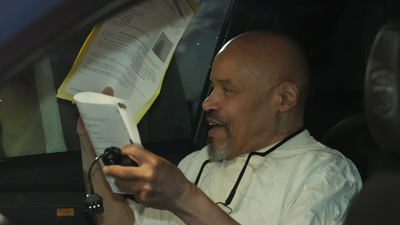
Douglas Stewart Carter sits in a car after he was released out of the Utah County Jail (Photo: AP)
A 71-year-old man who spent 41 years on death row has been ordered released on bail by a Utah judge after new DNA testing excluded him from evidence found at the crime scene. Douglas Stewart Carter was released from the Utah County Jail in Spanish Fork on Monday evening after a bond hearing in the 4th District Court in Provo.
State prosecutors said forensic reports received on 22 September showed no match between Carter and genetic material found on the handle of a knife used in the 1985 killing of Eva Olesen, or blood found on a doorknob at the scene. According to court filings reported by Associated Press, Utah County prosecutors withdrew their notice to seek the death penalty last week. Utah County prosecutor Erwin Petilos told the court that reviewing Carter’s bail conditions was "necessary and fair" while authorities examine the remaining evidence.
Landmark ruling following decades of appeals
Judge Derek Pullan ordered Carter’s release under strict conditions. These include mandatory electronic GPS monitoring and a ban on any contact with the victim’s family. Judge Pullan said in his ruling that the latest scientific results further weakened the state’s original case. However, he added that a jury could still consider the remaining circumstantial evidence and find Carter guilty. Defence attorney Neal Hamilton confirmed that Carter, a Chicago native who has maintained his innocence throughout four decades of imprisonment, would stay at an extended-stay residence near his son, Tyler Anger.
Speaking after the ruling, Hamilton described the serious toll of the case, as reported by News4Jax: "If the state of Utah had their way, he would have been executed 15, 20 years ago before we discovered the misconduct. It's not just as simple as, 'Let's let him go.' He's being released with 41 years of state-induced trauma and the effect it will have on him is very real."His son, who was adopted as an infant and only learned his father’s identity years later, waited outside the facility before the release.
Anger told reporters outside the jail that his main focus was helping his father adjust to freedom. He noted that Carter had not set foot on grass in 40 years.
Misconduct and recanted witness testimony
The victim, Eva Olesen, was the aunt of the Provo police chief at the time of her death on 27 February 1985. She was found dead in her home after being bound, stabbed and shot. No physical evidence linked Carter to the crime scene during his original trial in 1985. A jury convicted Carter, who is Black, based on a signed confession and testimony from two key witnesses who said he had boasted about the murder.
Carter later said police officers forced him to sign the statement during an interrogation in Nashville, Tennessee, where he was arrested four months after the killing.
The case began to fall apart in 2011 when defence investigators found the two key witnesses in Mexico. Both later admitted under oath that they had lied during the trial after receiving cash payments and help with utility fees from local police officers.
They also said investigators had threatened them and their child with deportation if they did not accuse Carter. The witnesses later recanted their testimony. The Utah Supreme Court formally overturned Carter’s conviction last year. The court cited widespread intentional misconduct by police investigators and a prosecutor and ordered a full retrial.
Victim's family expresses concerns
The decision to grant bail faced opposition from members of the victim’s family, who raised strong objections during the court proceedings.
Theresa Olesen, a daughter-in-law of the victim, spoke to the court and questioned what the forensic testing meant. As reported by Associated Press, she urged the court to keep Carter detained before any future trial: "By golly we were hoping for a concrete match. It doesn't mean he wasn't there.
There are other factors and hopefully the investigation will continue. We just want justice for Eva. And if he had any part of it we want that to be known."Defence lawyers had previously filed court documents describing other suspects from the original 1985 investigation. These included claims that eyewitnesses saw a white man fleeing the scene. They argued that investigators hid evidence that pointed away from Carter during the early stages of the murder investigation. Current reporting also identifies the victim’s husband, Orla Olesen, as a potential alternative suspect raised by the defence.
A two-month retrial remains provisionally scheduled for 2027. However, defence lawyers said they plan to file formal requests asking for all pending aggravated murder charges to be dismissed.