34 minutes ago
2
34 minutes ago
2

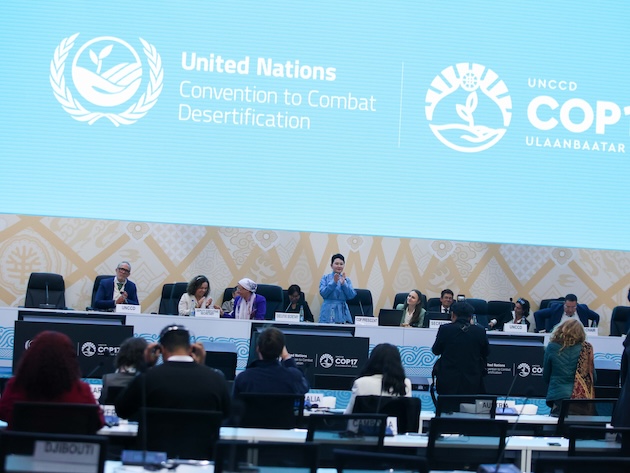 Closing plenary at UNCCD COP17 in Ulaanbaatar, Mongolia.
Credit: Anastasia Rodopoulou/ENB-IISD
Closing plenary at UNCCD COP17 in Ulaanbaatar, Mongolia.
Credit: Anastasia Rodopoulou/ENB-IISDDAR ES SALAAM, August 31 (IPS) - When the rains fail across Tanzania’s northern Maasai Steppe, herders drive their cattle farther in search of pasture and water.
Boreholes run low. Cattle lose weight, milk yields fall and families begin selling cows, often their main source of livelihood. If the dry spell persists, herds can die, leaving families facing hunger.
What is happening on the Maasai Steppe is part of a wider debate over how the world’s rangelands should be restored. At the UN desertification summit in Ulaanbaatar, Mongolia, governments backed a $1.2 billion programme to restore rangelands, alongside measures to repair degraded land and prepare for drought.
For African pastoralists, the question is whether that money will reach them before the next drought.
Governments, meanwhile, failed to seal a global drought agreement, pushing the dispute into another round of negotiations in Egypt in 2028.
The consequences are particularly serious in Africa, where millions depend on livestock for food and income. Restoring pasture could help pastoralists survive dry years, but it will not solve the problem if grazing routes disappear, drought warnings arrive too late or funds fail to reach the people managing the land.
“The $1.2 billion Rangelands Flagship Initiative is an important recognition that rangelands are not wastelands or marginal areas,” said Ephraim Mtengeti, Professor of Range Sciences at Sokoine University of Agriculture.
“They are productive ecosystems that support millions of people, livestock, biodiversity and important ecological functions. For Africa, where pastoralism remains central to rural livelihoods, giving these landscapes greater financial and political attention is long overdue.”
The 45 projects sit within a wider $1.3 billion programme covering land restoration and drought measures in 23 countries. About $644.5 million is new finance, while another $216 million had already been confirmed.
The pledge is substantial, but it is small compared with the scale of the funding gap. The UN Convention to Combat Desertification estimates that about $355 billion a year will be needed until 2030 to meet global land-restoration commitments. Current investment is about $77 billion.
That leaves a shortfall of roughly $278 billion a year.
Private finance accounts for only about 6% of restoration investment. Governments and development agencies are therefore looking to blended finance, using public money to make projects that might otherwise appear too risky more attractive to private investors.
Many of the benefits of restoring rangelands, however, are difficult to turn into financial returns.
Peter Bakker, president and chief executive of the World Business Council for Sustainable Development, said companies were willing to invest but needed projects that could make money.
“Business does not lack appetite for resilient supply chains, secure water and productive soil – it lacks bankable projects, credible data and a fair share of the early risk,” he said.
Mtengeti agreed that private investment was needed but warned against judging restoration solely by the returns it could generate.
“The financing gap is enormous, so it is understandable that COP17 is looking towards private capital and blended finance,” he said.
“But investors will naturally look for financial returns, whereas many of the most important benefits of rangeland restoration — water security, biodiversity, carbon storage, food security and social stability — are public goods.”
Rangelands as Economic Infrastructure
Rangelands cover about 54% of the Earth’s land surface and support roughly 2 billion people, including 500 million pastoralists. They provide pasture for livestock while storing carbon, supporting biodiversity and helping regulate water.
Restoration could generate $4 to $6 for every dollar invested, rising to as much as $36 when wider public benefits are included.
Restoring rangelands in Africa cannot simply mean fencing off land or imposing farming models designed for settled communities.
Pastoralism depends on mobility. Herders move livestock as pasture and water shift, sometimes crossing national borders.
“Rangelands cannot be restored effectively by treating them like a conventional agricultural field,” Mtengeti said.
“These are dynamic ecosystems, and pastoral mobility is one of the mechanisms through which livestock production adapts to variable rainfall and pasture availability.”
The pressure on grazing land is also increasing. Farms, roads, conservation areas and settlements are taking up more dryland, leaving less room for herders. During drought, the pressure becomes acute as people and livestock crowd around the few remaining sources of grass and water.
“Drought does not respect political boundaries,” Mtengeti said. “Pastoral systems in East Africa are interconnected, and livestock movements often respond to ecological conditions rather than national borders.”
Who Gets the Money?
COP17 also highlighted a shift towards larger, landscape-wide projects rather than small, isolated conservation schemes.
They include Kenya’s TWENDE programme, locally led adaptation financing across Africa, the $35 million Herding for Health initiative and a $100 million African Development Bank programme covering the Zambezi River Basin.
Scale alone, however, will not guarantee better results. Money can still go astray when land rights are disputed, local authorities are weak or communities struggle to gain access to funds.
“Communities should not be treated merely as beneficiaries of projects designed somewhere else,” Mtengeti said.
“They have knowledge of their landscapes, their grazing patterns and how ecosystems respond to climatic variability. That knowledge must inform the design and implementation of restoration programmes.”
Access to international finance presents another obstacle.
“If international finance remains locked behind complicated procedures that local organisations cannot access, then some of the people most exposed to drought will continue to receive the least support,” Mtengeti said.
The Drought Gap
The failure to agree on a global drought agreement was one of COP17’s biggest setbacks. The issue had already been left unresolved at COP16. Governments remained divided over whether such an agreement should be legally binding, leaving the decision until 2028.
“The postponement of a global drought instrument is disappointing because drought is no longer an occasional shock that communities can simply recover from,” Mtengeti said.
“In many dryland areas, repeated droughts are eroding livestock assets, weakening household incomes and undermining the ecological foundation on which pastoral livelihoods depend.”
Governments do not have to wait for a global agreement. More than 70 countries now have national drought plans, compared with only three in 2013.
COP17 also launched the Drought Resilience Investment Facility, which aims to raise up to $400 million from public and private sources.
Finance will also have to be matched by preparedness. Early-warning systems, reliable data, functioning institutions and water infrastructure are crucial, as is acting before drought develops into a humanitarian emergency.
“Countries should not wait for a global instrument before strengthening their own drought preparedness and investing in anticipatory action,” Mtengeti said.
The deadlock over drought came despite progress elsewhere at the summit.
Joao Campari, global food and agriculture leader at WWF, said the summit had given greater prominence to rangelands, grasslands and nature-positive farming.
“Yet hope alone will not protect nature, limit climate change or put food on the table. COP17 has laid strong foundations, but the focus must now shift to implementation on the ground and supporting local communities to deliver lasting benefits for all,” he said.
Where Will the Money Come From?
Closing the funding gap will also require governments to change policies that continue to undermine land resilience.
The UNCCD estimates that about $2.4 trillion in public finance supports environmentally harmful subsidies. Redirecting even part of that money could dwarf many of the commitments announced in Ulaanbaatar.
Governments must also protect grazing corridors, strengthen community land rights and ensure that the people managing the land receive a meaningful share of investment.
“Healthy rangelands are economic infrastructure,” Mtengeti said.
“They support livestock production, food security, employment, water systems and biodiversity. When these landscapes degrade, the costs are eventually borne by households and governments through livestock losses, food insecurity, humanitarian assistance and environmental damage.”
For pastoralists, the outcome of COP17 points to a basic reality: rangelands cannot be treated as empty land waiting for a more profitable use. They are part of the economic infrastructure on which food supplies, livelihoods and climate resilience depend.
Mtengeti said the summit had moved rangelands higher up the international agenda but that the commitments would need to be followed by action in pastoral areas.
“COP17 should therefore be seen as a step forward, but not as a solution,” he said. “The financing commitments are encouraging, and the greater attention to rangelands is important. But Africa’s dryland communities need action that is predictable, locally grounded and delivered before drought becomes a crisis.”
When governments meet again in Egypt in 2028, the value of the Mongolian pledges will be judged by what has happened in the drylands: whether pasture has recovered, livestock can move safely, communities have gained access to finance and drought losses are falling.
For pastoralists, the pledges will ultimately be measured during the next drought, when they need pasture, water and support to keep their herds alive.
IPS UN Bureau Report
© Inter Press Service (20260831102401) — All Rights Reserved. Original source: Inter Press Service