5 months ago
29
5 months ago
29

Yolande Knell,Middle East correspondent, Jerusalemand Sophie Williams,Jerusalem

 EPA
EPA
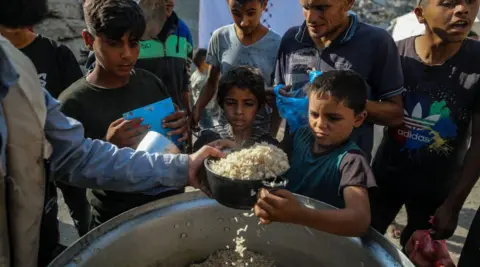
Most of Gaza's population relies on aid for food, medical care and water
Israel's High Court has temporarily halted a ban on international aid groups from working in the occupied Palestinian territories unless they meet strict new rules.
The injunction came ahead of an Israeli deadline for 37 well-known organisations to stop work, something the groups warn will remove a lifeline for vulnerable people and cause "irreparable harm".
Four months into a fragile ceasefire in war-torn Gaza, most of the more than two million population relies on aid – for food, medical care and water. In the West Bank, humanitarian organisations have been helping Palestinians who have been forced off their land by rapid Israeli settlement expansion and settler violence.
In December, Israel told organisations – including Médecins Sans Frontières (MSF, Doctors Without Borders), Oxfam, Save the Children, ActionAid and the Norwegian Refugee Council (NRC) – that their registrations had expired. They were given 60 days to renew them – by complying with new rules – or cease operations by 1 March.
This week, a group of 17 NGOS jointly petitioned the High Court to suspend the new measures, arguing that Israel has obligations as an occupying power under international humanitarian law.
Responding on Friday, Judge Dafna Barak-Erez said there was "a real legal dispute" which would require more time to work through.
The right-wing government of Israel's Prime Minister, Benjamin Netanyahu, has taken a tough stance against international and Palestinian NGOs as well as UN agencies, some of which have operated in the region for decades, citing security reasons. It has also passed legislation banning the UN agency for Palestinian refugees, Unrwa, from operating in Israel, impacting its work in the West Bank and Gaza.
Israel has claimed that Unrwa - and other organisations, including MSF - have been infiltrated by members of Palestinian armed groups or have ties to them. The humanitarian groups strongly deny that.
Israel's Ministry for Diaspora Affairs and Combating Antisemitism says its "clear transparency requirements" mean all NGOs and humanitarian organisations must now give full details of their staff, funding sources and operational structures. Its stated aim is to prevent any links to Palestinian armed groups in the wake of the Hamas-led attacks on Israel on 7 October 2023 which triggered the Gaza war.
Israeli operating licences can be lost through actions such as "delegitimisation of the State of Israel, legal campaigns targeting soldiers of the Israel Defense Forces (IDF), Holocaust denial, denial of the 7 October atrocities or documented cooperation with terrorist organisations".
Aid groups have rejected sharing details of their personnel, pointing out that hundreds of humanitarian workers have been killed during the Gaza war. Those based in Europe say the demands breach EU laws on data protection and privacy.
The NGOs say the changes go against long-established practices "to ensure that humanitarian relief remains "principled, independent, and unhindered." Many argue that the new Israeli licensing system is politically motivated.
"It has nothing - zero – to do with countering terrorism, which is a united fight for all of us. We have suffered from terror all over the world for a very long time," says Jan Egeland, Secretary General of the NRC - which joined the petition.
"That's why we vet each and every staff against all lists of possible sanctioned people everywhere in the world. We do that regularly and the Americans and the Europeans and so on are very happy with our screening of all our employees."
"This is a political matter," Mr Egeland goes on. "They don't want independent witnesses that are not pro-Netanyahu to operate in the Palestinian areas. That's why they've come after us and so many others."
With foreign journalists banned by Israel from entering Gaza during the war - except on limited tours embedded with the IDF - visiting medics and aid workers have been important international voices describing the situation on the ground. Many have criticised Israel's conduct of the war and Israeli restrictions on aid entering the territory which, at one point, led to the UN declaring a famine.
In early 2025, a controversial US- and Israeli-backed organisation the Gaza Humanitarian Foundation (GHF) was set up to distribute food and positioned as an alternative to the UN, amid claims that Hamas was diverting aid. Following deadly shootings at its sites, criticism intensified and by the end of the year, the GHF announced it had ended its mission.
The Israeli Diaspora Ministry says that since its guidelines came into effect, it has been contacted by 117 NGOs. Of these, 27 have been approved and 11 were rejected with the remainder still undergoing review or told to conclude operations should they fail to meet the compliance requirements. It said the 11 NGOs whose applications were turned down amounted to about 1% of the total humanitarian aid entering Gaza.
"Aid continues to flow through legitimate and transparent channels operated by organisations that adhere to international humanitarian law, do not cooperate with terrorist groups such as Hamas, and operate in full compliance with Israeli regulations," the ministry said in a statement. It says its measures comply with President Trump's 20-point peace plan to end the Gaza war "which prioritises dismantling Hamas' military and governing capabilities".
Save the Children was told last year it has lost its licence, accused of delegitimising the State of Israel. It says this is because it has spoken out against violations of international law and harsh conditions in Gaza.
The NGO says deregistration leaves it unable to bring in international staff to provide support to local ones who continue to work. Alexandra Saieh, Head of Humanitarian Policy and Advocacy, says the more obstacles in place, the further it impedes the ability to offer effective humanitarian assistance and causes "a catastrophic impact on people in Gaza."
"This is why we're not seeing the situation improve as quickly as we've needed it to improve," she adds. "Just from our experience in our clinics, while we've seen the reduction in numbers of children coming in with malnutrition, we haven't seen those improvements at the pace and scale you would have thought we'd seen them during a ceasefire."
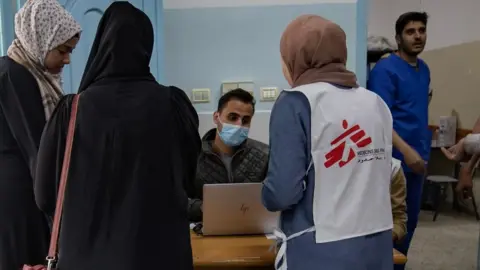
Israel has made specific allegations against the medical charity, MSF, which runs two standalone field hospitals and supports other healthcare facilities.
 EPA
EPA
MSF has denied Israeli accusations that it has been infiltrated by Hamas and Islamic Jihad
In a report, Israel accuses MSF of "grave misconduct" and "a recurring pattern that contradicts the fundamental ethics of international humanitarian action." It has alleged that some MSF employees have links to Hamas and Islamic Jihad, which it has vehemently denied.
MSF says that at least 15 of its workers were killed in the war. In one case a physiotherapist, killed in an Israeli air strike in 2024, was later confirmed by Islamic Jihad to have been a commander involved in making rockets.
MSF's Head of Mission in Gaza, Will Edmond says the NGO checks all staff and "would never knowingly employ anyone affiliated with any armed group".
"It would directly harm our staff and patients which is absolutely against everything that's in our principles," he adds. "The requirements that were demanded by Israel in order to get the registration, we could not do because for obvious reasons, providing a list of staff names to the other side of a conflict is a complete violation of our principles and presents a very dangerous precedent for our programmes elsewhere as well."
The NGOs have welcomed the injunction issued but are waiting to see what effect it will have and how they will now be able to operate. It is not yet clear when a final decision will be made.