4 months ago
34
4 months ago
34

Hannah Karpel,BBC Newsand Vanessa Clarke,Senior education reporter

 PA Media
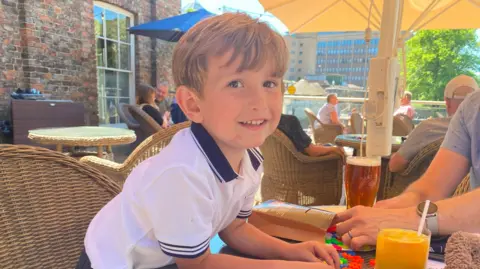
Benedict Blythe died aged five after accidental exposure to an allergen - cow's milk protein - while at school
Schools in England must provide allergy awareness training for all staff for the first time, under new statutory guidance announced by the Department for Education.
Spare adrenaline auto-injectors must also be stocked by schools for emergencies involving children without a prior allergy diagnosis.
The plans follow cross-party support for Benedict's Law, a campaign to improve allergy safety in schools by ensuring consistent, life-saving protections for children with food allergies and anaphylaxis.
However, Paul Whiteman, general secretary of school leaders' union NAHT, warns each requirement in the new guidance needs funding and "schools cannot be expected to fund from their budgets".
Early education minister Olivia Bailey said: "Lots of schools in the country already have great policies in place and are already doing a lot of this. It is something which we think is reasonable for schools to pay for out of core budgets. We are committed to working with schools to make that as easy as possible."
The plans form part of the government's wider work to reform the school food system and expand free school meals to an additional 500,000 children this September.
The campaign is named in memory of five-year-old Benedict Blythe, who died from an anaphylactic reaction at school in December 2021.
His mother Helen, who has campaigned alongside the National Allergy Strategy Group, describes today's announcement as "a really significant day".
She says there was a "catalogue of errors" that contributed to her son's death when he was given milk containing cow's milk protein at school, despite his allergy being on record.
An inquest last year into Benedict's death showed a failure by the school to identify his symptoms in time, meaning that he was not given the medication soon enough to save his life.
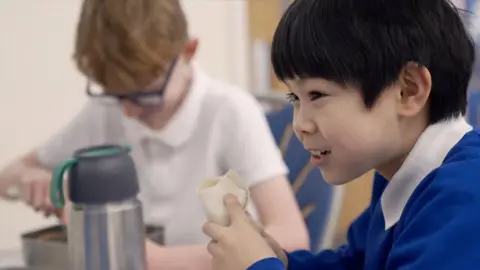
According to anaphylaxis UK, 680,000 children in England are living with allergies
"We don't want any other families to go through what we've been through," Helen Blythe said. "The experience of having an allergic reaction is really distressing and we want to guard against that wherever possible."
According to the DfE, 500,000 days of learning were lost last year due to allergy-related illnesses or medical appointments. The government hopes the new statutory guidance will not only save lives, but also keep more children in school.
Helen Houghton, headteacher of Warton Primary School in York, described the new guidance as "fundamental". She said 5% of children at her school have allergies, with some that are "quite complex" to manage.
In response, the school has allocated part of its budget towards further staff training and equipment for allergies. "It's a small amount to have them there and make sure everyone is safe," said Houghton, who meets in-person with parents of children with allergies to ensure a personalised medical plan is in place.
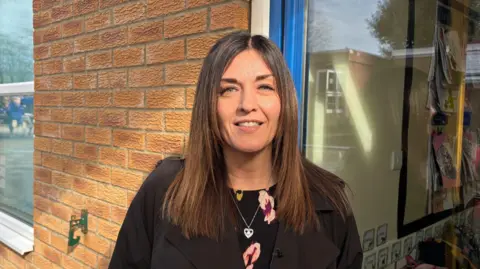
Headteacher Helen Houghton says the new guidance will give more reassurance to parents of children with allergies
"It must be terrifying to be a parent or a child with allergies, and I think certainly for the school it's about keeping our systems incredibly tight, incredibly consistent, and having a whole-school collective responsibility. It's so important to help reassure parents here that their children are safe."
Though some schools, like Warton Primary School, may already have allergy plans in place, today's announcement means these precautions will be compulsory across all schools in England.
A freedom of information request sent by the Benedict Blythe Foundation in 2024 found that 70% of schools in England did not have the recommended allergy safeguards in place, and half of all schools did not have adrenaline pens and spare auto-injectors on site.
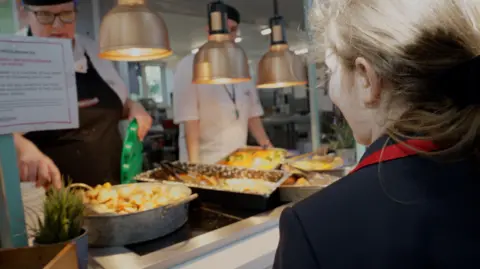
The plans form part of the government's wider work to reform the school food system
Whiteman said: "The expected guidance and advice is clearly welcome because it should provide more comprehensive information for schools to ensure they can continue to support all pupils in their education, including those with health conditions.
"Schools want to be as inclusive as possible while also ensuring they can continue to fulfil their safeguarding duty and keep every child as safe as possible whilst in their setting."
According to Houghton, dealing with allergies in school is as much about changing the culture and environment as it is about education. "We make sure that the resources we buy for the wider curriculum subjects, or for science experiments, are allergy-safe too," she said.
Blythe believes the changes will save lives.
"This is the first generation of children that will be starting school in September who will be in an environment that will be completely safe for them in terms of those allergy safeguards being in place and that's a kind of exciting and magical thing," Blythe told the BBC.
Parents, teachers and experts are now being asked for their views on the plans before they come into force in September.