1 month ago
35
1 month ago
35

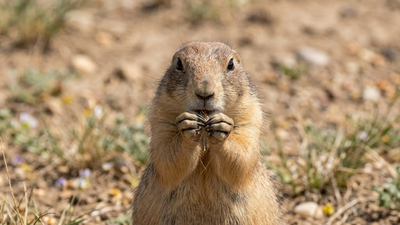
For generations, prairie dogs were often treated as a problem rather than an ecological asset. Their burrows were blamed for competing with livestock, while their colonies were targeted through shooting and poisoning across large parts of their former range.But removing them had consequences far larger than the disappearance of one small mammal. Scientists studying black-tailed prairie dogs found that the animals were quietly reshaping the grasslands around them. Their burrowing loosened soil, improved water infiltration and redistributed nutrients, while their grazing helped maintain open grassland instead of allowing woody shrubs to take over.A study led by Lourdes Martínez-Estévez, Patricia Balvanera, Jesús Pacheco and Gerardo Ceballos, published in PLOS ONE under the title ‘Prairie Dog Decline Reduces the Supply of Ecosystem Services and Leads to Desertification of Semiarid Grasslands,’ found that grasslands containing prairie dog colonies provided greater levels of several ecosystem services than areas where the animals had disappeared.
These included groundwater recharge, soil-erosion regulation, soil productive potential, soil carbon storage and forage availability. The research revealed that prairie dogs were not simply living in the grassland. They were helping build and maintain it.
How these small mammals reshaped the land around them
Black-tailed prairie dogs once occupied an enormous range stretching from southern Canada to northern Mexico. According to Martínez-Estévez and her co-authors, the species has disappeared from about 98% of its original distribution.
Several pressures, including the conversion of grasslands to agriculture and the direct extermination of prairie dogs through shooting and poisoning, drove that decline. The researchers noted that prairie dogs were also commonly believed to compete with cattle for forage.Yet prairie dogs perform an ecological role that is disproportionate to their size. They are classified as both a keystone species and an ecosystem engineer.
Their burrows physically alter the soil, while their feeding and grazing change the vegetation growing above it. Together, these activities influence both the physical environment and the animals and plants that depend on it.When prairie dogs dig, they aerate the soil, redistribute nutrients, add organic matter and create pathways that allow water to penetrate deeper into the ground.Their grazing also keeps vegetation short and maintains open patches of grassland.
That can limit the spread of woody plants and preserve the open habitat on which numerous grassland species depend.Their colonies then become habitat in their own right. Burrows can provide shelter for amphibians, reptiles, birds and other mammals, while prairie dogs themselves form an important part of the food chain for predators such as the endangered black-footed ferret.In other words, removing prairie dogs does not remove only prairie dogs.
It can remove an entire set of ecological processes.
What happened when the prairie dogs disappeared?
To understand the consequences, the researchers studied grasslands in the Janos Biosphere Reserve in north-western Chihuahua, Mexico, an important conservation area for North American grasslands.The study compared three conditions: areas still occupied by prairie dogs, grasslands where prairie dogs had disappeared, and former prairie dog habitat that had become dominated by mesquite shrubs.
The researchers then measured five ecosystem services across these landscapes.The differences were striking. Grasslands with prairie dogs generally performed better in all five of the services measured: water infiltration, erosion regulation, soil productive potential, carbon storage and forage availability.Water infiltration was particularly revealing. In prairie dog grasslands, the measured infiltration rate averaged about 357 millimetres per hour.
It was about 283 millimetres per hour in grasslands without prairie dogs and fell to only about 97 millimetres per hour in mesquite-dominated areas.That difference matters in a dry environment. The Janos region receives relatively little rainfall, and water arrives in pulses. When rain does fall, the ability of soil to absorb it rather than lose it as surface runoff becomes crucial.Prairie dog burrows appear to help create the soil conditions necessary for that infiltration.
Their underground activity produces more pore spaces, improving aeration and allowing water to move through the soil profile.Without those processes, water is more likely to run across the surface, increasing erosion and reducing the amount that reaches deeper layers.
Prairie dogs can help keep grasslands from turning into scrub
One of the most important findings concerns what happens to former prairie dog habitat after the animals disappear. In the study area, landscapes that had lost their prairie dog colonies could gradually become dominated by shrubs such as mesquite.That transformation changes far more than the appearance of the land. The researchers found that mesquite-dominated areas had the least stable soils and were more vulnerable to erosion. Their overall erosion indicator score was 55, compared with 22 for prairie dog grasslands and 14 for grasslands without prairie dogs.Mesquite-dominated soils were also more compacted, making it harder for grasses and herbs to establish.The researchers linked this shift to a broader process of land degradation. As native grassland gives way to shrubland, soil conditions deteriorate, water infiltration declines and the landscape becomes less capable of supporting the vegetation that once characterised it.In the Janos region, the researchers reported that more than 47,000 hectares of ground cover had been lost over a decade, while bare ground increased dramatically.
During the same period, about 73% of the 55,000 hectares of prairie dog colonies had been lost, alongside increasing shrub encroachment.The findings do not mean prairie dogs are the only factor driving desertification. The study also identifies drought, overgrazing, agricultural expansion, groundwater exploitation and the suppression of natural fire regimes as pressures affecting the landscape. But the disappearance of prairie dogs removes one of the natural forces helping the grassland resist those pressures.
Their colonies can actually provide more forage for cattle
Perhaps the most counterintuitive result concerned livestock. Prairie dogs have often been portrayed as competitors with cattle because both feed on grassland vegetation. But the researchers found that areas containing prairie dogs actually produced more available forage than both grasslands without prairie dogs and mesquite scrublands.Average standing forage biomass was approximately 916 kilograms per hectare in prairie dog grasslands, compared with 794 kilograms per hectare in grasslands without prairie dogs and only 489 kilograms per hectare in mesquite scrub.The explanation lies partly in the way prairie dogs graze. Their moderate grazing removes older plant material, allowing younger tissues with higher nutrient concentrations to receive more light and water. Their activities can also accelerate nutrient cycling and improve the quality of forage available to other herbivores.The researchers noted that cattle can benefit from feeding around the edges of prairie dog colonies, where forage quality can be higher.That complicates the old idea that prairie dogs and livestock are inevitably in conflict. Under appropriate management, the study suggests, both can benefit from a functioning grassland ecosystem.
Their impact extends underground, too
The prairie dog's influence is not confined to plants and grazing animals. The researchers also found higher soil carbon storage in prairie dog grasslands than in the grasslands examined after prairie dog loss. Carbon concentrations were particularly greater in deeper soil horizons within prairie dog areas.That gives these small mammals a role in a process that reaches far beyond their colonies. Grasslands are significant stores of carbon, much of it held below ground. When grasslands are degraded or converted, some of that stored carbon can be released.Maintaining healthy grasslands therefore provides benefits not only for wildlife and livestock but also for the wider climate system.The researchers concluded that the loss of black-tailed prairie dogs and the subsequent transition towards mesquite scrub reduced the landscape's ability to provide ecosystem services important to both natural communities and people.
A species once seen as a pest turned out to be part of the infrastructure
The story of the prairie dog is a reminder that an ecosystem can depend on animals whose importance is easy to overlook. A prairie dog does not look like an architect. It is a small burrowing rodent living in colonies across the grasslands of North America. Yet its daily activities can alter soil structure, water movement, vegetation, nutrient cycling and habitat availability for other species.That is why the researchers describe prairie dogs as ecosystem engineers.
Their disappearance does not automatically turn every grassland into desert, and the study itself recognises that drought, livestock, agriculture and other human pressures also shape the outcome. But where prairie dog populations decline, one of the forces maintaining open, productive grassland disappears with them.The lesson is therefore larger than the prairie dog itself. For decades, people tried to remove these animals because they were viewed as competitors and nuisances. Research has since shown that their colonies can support services that humans themselves depend upon, from groundwater recharge and soil stability to forage production and carbon storage.Sometimes, an animal does not need to be large, rare or visually impressive to hold an ecosystem together. Sometimes, it only needs to keep digging.