3 weeks ago
30
3 weeks ago
30

Around a thousand years ago, the ancient city of Cantona stood as one of the largest urban centres in the Americas, with an estimated population of 90,000 people. Built on the volcanic highlands of central Mexico, the fortified settlement thrived for centuries before it was mysteriously abandoned by the mid-11th century.
Archaeologists have long debated what caused its decline, pointing to conflict, political upheaval and shifting trade networks. The PNAS study suggests climate may have played a crucial role. By analysing sediments from a nearby lake, scientists uncovered evidence of a prolonged 650-year period of recurring drought that coincided with Cantona's final centuries. While researchers say drought alone did not doom the city, the findings offer fresh insight into how environmental stress combined with social and political pressures may have led to its eventual collapse.
The volcanic landscape behind Cantona's remarkable growth
According to the study, Cantona occupied a striking position within the Cuenca Oriental, a high-altitude basin in central Mexico known for its dry climate and volcanic landscape. Although the environment was never especially forgiving, the area offered one valuable advantage: rich deposits of obsidian, the volcanic glass that served as one of the most important raw materials in pre-Columbian Mesoamerica.The city appears to have grown into a major centre for both trade and regional defence.
Reportedly, archaeological evidence suggests it may have housed around 90,000 inhabitants during its height, making it one of the largest settlements in the New World before European contact. Its heavily fortified design also hints at a landscape shaped by political uncertainty rather than prolonged peace.
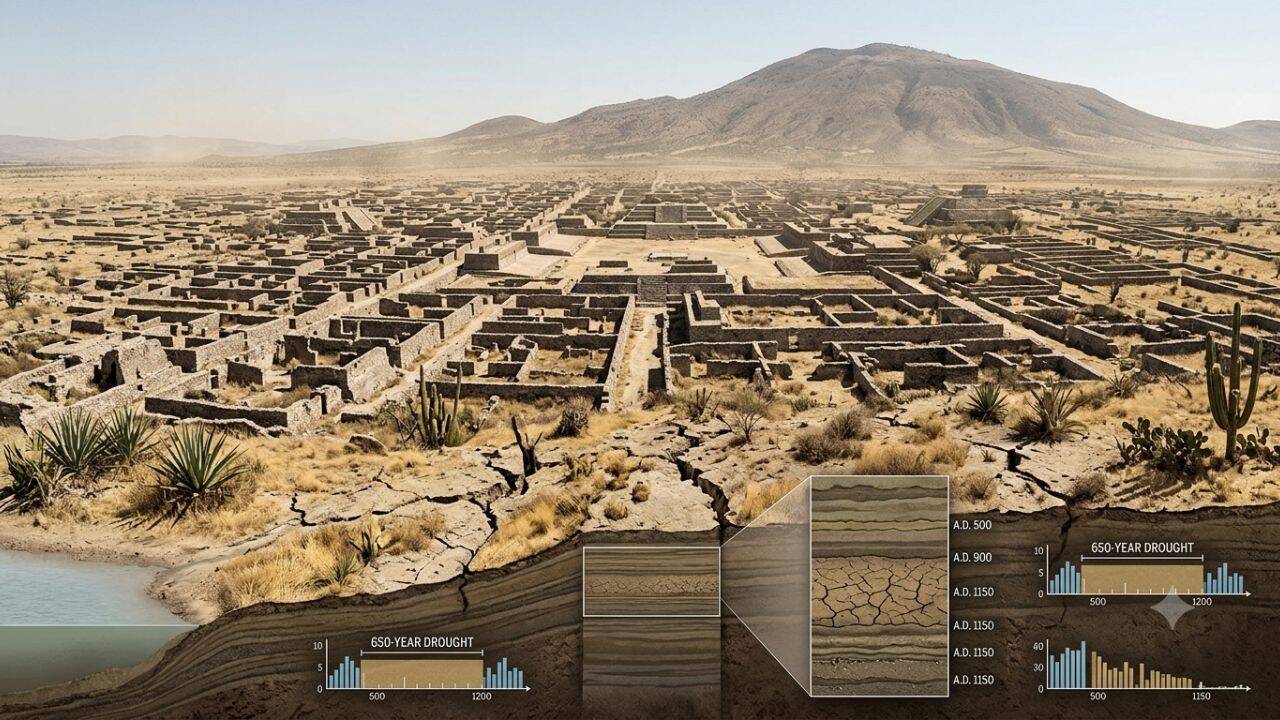
PC: AI Generated
Lake sediments reveal centuries of drought in ancient Mexico
The PNAS study titled, ‘Cultural implications of late Holocene climate change in the Cuenca Oriental, Mexico’ revealed that instead of relying solely on archaeological remains, scientists turned to the sediments preserved beneath Lake Aljojuca.
Fine layers of mud, minerals and organic material settled year after year, quietly recording changes in the surrounding environment.The research team examined oxygen isotope patterns locked within carbonate deposits. These chemical signatures shift depending on the balance between rainfall and evaporation, making them useful indicators of wetter or drier conditions. Radiocarbon dating of organic material within the sediments allowed the timeline of environmental change to be reconstructed over many centuries.Their analysis pointed towards a long interval of recurring drought that stretched from around AD 500 until approximately AD 1150. Rather than a single catastrophic event, the record suggests repeated periods of reduced rainfall over roughly 650 years, as reported by the UC Berkeley News. The findings also fit into an even broader trend indicating that parts of Mexico's highlands had been gradually becoming drier since around 200 BC before conditions began improving again during the early 14th century.
How drought and politics shaped Cantona's rise and fall
One aspect of the evidence stands out because it does not follow the simplest explanation. Cantona did not immediately shrink when rainfall became less reliable. Instead, its population appears to have expanded during the earlier stages of the prolonged dry spell.This pattern suggests climate alone cannot explain the city's fortunes. Political changes elsewhere may have driven people towards Cantona, whose defensive layout and strategic position along important inland routes could have made it a comparatively secure destination.
At roughly the same time, the influential city of Teotihuacan, located further west, was itself experiencing decline.Only after centuries of repeated dry conditions does the picture begin to change. By around AD 1050, long-term environmental pressure may have weakened local farming and water supplies enough to make continued occupation increasingly difficult.
How repeated drought strained Cantona's food supply
Agriculture in the Cuenca Oriental was already constrained by geography.
Modern farming without irrigation sits close to the northern limit for successful maize cultivation, suggesting ancient communities were operating with little margin for prolonged shortages of rainfall.The climate itself did not transform into a desert overnight. Seasonal rainfall patterns probably continued much as before, with summer monsoons followed by dry winters. The difference appears to have been the increasing frequency of shorter drought episodes, each placing additional strain on crops, water storage and local food production.Communities can often absorb isolated poor harvests. Repeated failures over generations create a different challenge altogether, particularly for a large urban population dependent on surrounding farmland.
Why drought was not the only reason Cantona was abandoned
According to UC Berkeley News, geography graduate student Tripti Bhattacharya and professor Roger Byrne states that the climate record does not argue that drought single-handedly brought about Cantona's abandonment.
Instead, it supports a more complicated sequence in which environmental stress interacts with existing political and social changes.“We can show that both the growth and decline of the site took place during a time period of frequent drought, which forces us to think in more nuanced ways about how political and social factors interact with environmental factors to cause social and cultural change,” Bhattacharya said. “The city's expansion during the early centuries of the dry period makes that clear.
If climate alone determined events, growth would be difficult to explain. The evidence instead points towards a settlement that benefited from wider regional instability before eventually facing mounting ecological pressures that became increasingly difficult to overcome.
A wider picture of ancient Mesoamerica
Cantona is only one example among many archaeological sites where drought has been proposed as part of the explanation for societal change.
Across Mesoamerica, researchers continue to investigate whether prolonged shifts in rainfall affected different regions at different times, rather than triggering a single continent-wide crisis.Large gaps remain in the prehistoric climate record for Mexico's central highlands, making studies based on lake sediments especially valuable. By combining archaeological evidence with environmental records, scientists are gradually building a clearer picture of how ancient communities adapted, reorganised or relocated when faced with long-term changes in water availability.