57 minutes ago
4
57 minutes ago
4

Among some of the great philosophers of the world was Aristotle and among some of the great conquerors of the world was his student, Alexander the Great. History takes both of their names with great reverence and passes on their tales through generations.
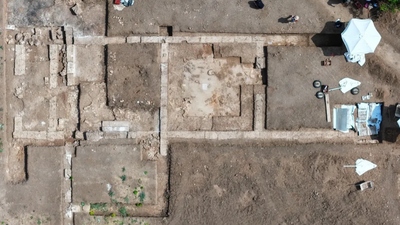
But have you ever wondered exactly where this iconic duo shared their knowledge? The vast halls or lavish seats where they may have sat as teacher and student?During ongoing excavation in northern Greece, archaeologists have unearthed something that sheds light on the early years and education of Alexander the Great and his mentor, Aristotle. In a recent statement, Greek officials announced that archaeologists working at the historical site of the royal gymnasium of Mieza have uncovered ornate, mosaic-decorated halls that may have formed part of Alexander's school.The recent discoveries are the latest in a three-year project that has been peeling back the layers of Mieza, where scholars claim Aristotle taught a teenage Alexander, according to a report by La Brújula Verde. Previous excavations revealed that the 30-acre gymnasium complex housed a palaestra or wrestling ring; a stadium; arcades and a xystus, a covered, 200-meter-long running track where athletes could train regardless of the weather.
However, their most recent discovery may have been the most revealing yet, offering a previously unknown insight into the specifics of Alexander the Great's education. In the first century C.E., the ancient writer Plutarch wrote in his biography The Life of Alexander that Alexander’s father, the ruling king Philip II, had a school built for his son and other nobles in the Macedonian town of Mieza. Although the complex is called a gymnasium, the ancient Greeks used these buildings for much more than just physical training, according to a report by Live Science.A team of archaeologists led by Angeliki Kottaridi, director emerita of antiquities with the Hellenic Ministry of Culture, has uncovered a large area called the Didaskaleion, or “place of teaching,” where students learned using styluses and stone desks, according to La Brújula Verde.Archaeologists also uncovered two banquet halls adjacent to the teaching area: lavish rooms with mosaic tile floors and intricate finishes that mirror those of Philip II's palace at Aigai.
Kottaridi said that she believes these similarities are no coincidence; rather, they confirm that the complex at Mieza was expressly built by Philip II “for the education of his son Alexander and the children of the noble Macedonians.
”The school’s layout also offers a glimpse into the structure and values of elite Macedonian education during the fourth century B.C.E., as per a report by the Greek Reporter. It said the complex’s size and structure—combining athletic and instructional spaces—reveal the Mieza gymnasium’s status as a Macedonian educational institution.
The formal nature of the banquet halls, once fitted with reclining couches, suggests that social education played a central role in the schooling of Alexander and his peers, La Brújula Verde reported.
As they prodded the limits of Aristotelian logic and pushed the boundaries of physical strength, they also practised the refined mores necessary to host and attend “symposia,” the dining parties of the Macedonian elite.Earlier discoveries at the complex found pieces of pottery, old coins and assorted antiquities along with four bronze writing styluses that may have been used by Aristotle's students, potentially even by Alexander himself. Archaeologists also found fragments of containers meant to hold sacred olive oil from Athens, suggesting that students at the Mieza complex had access to one of the most valuable products in the Hellenic world.While the findings may not conclusively prove that the gymnasium is where Alexander learned his lessons, researchers are confident in the clues archaeologists have already amassed and hope more of such will turn up soon. “All the evidence suggests this is the school Philip provided for Aristotle to tutor the young Alexander and his fellow students,” Jeanne Reames, director of the ancient Mediterranean studies program at the University of Nebraska at Omaha, who was not involved in the research, told Live Science.
As the excavation continues, she believes it will “shed more light on elite education in Macedonia in the second half of the fourth century B.C.E.”