2 months ago
37
2 months ago
37

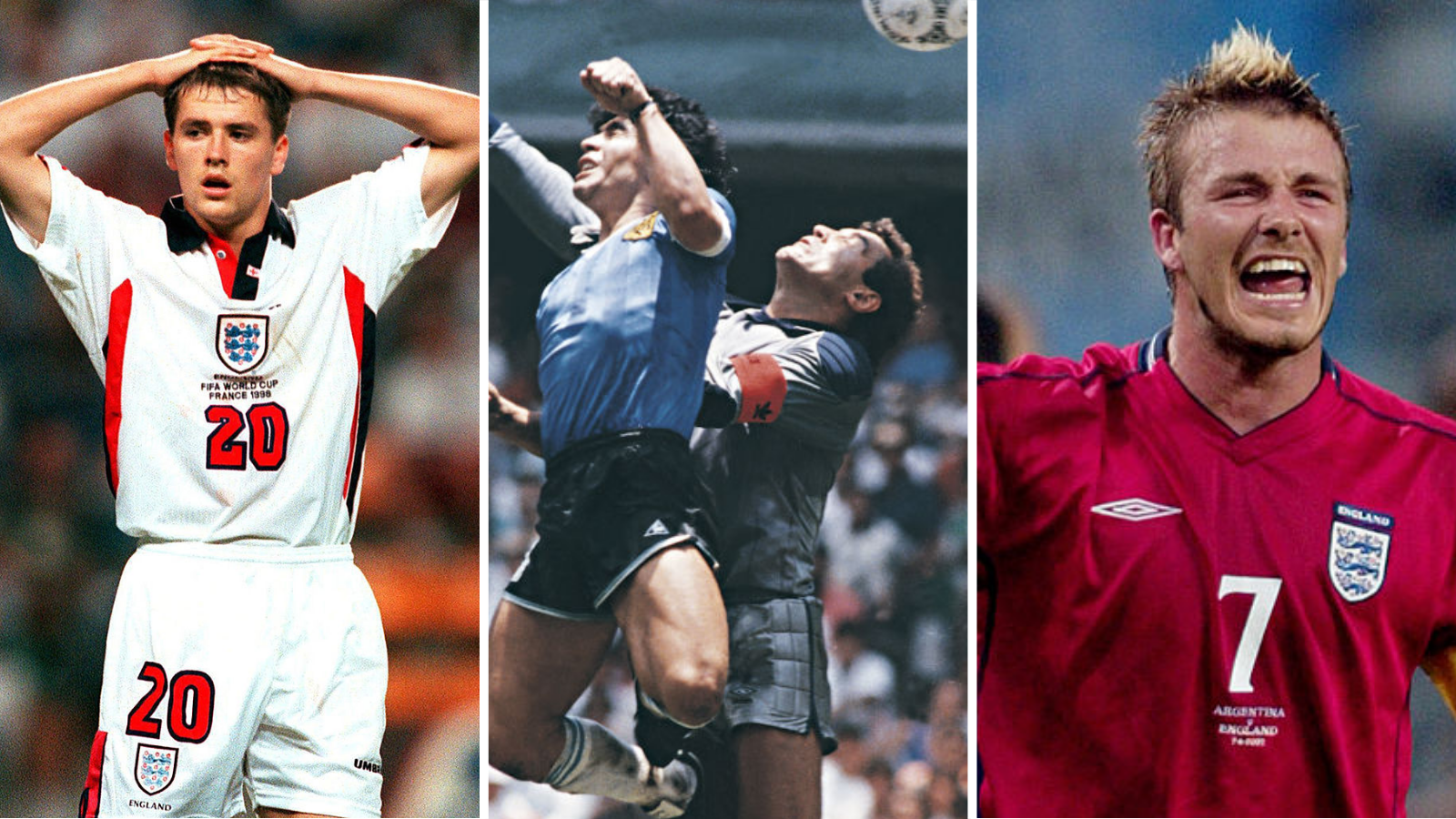 Image source, Getty Images
ByAndy Cryer
BBC Sport senior journalist
It's a footballing rivalry that goes back generations.
England v Argentina for a place in the World Cup final. Iconic. Generational. Classic. It's hard to find the words to do the occasion justice.
On Wednesday in Atlanta, Lionel Messi will be playing against England for the first time in his career as the defending world champions bid to stop Thomas Tuchel's Three Lions ending 60 years of hurt.
It's a World Cup rivalry that started back in 1962 and has featured wonder goals, controversy and red cards ever since.
But it's not just an on-field rivalry. Political tensions, especially around the Falklands War in the 1980s, dominate the relationship between the two nations. Argentina players and fans still reference the conflict in football songs.
Before one of England's biggest matches in history, BBC Sport takes a look back at the World Cup rivalry between the two sides.
It may surprise many that of the five World Cup matches played between the two sides, it is England that are on top, but it has been a while since they won one that really mattered.
With their last World Cup meeting back in 2002, many of the countries' younger generations won't even remember the rivalry, so BBC Sport revisits six decades of controversy.
1962: England 3-1 Argentina (Rancagua, Chile -group stage)
A tame affair compared to what was to follow.
Goals from Ron Flowers, Bobby Charlton and Jimmy Greaves put England into an unassailable 3-0 lead, with a late consolation from Argentina.
Both sides finished the group stage with a win, defeat and a loss, but England edged through at the expense of Argentina thanks to a superior goal difference.
The Three Lions were knocked out by Brazil in the quarter-finals.
1966: England 1-0 Argentina (Wembley, England - quarter-finals)
Was this the moment the footballing rivalry between the two sides really developed? Possibly. Probably.
The two teams met in the quarter-finals in a match Argentina, to this day, insist they were robbed in, claiming Geoff Hurst's winning goal was offside.
That was just the tip of the iceberg when it came to controversy though, with Argentina captain Antonio Rattin sent off after just 33 minutes for two offences in the space of three minutes.
The first was for a trip on Bobby Charlton, the second was for continuing to argue with German referee Rudolf Kreitlein.
The match was delayed for almost eight minutes as Rattin refused to leave the pitch.
England held on, in an incredibly ill-tempered affair, with Three Lions boss Alf Ramsey describing the Argentine side as 'animals' and insisting that his players did not swap shirts.
England's 1966 World Cup-winning defender George Cohen reflected on the match in the Guardian in 2009.
"Tackling is fine," he said. "But it was some of the snidey things, the spitting and pulling the short hairs on your neck, pulling your ear. They were trying to intimidate us. The trouble was when they found out they weren't going to get their way they fell into some of the worst excesses I've ever seen.
"I just consider it the greatest shame that they didn't play the game they were capable of. We might even have got beaten but they just should have got on and shown what they could do.
"There was a lot of commotion in the tunnel after the game. Nobody was allowed out so we didn't see it."
The match is also believed to have led to the introduction of red and yellow cards, which were first used in the 1970 World Cup in Mexico. Previously, referees had to rely on verbal warnings.
Rattin, who represented Argentina from 1959 to 1969 and played at the 1962 and 1966 World Cups, died at the age of 89 on Saturday.
1986: Argentina 2-1 England (Mexico City, Mexico - quarter-final)
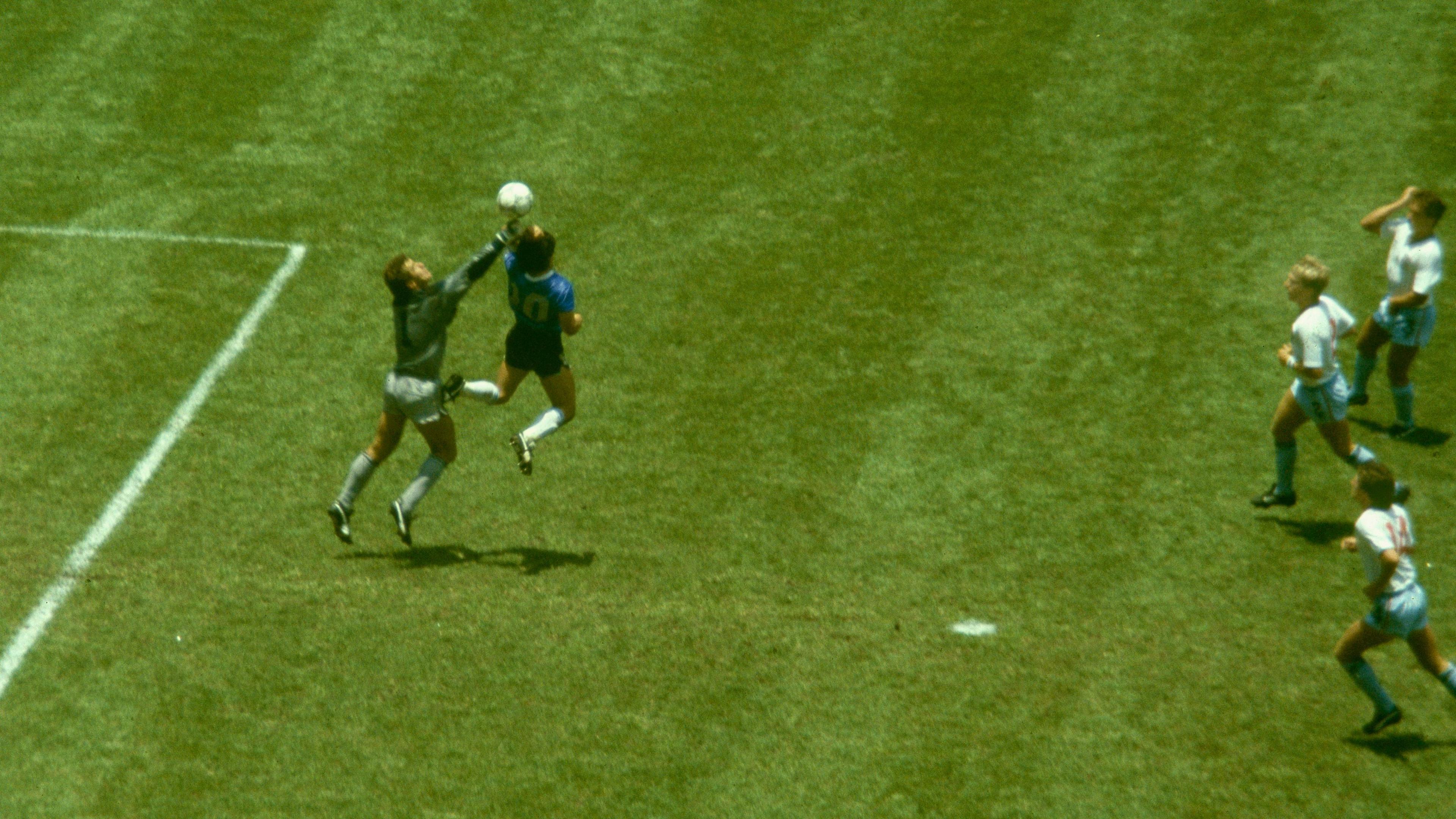 Image source, Getty Images
The Hand of God. Sigh.
This quarter-final was played just four years after the two countries had fought the Falklands War. This wasn't just a football rivalry, political tensions were huge as well.
The Argentine media and public framed the match as a way to express their resentment at the conflict, while their British counterparts also leaned into it, using nationalistic language to heighten the animosity between the countries.
BBC World Service's Lourdes Heredia, who was at the game in the Azteca Stadium, said: "My father wasn't sure about his 'princesses going'. He was worried that tensions between Argentina and England fans would spill over. My mother didn't hesitate. A once in a lifetime opportunity."
It provided a moment no English football fan from that era will ever forget as the genius that was Diego Maradona punched Argentina into the lead against England. Literally.
The Argentine number 10 leapt for a ball with England goalkeeper Peter Shilton but, somehow unnoticed, he opted to punch the ball into the empty net. If only VAR was around then.
To be fair to Maradona, he then scored probably the greatest World Cup goal of all time as he dribbled through half the England team, rounded Shilton and slotted home to double Argentina's lead.
"When I lived and worked in Argentina, people regularly brought up the Hand of God," said Heredia. "But this is to forget that the second goal was just spectacular - almost unbelievable."
Gary Lineker pulled one back late on but it was to no avail as England crashed out in the most controversial of circumstances
It took until 2005 for Maradona to apologise. An apology Shilton rejected,
To rub salt into the wound, Argentina went on to beat West Germany in the final to lift the trophy.
1998: Argentina 2-2 England (Argentina win 4-3 on pens) (St Etienne, France - last 16)
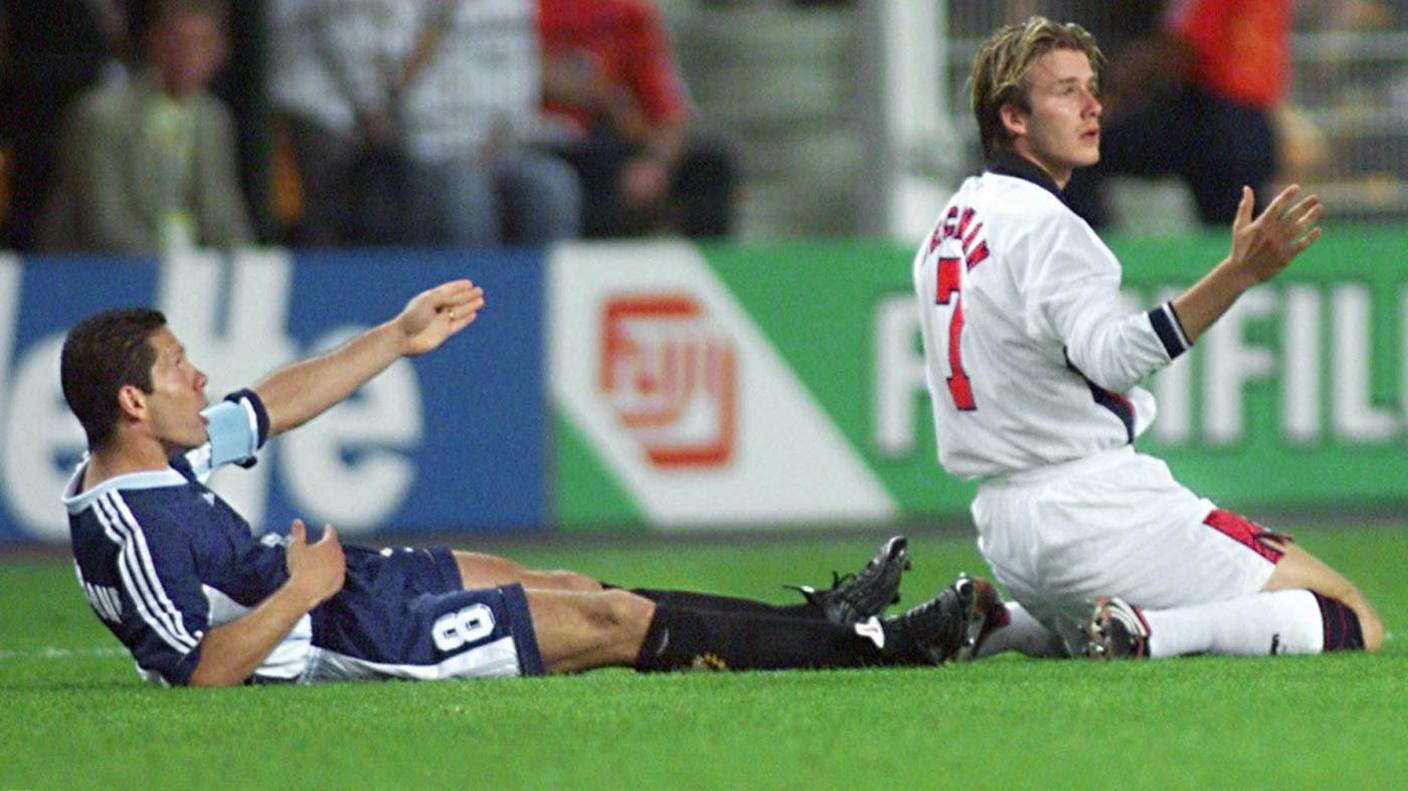 Image source, Getty Images
Whie lying on the floor, Beckham swung his leg up and kicked out at Argentina midfielder Simeone, who collapsed to the ground
A match David Beckham will never forget.
The game will always be remembered for his kick out at Argentina's Diego Simeone and subsequent red card.
Prior to that Gabriel Batistuta and Alan Shearer had traded penalties, before Michael Owen scored one of his country's greatest World Cup goals to give England a 2-1 lead.
Owen burst past the Argentine defence to score a spectacular solo goal, before a clever free-kick saw Javier Zanetti level the scores before the break.
After Beckham's red, England bravely hung on and even thought they had won it when Sol Campbell headed home in the 81st minute, only for it it to be ruled out for a push.
The match went to penalties which, after misses by David Batty and Paul Ince, Argentina prevailed in, before being knocked out themselves in the next round by the Netherlands.
To stoke the tensions in the rivalry further, Simeone admitted a year later: "Let's just say the referee fell into the trap.
"It was also a difficult one for him to have avoided because I went down well and in moments like that there's a lot of tension.
"You could say that my falling transformed a yellow card into a red card. But in fact, the most appropriate punishment was a yellow one."
2002: Argentina 0-1 England (Sapporo, Japan - group stage)
This was the match that will be remembered as redemption for Beckham.
The then England skipper scored the only goal of the game from the penalty spot, after Owen was chopped down by Mauricio Pochettino - yes, that one.
Having only drawn with Sweden in their opening group game, it was a crucial win for the Three Lions.
A goalless draw for England against Nigeria in the final match saw them progress, while Argentina - who concluded with a 1-1 draw against Sweden - were eliminated before the knockouts for the first time since 1962.
England went on to beat Denmark in the last 16 before being knocked out by Brazil - and Ronaldinho's impudent free-kick - in the quarters.
BBC Sport's chief football reporter Phil McNulty remembers: "The futuristic Sapporo Dome was the scene of redemption for Beckham and England at the 2002 World Cup in Japan.
"Lingering tensions between the teams in the wake of Beckham's red card against Argentina in France four years earlier, along with a painful defeat on penalties in the last 16, made this a highly-charged occasion.
"And it was England – led by Sven-Goran Eriksson with Marcelo Bielsa his opposite number - who came out on top with a 1-0 win, fittingly scored from the spot by Beckham a minute before half-time, contentiously awarded after future Spurs manager Pochettino was adjudged to have fouled Owen."