1 month ago
33
1 month ago
33

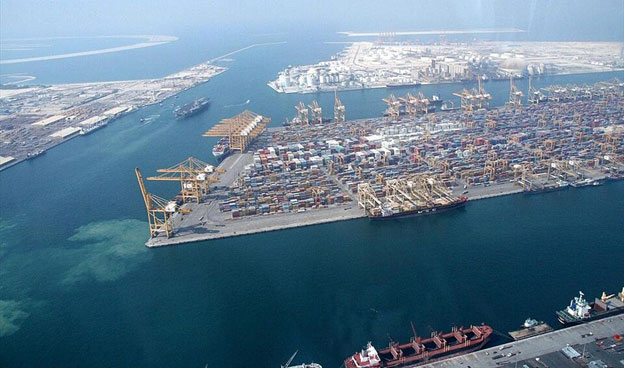 Aerial view of the Port of Dubai Emirate located in Jebel Ali district, Dubai, United Arab Emirates. Credit: WikiMedia/Imre Solt
UNITED NATIONS, July 14 (IPS) - Despite the importance of international trade as an engine for economic growth and development, only fourteen of the twenty-two Arab states are members of the World Trade Organization (WTO). The remaining Arab states risk missing out on opportunities for greater integration into the global economy and the multilateral trading system facilitated by the WTO.
A new joint study produced by the WTO, the Arab Monetary Fund, the Islamic Development Bank, and the Islamic Centre for Development of Trade examines the benefits of WTO membership, the barriers facing Arab states seeking accession and the economic characteristics which define the region.
According to the publication, WTO membership has “facilitated and secured significant export opportunities in the markets of other WTO members,” while also developing “competitive market conditions and a business-friendly environment.” Membership can create the predictability and stability needed to attract foreign direct investment, while encouraging economic diversification and supporting regulatory reform.
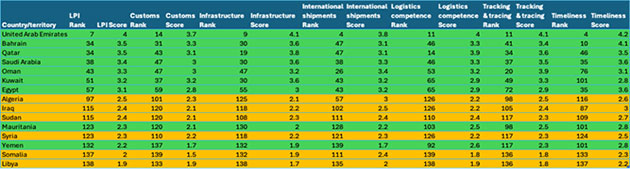
The potential benefits of WTO membership can also be reflected by logistics performance of Arab economies. According to the World Bank’s 2023 Logistics Performance Index, Arab members of the WTO generally outperform non-member economies across infrastructure, international shipments, logistics competence, and other logistics related sectors.
The Index recorded that Arab WTO members had an average logistics score of 3.17 compared to an average of 2.25 among non-member states. The United Arab Emirates (UAE) ranked the highest among Arab economies with a score of 4.0. In contrast, non-member states such as Somalia and Libya received scores of 2.0 and 1.9.
Despite the potential benefits of WTO membership, WTO accession has proven to be a lengthy process for Arab states. Seven countries seeking membership — Algeria, Iraq, Lebanon, Somalia, Sudan, Libya, and Syria — have been engaged in accession processes for an average of 18 or more years, with negotiations for some countries remaining inactive for extended periods.
The report attributed these delays to a combination of institutional challenges, political instability and economic turmoil. Political instability and conflict have especially disrupted investment and infrastructure which has halted much needed development across parts of the region, while weak regulatory frameworks have complicated efforts to align national policies with WTO requirements.
For accession to occur, it requires extensive legal and institutional reforms, coordination among regulatory agencies and ministries, and sustained political commitment throughout the years of negotiations. The report identifies the history of centrally planned economies as one of the defining characteristics which has complicated accession for some Arab states.
“An inevitable consequence of this history was the limited experience gained in regulating and governing a competitive private sector-led economy.” the report states. “A transformation from a centrally planned economy to a market economy model normally requires a fundamental shift in the government’s role from being a producer to becoming a regulator.”
These challenges are further complicated by the considerable economic differences among the Arab economies seeking integration within the global trading system.
Dependence on oil and gas for exports remains particularly significant. In 2020, 97 percent of Iraq’s total exports and 95 percent of both Algeria and Libya’s exports were fuel, all three of which are seeking WTO membership. The report argues that this dependence leaves economies vulnerable to fluctuations in global commodity markets and calls for greater economic diversification.
Economic disparities in the region can also be seen through merchandise trade composition. During 2022, Saudi Arabia had recorded a merchandise trade surplus of USD 221.3 billion, followed by the UAE at USD 112.3 billion and Qatar at USD 97.5 billion. Egypt on the other hand recorded a USD 37 billion trade deficit, while Morocco and Lebanon recorded deficits of USD 30.3 billion and USD 15.1 billion, reflecting their respective trade.
These trade compositions highlight the vastly different economic characteristics between Arab states and how they partake in the global trading system. Several of the region’s largest commodity exporters depend heavily on oil and gas, including Saudi Arabia, the United Arab Emirates, Qatar, Oman, Kuwait, Iraq, Algeria, and Libya. Other Arab economies such as Egypt, Jordan, Tunisia, Morocco, and Lebanon, have smaller hydrocarbon sectors and greater dependence on imported goods.
These structural differences alongside varying levels of political stability and institutional capacity, mean that strategies for greater integration into the global trade system cannot be uniform. The report argues that WTO accession strategies must instead be tailored to individual economic and institutional circumstances of each country.
Although the Arab states might differ in how they trade, trade remains central to the region’s economic engine, accounting for 87 percent of GDP across the Arab economies in 2023. Intra-Arab trade on the other hand only accounted only for 9.9 percent of total exports, while intra-Arab imports represented 12.1 percent of total imports during the same period.
International organizations have sought to address some of the barriers facing countries seeking WTO membership. In Iraq, the European Union (EU) funded “strengthening the Agriculture and Agri-Food Value Chain and Improving Trade Policy project” (SAAVI) which has provided aid to Iraq’s WTO accession. SAAVI aims to align Iraq’s trade policies and international standards with the WTO framework through technical assistance, capacity building, and advisory services.
The report argues that greater involvement in the multilateral trading system can greatly support economic diversification and further integrate Arab economies into global value and supply chains. Especially when looking at the model of the gulf countries, where vital energy, petrochemicals, and metals have become nonnegotiable parts of the international trade system. However the report indicated that WTO membership alone cannot guarantee these outcomes. For the seven Arab states seeking accession, strengthening regulatory institutions, improving coordination across government agencies and maintaining sustained political commitment will be critical to advancing accession processes that have already lasted an average of more than 18 years.
IPS UN Bureau Report
© Inter Press Service (20260714054341) — All Rights Reserved. Original source: Inter Press Service