3 weeks ago
28
3 weeks ago
28

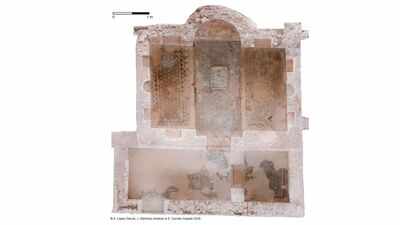
PC: Antonio López García – University of Granada
Archaeologists have identified a room within the Roman villa of Fuente Álamo, near Puente Genil in Córdoba, as the oldest confirmed library on the Iberian Peninsula. A team from the University of Granada overturned an earlier theory that the space had been a shrine to the god Mithras, arguing instead that its architecture matches known patterns of Roman library design.
According to the study published in the Journal of the Mediterranean, titled “New Approaches to Identifying Roman Libraries”, the researchers place Fuente Álamo as the westernmost library documented anywhere in the Roman Empire, adding a significant new chapter to the story of literary culture in Roman Spain.
How archaeologists identified the ancient Roman library at Fuente Álamo
For decades, the room in question at Fuente Álamo had been catalogued as a probable mithraeum, a space dedicated to the mystery cult of Mithras, popular among soldiers and officials across the Roman world.
According to La Brújula Verde, the researchers behind the reassessment are Antonio López García and Javier Martínez Jiménez of the University of Granada, alongside Eduardo Cerrato Casado of the University of Córdoba, working as part of the Exploratio Territorii Antiquae Ecclesiae Cordubensis project.The difficulty, as the team explains, is that Roman libraries rarely leave obvious physical traces. Papyrus and parchment scrolls decay within centuries, and the wooden shelving units that once held them disappear along with them, leaving archaeologists with little more than empty rooms to interpret.
Rather than relying on portable finds that no longer exist, the Granada-led team turned to the architecture itself, reading the shape of the room as evidence in its own right.
This approach allowed them to build a case for the room's original function that rests on structural logic rather than speculation.
How shape grammar helped identify the ancient Roman library
The technique at the centre of the study is known as shape grammar, a method originally developed in design and engineering that breaks a building down into its constituent architectural elements and examines how those elements combine.
The approach was first proposed by researcher Mamoli as "a solution that deploys computational techniques for studying shape grammar to develop library grammar." In practice, this means treating features such as apses, niches, and podiums as a kind of vocabulary, their combination revealing whether a space was built to function as a library.Applied to Room 10 at Fuente Álamo, the method pointed to a layout including an apse, rectangular niches sized to match the standard dimensions of Roman wooden cabinets, semicircular niches likely intended for statues or busts, a raised podium, and adjoining rooms probably used for storage or study.
Crucially, the researchers note that mithraea typically follow a very different plan, featuring a long nave lined with benches and a sanctuary at one end.
The absence of that layout at Fuente Álamo, combined with the presence of features consistent with known libraries elsewhere in the empire, gave the team confidence in their reattribution.
Why the Fuente Álamo library is unique in the Roman Empire
Dating to around the fourth century AD, the Fuente Álamo library is now considered not only the oldest such space identified on the Iberian Peninsula but the westernmost known example anywhere in the Roman Empire.
The study draws a pointed comparison with the famous Villa of the Papyri at Herculaneum, home to a vast collection of carbonised scrolls. Where Herculaneum preserved the documents but lost the building around them to Vesuvius, Fuente Álamo preserves the opposite: an intact architectural shell with no surviving books, giving the Córdoba site what researchers describe as unique value for classical archaeology.The presence of a private library on a rural estate in Late Antique Baetica speaks to the wealth and cultural ambitions of its owner. Such spaces, typically found alongside baths, porticoes and gardens within elite residential complexes, functioned as markers of social prestige as much as places of study. Their existence signals that the family who owned Fuente Álamo maintained ties to a wider Mediterranean network of learning, collecting and consulting texts even in a period when the Western Empire was undergoing considerable upheaval.
Ancient sarcophagus may depict the owner of the Fuente Álamo Roman library
The study also revisits an intriguing piece of evidence unearthed in the nineteenth century at the nearby site of Villares del Carril: a carved sarcophagus known as the Declamatio Sarcophagus, now housed in the Málaga Museum. Its imagery, centred on themes of reading and teaching, includes a bearded figure holding both a scroll and a codex. This figure bears a striking resemblance to a man depicted in one of the villa's mosaics, previously proposed by earlier scholarship as a likely portrait of the estate's owner.The researchers are careful to stress that the connection between sarcophagus and mosaic cannot yet be proven, and they call for further investigation before any firm identification is made. Even so, they suggest the link raises the possibility that archaeologists have, in effect, found a portrait of a Roman librarian. This rare occurrence would offer an unusually personal glimpse into the intellectual life of Baetica's rural elite.
Local authorities in Córdoba have already expressed interest in weaving the discovery into museum displays and educational material at the Fuente Álamo site.