
 1 month ago
60
1 month ago
60

 Image source, PA Media
ByBeth Rose
Education reporter
A record number of UK 18-year-olds have been accepted into university this year, according to the Universities and Colleges Admissions Service (Ucas).
But the biggest increase in acceptances was for the most selective, "higher-tariff" universities – such as those in the Russell Group.
Nick Hillman, chief executive of the Higher Education Policy Institute (Hepi), said the top institutions were "hoovering up all the crumbs" when it came to the top students, even if they had not met the grades they had been offered.
The Russell Group itself said there was "always some flexibility in admissions decisions", and that this "should not be confused with lowering standards".
The number of students accepted into higher-tariff universities in 2026 was 5.5% higher than last year.
By comparison, for medium-tariff universities - where students tend to get in with fewer Ucas points than the more selective universities - acceptances increased by 3.8%.
And acceptances at lower-tariff universities fell by 1.7% year-on-year.
The increase at the more selective universities comes at a time when the sector has been struggling financially as a whole, and questions have been raised about the importance of degrees and the cost of going to university.
"Universities are like every other institution, they want to be bigger and better next year," said Nick Hillman, chief executive of Hepi.
"If you can recruit good students, why wouldn't you?"
He said universities taking on more students meant less popular courses, such as modern languages, could be kept running, keeping staff redundancies at bay.
While there had been a "significant drop in international students" - who are largely postgraduates, and who pay higher fees - Hillman said universities were utilising their resources for UK undergraduates instead.
As it congratulated the 2026 cohort of new students, the Russell Group was quick to dampen down any questions that a boost in student numbers was a result of "lowering standards", and said it would "remain highly selective"
It said: "While there is always some flexibility in admissions decisions, this should not be confused with lowering standards. Our universities will only admit students who show evidence of being able to succeed on the course."
Duncan Ivison, president and vice chancellor at The University of Manchester, said students had been working hard to get the places they wanted and deserved.
"We're not cutting our standards," he said.
"We want our students not just to pass, but really flourish and do well. You can't admit students who aren't going to be able to take advantage of the opportunity that universities are offering."
The university said that, for the first time, it had received more than 100,000 applications this year – an increase of 13%.
A further 8,000 conversations were expected to take place through Clearing on results day alone.
For A-level student Stephen, from Carmel College in St Helens, results day turned into a "miraculous" morning after New College, Oxford, accepted him to study law despite him missing the grades he had been offered.
"When I opened my slip, I was initially really disappointed. I'd been made an offer of three As. I came out with ABB," he said.
"Then it was miraculous, I opened my Ucas form and I'd had my place confirmed.
"I'm absolutely over the moon."
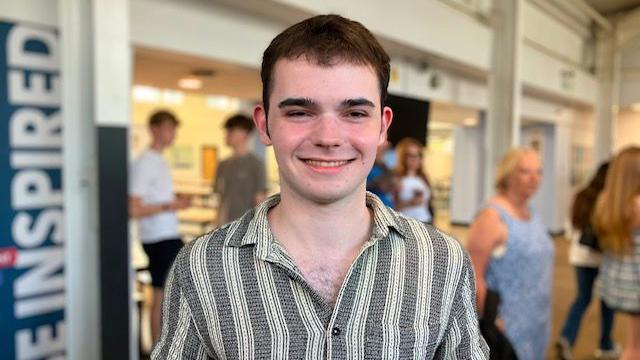 Image source, Emily Doughty / BBC
Stephen initially thought he'd missed his chance of a place at Oxford
It was a big relief for Niamh, too, who studies at the same college in the North West.
She told the BBC she had her heart set on studying midwifery at Edge Hill University in Ormskirk, Lancashire, but was turned down at the application stage and told she did not have the grades.
She had planned to go through Clearing and try her luck again, but was instead offered a place by the university about a month ago.
She said she was "really happy" and wanted to "empower women" and "leave an imprint on their lives" with her future career.
 Image source, Emily Doughty / BBC
Niamh is off to study midwifery after her application was initially turned down
Universities UK, which represents 142 institutions, said the changes in student acceptance numbers was not necessarily as simple as the top universities grabbing as many students as they could by lowering grades.
Chief executive Vivienne Stern said the grade profiles accepted by different universities were "more or less identical to the pattern in previous years".
There are numerous reasons why students might be offered places with higher or lower grade requirements than average, she said, such as certain courses being under-subscribed.
While the financial situation of the higher education sector may have brought the issue to the fore, she said there were "checks and balances" in place.
"The important thing is we've got a system which regulates universities on outcomes," she said.
"You can recruit a student, but we're going to hold you to account. It's not in the interest to recruit a student who is not well equipped to succeed."
Hillman, from Hepi, said while universities were likely to be "breathing a sigh of relief" over the high student numbers, the true picture would only become clear once the new term begins.


