4 months ago
37
4 months ago
37

Glenn CampbellScotland Political Editor

 PA Media
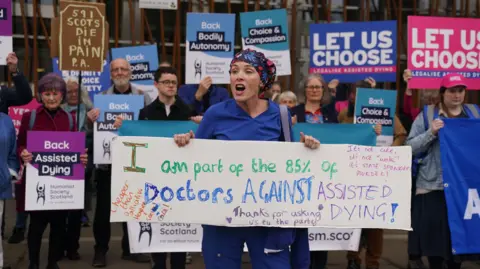
The debate over assisted dying has sparked passionate debate across Scotland
It is the biggest decision MSPs will take in this five-year term at Holyrood - and one of the most consequential in the devolved parliament's short history.
At first glance the question seems relatively straightforward.
Should terminally-ill adults with decision-making capacity and six months or less to live be allowed to seek medical help to die?
All that is required of our politicians is a yes or no.
But they first have to disentangle a complex web of emotional, philosophical and practical considerations.
These have been laid bare in the past week of debate on the assisted dying legislation proposed by the Liberal Democrat MSP Liam McArthur.
MSPs have looked at more than three hundred possible changes to his bill and agreed some revisions.
They have had the weekend to reflect on the bill in its final shape. Now they must make up their minds.
To illustrate some of the arguments, we have spoken with two women who have been confronted with their own mortality and want to influence the debate in fundamentally different ways.
'I've had so many choices taken away'
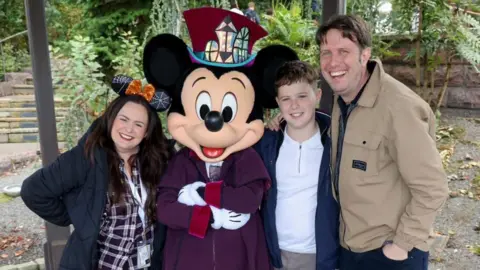 Fleming family
Lisa Fleming, who has incurable cancer, believes the right to end her own life would give her peace of mind
Lisa Fleming lives in Edinburgh with her husband Euan and son Cameron. She has incurable secondary breast cancer.
Lisa's treatment over the last nine years has included seventeen surgeries. She started a fresh round of chemotherapy last week.
"People probably look at me and think 'you look so well' but that's only one side of it," she said.
"There are still days that I'm consumed by bad mental health, by deep dark thoughts.
"I've had so much of my dignity stripped away because of my diagnosis. I've had so many choices taken away, I've had my hope taken away".
Lisa has watched two friends with her condition die in pain. She wants to avoid a similar experience.
"You can have the best palliative care in the world but at times they can't control that pain.
"All I am asking for is the right to be able to have a choice at the end of my life."
For her, that would be empowering. It would give her peace of mind.
"Once the bill is hopefully passed I can stop worrying and being scared of dying and I can get on with living" she said.
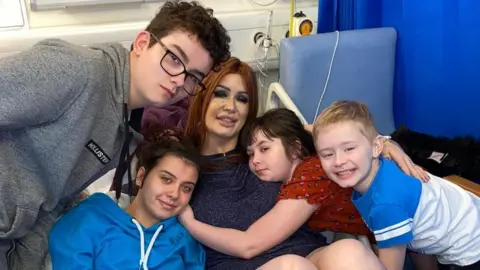 Moffat family
Michelle-Anna Moffat has moved from supporting assisted dying to speaking out against it
But having the option of assisted dying is not what everyone confronted with the most challenging health circumstances wants.
Michelle-Anna Moffat from Dumbarton thought she supported it but has changed her mind.
She was working as an intensive care nurse when her life was turned upside down.
Bending over to pick up a pen one day, she suffered a spinal injury that has left her paralysed.
The assisted dying proposals are limited to terminal illnesses, so would not apply to this condition.
However, there was a point when Michelle-Anna found her condition intolerable and resolved to end her life at a clinic in Switzerland.
She told the BBC how she felt at that time.
"I can't go on, life is not the same, it can't be the same, I can't contribute anymore," she said.
"I'm a burden, I'm in pain and the most compassionate and loving thing that I can do for those around me that I love is just to not be here anymore."
Michelle-Anna said that she told her husband Ross to find a new wife and that he was "horrified" by her approach.
Her family doctor helped change her perspective. The GP told her the right medicine could end her suffering without ending her life.
Since then she has developed new medical problems including gastric failure, for which she requires tube-feeding.
This is generally considered to be a chronic condition rather than a terminal illness.
While her health has deteriorated, Michelle-Anna's outlook on life has brightened and she explained what's changed in her thinking.
"I guess realising that I still have value and that life does have a lot to offer," she said.
Michelle-Anna and Lisa have become active campaigners on either side of the assisted dying debate.
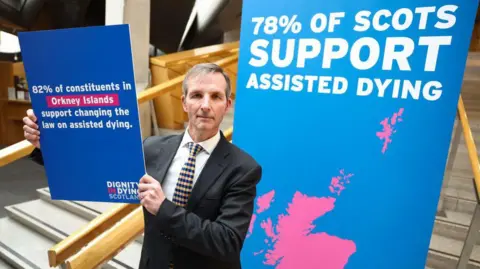 Getty Images
Liberal Democrat Liam McArthur is the MSP behind the assisted dying bill
The contrasting opinions and a great many other perspectives will weigh heavily on MSPs as they edge towards the final vote on Tuesday.
I have spoken to many politicians who are obviously torn.
There will be those on both sides who have not budged an inch since the assisted dying bill was approved in principle by 70 votes to 56 last May.
But among the bill's supporters at that stage was a group of MSPs who wanted to allow the debate to continue, in the hope their concerns could be addressed.
For some, serious concerns remain.
Has enough been done to guard against coercion? Will medical professionals who conscientiously object to carry out assisted dying receive proper protection? Could the scope of the law be expanded by future court challenges?
The basic answer from the bill's proponents is that similar systems operate in countries around the world and these issues have not become major controversies.
Their question to critics is: why should someone who may be suffering at the end of their life be denied the right to choose how and when to die?
There is consensus that - in all circumstances - palliative care needs to be better and more consistently available at the highest standard.
That way, if there is to be a choice, it is a genuine one.