2 months ago
34
2 months ago
34

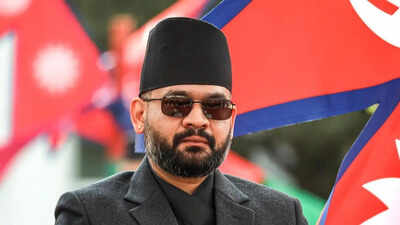
Two months into office, Nepal's Gen Z icon and Prime Minister Balendra Shah, popularly known as Balen, is already facing questions over whether his ambitious reform agenda is slipping behind schedule, with a government tracker showing multiple key promises marked "overdue" and early signs of political and administrative strain emerging inside his administration.The pressure has been compounded by cabinet churn, legal controversy over key decisions, and growing scrutiny of his governing style, including criticism over ordinances, institutional bypassing, and the handling of arrests and enforcement actions.Even as protests and judicial challenges mount over several policy moves, questions are now being raised over accountability and the pace of delivery from a leader who swept to power on a wave of unprecedented public expectation.That wave itself was born last year when Nepal witnessed a Generation Z led uprising against corruption, nepotism and unemployment that forced then-prime minister KP Sharma Oli to resign and upended the country’s political establishment.In the elections that followed, young voters turned to 35-year-old rapper Balendra Shah, popularly known as Balen, expecting a decisive break from traditional politics.Is Balen-ce sheet tipping already?After taking oath as Nepal’s Prime Minister on March 27, Balen moved swiftly to endorse an ambitious 100-point governance reform agenda.
The proposal promised structural changes, including downsizing federal ministries, merging financially burdensome boards and committees, and depoliticising civil servants and teachers.Further proposals included implementing recommendations from a commission led by Gauri Bahadur Karki, reviving underperforming projects, digitising investment and industrial services, and preparing a long-term energy export strategy.The tracker website launched by the prime minister, however, paints a different picture, with most of the promises running behind schedule and flagged as "overdue".
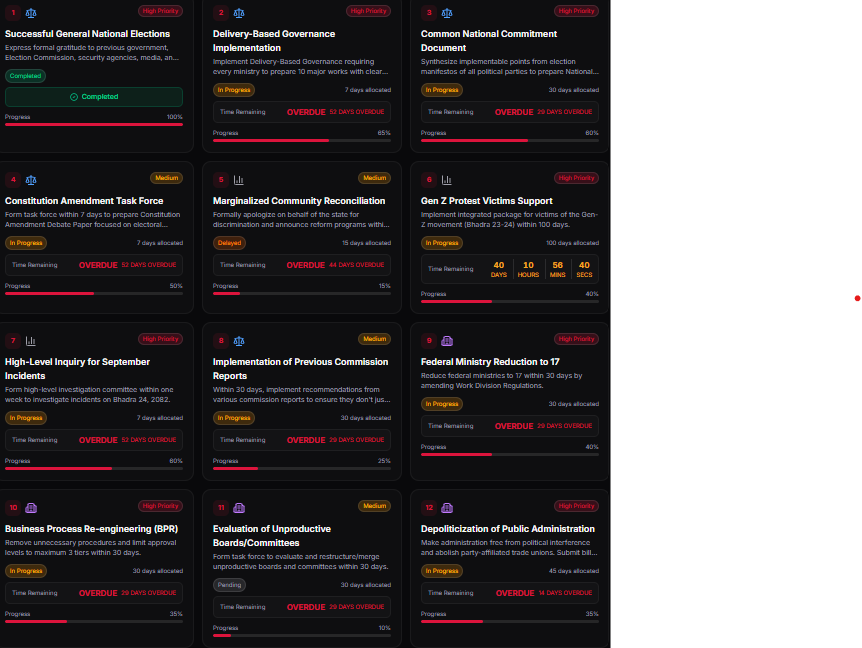
Additionally, Balen’s cabinet had already seen the exit of two ministers within 30 days of taking oath.Nepal’s labour minister Deepak Sah was recalled following controversy over appointing his spouse to the Health Insurance Board, while home minister Sudan Gurung resigned amid criticism over alleged links with a businessman under investigation."Are there no capable ministers in Parliament who can take over the post? This raises questions about who that capable minister is - and if there isn’t one, then why," Michael Tamang, a Gen Z Nepali, told news agency ANI.Nepal’s government also drew flak after its decision to implement the Karki Commission report, linked to the Gen Z protests and issued by the interim government under former prime minister Sushila Karki, without a clear legal grounding.The arrest of former prime minister KP Sharma Oli and former home minister Ramesh Lekhak without proper paperwork invited legal and political backlash.Nepali Congress leader Deepak Khadka was also freed after prolonged detention due to insufficient evidence.Rule by ordinance?While Balen’s government enjoys a two-thirds majority in the Lower House, it does not have a single member in the National Assembly, which plays a key role in the passage of legislation, including amendments.To bypass the Upper House, Balen pushed eight ordinances, including measures to dissolve civil service trade unions and student organisations in universities.The Nepal Supreme Court, however, stayed the ordinances amid street protests by employee and student groups.The Nepal prime minister defended the measures in a social media post, saying that "banning party flags in schools and bureaucracy will not seize the rights of students and employees, but strengthen professional freedoms".He said the move aimed to end partisan influence in education and bureaucracy, where student and employee organisations had become "sleeper cells" of political parties. He added that transfers and promotions should be guided by procedure, competence and delivery - not party affiliation.Nepal = bulldozer republic?Another point of contention is the Balen government’s anti-eviction drives across Nepal. Hundreds of landless squatters staged anti-government demonstrations protesting the eviction campaign.The protesters, agitating under the banner of the National Landless Squatters Front at Maitighar Mandala, demanded compensation for families whose settlements were bulldozed by authorities deploying armed security personnel.They carried placards reading "No Balen government, no bulldozer", "Stop forcible eviction, halt bulldozer terror" and "We need justice, no bulldozer".According to officials, around 4,000 structures belonging to landless people have been demolished in Kathmandu Valley alone, displacing at least 15,000 people.Eviction drives have been central to Shah’s politics since his tenure as Kathmandu mayor, when his administration repeatedly used bulldozers to clear settlements and structures it described as encroachments.As prime minister, he revived that approach through a nationwide anti-encroachment push. However, landless groups and rights activists said the government had moved against some of Nepal’s poorest residents without proper identification, consultation or a credible rehabilitation plan.Experts from the UN and several human rights organisations, including Amnesty International, have criticised the eviction campaigns.Less talk, more work, or just less talk?In the run-up to Nepal’s national elections, Balen campaigned on transparency and accountability. Yet, during the entire campaign, he spoke publicly for just 27 minutes.Public resentment against the political establishment ran so deep that voters backed his party in several constituencies without even knowing the candidates.But two months into office, Balen’s silence has increasingly come under scrutiny from both the opposition and critics. Since taking oath as Nepal’s prime minister, he has neither addressed the nation nor held a press conference. He abruptly walked out midway through the President’s address outlining the government’s policies and programmes, and later skipped Parliament without notice.The opposition repeatedly disrupted parliamentary proceedings, demanding that the prime minister appear before the House and answer lawmakers’ questions.Even leaders from Balen’s own Rashtriya Swatantra Party, including Ashika Tamang and Amresh Kumar Singh, publicly questioned his absence from Parliament. Singh went as far as warning that Nepali democracy was beginning to resemble the "Pakistan model" - where the executive remains largely unaccountable to the legislature.Balen’s supporters, however, defend his silence by arguing that previous prime ministers spent hours speaking in Parliament while failing to deliver on governance.Yet, in a parliamentary democracy, the prime minister’s presence in Parliament is not merely symbolic - it is also a constitutional and political responsibility.On the diplomatic front too, Balen has reportedly resolved not to undertake any foreign tours for at least a year. Additionally, he has set a condition that he will meet only visiting dignitaries of ministerial rank or above.Border bluesProtests have also erupted over the Nepal government’s stricter enforcement of customs duty on Indian goods brought across the Indo-Nepal border.Under the rule, Nepal has imposed mandatory customs duty on goods worth more than Nepali Rs 100 (around Rs 63) purchased from India. Depending on the category of the product, the levy ranges from 5% to 80%.For decades, Nepali families routinely crossed into Indian border towns to buy groceries, medicines, utensils, clothes, electronics and wedding supplies. Carrying those goods back home was rarely an issue. But traders and residents say that changed after authorities began strictly enforcing the rule around the Nepali New Year.The move has triggered protests along the 1,750-km open border, with critics calling it an "unofficial blockade" of Indian goods. Even some leaders from Balen’s Rashtriya Swatantra Party have reportedly described the measure as "impractical"."For the rituals performed here from birth to death, we bring all the essentials from India. Even fertilisers that Nepal’s government sometimes fails to provide on time are brought from there. Now the situation has completely changed. It feels like an unannounced blockade," a protester told news agency ANI.