1 hour ago
4
1 hour ago
4

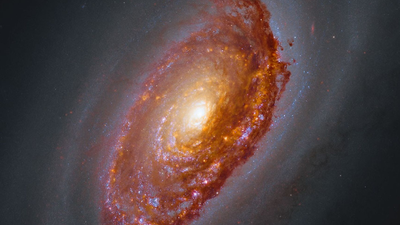
At first glance, Messier 64 looks like a classic spiral galaxy. Its bright centre is wrapped in sweeping arms, while a broad, dark band of dust cuts across one side of its nucleus, giving it the distinctive appearance that earned it the nickname Black Eye Galaxy.
But beneath that familiar spiral shape lies something much stranger. Located roughly 17 million light-years from Earth in the constellation Coma Berenices, M64 is known for an unusual internal motion: gas in its outer regions rotates in the opposite direction to the gas and stars closer to the centre. NASA says this counter-rotation may be a remnant of a merger involving M64 and a smaller satellite galaxy more than a billion years ago.
Webb sees what Hubble could not
The new composite image combines observations from the James Webb Space Telescope and Hubble Space Telescope, allowing astronomers to examine M64 across different wavelengths.Webb’s Mid-Infrared Instrument, or MIRI, is particularly useful for studying the galaxy’s dusty regions. While the dust can appear dark in visible-light observations, infrared wavelengths allow Webb to detect radiation associated with the dust and the young stars embedded within it.
NASA’s APOD description notes that MIRI reveals the dust in red, while Hubble’s observations show pink regions associated with active star formation.That difference is important because the dark band that gives M64 its name is not simply an empty, shadowy region. It contains material involved in the ongoing process of forming new stars.
Two gas streams moving against each other
The galaxy’s most intriguing feature is its opposing gas motion. The gas closer to M64’s centre rotates in one direction, while gas farther out rotates in the opposite direction.
Where these two systems interact, the gas can collide and become compressed. That compression helps trigger the collapse of gas clouds, creating conditions favourable for new stars to form.This makes M64 something of a cosmic record of its own past. The opposing motion is thought to have originated when a smaller galaxy interacted with and was eventually absorbed by M64. Astronomers have studied this unusual behaviour for decades.
NASA’s earlier Hubble observations found that the outer gas extends much farther from the centre and rotates in the opposite direction, while regions where the gas systems meet show evidence of active star formation.
A merger hidden inside a beautiful spiral
The idea that a spiral galaxy could have undergone such a dramatic merger was significant in the study of M64. Rather than being a completely settled system, the galaxy preserves traces of an ancient encounter in the movement of its gas.
NASA notes that M64 became important evidence that spiral galaxies can experience mergers, challenging the older assumption that their histories were comparatively peaceful. The smaller galaxy involved in the event is no longer an obvious separate object.
Instead, evidence of the encounter remains embedded in M64’s unusual gas dynamics.
Why Webb’s view matters
The new Webb observations are not simply about producing a more detailed-looking photograph.
Infrared observations allow astronomers to study the structure, composition and behaviour of dust that is difficult to see in visible wavelengths.Combined with Hubble’s view, the observations provide a broader picture of how dust and star-forming regions are distributed throughout M64. NASA says the Webb data will help researchers better understand the galaxy’s dust and provide additional context for reconstructing its merger history and evolution.For a galaxy some 17 million light-years away, its appearance may seem frozen in time. Yet the Black Eye Galaxy is effectively carrying the evidence of an ancient cosmic collision within it. What looks like a dark streak across a beautiful spiral is part of a much larger story involving two streams of gas, newly forming stars and a merger that happened more than a billion years ago.