6 months ago
49
6 months ago
49

Jeremy BowenInternational editor

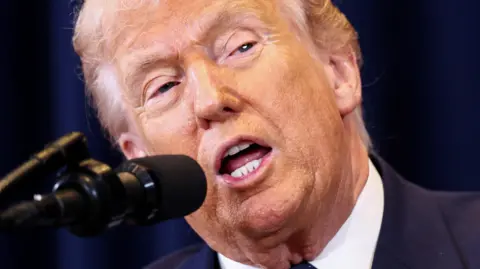 Reuters
I know what can happen when an American president calls for an uprising and then doesn't get involved when it starts. That's because I've seen it before.
In 1991, on 15 February to be precise, the first President George Bush made a speech that he probably regretted until the end of his days.
It was at the factory in Massachusetts where they built Patriot interceptors, which were making their debut as the most advanced weapon of that first Gulf war.
Patriots, which shoot down incoming missiles, still have a vital role in Ukraine and in the war with Iran.
When Bush went to the Patriot factory, Desert Storm, the massive military operation to drive Iraqi troops out of Kuwait was under way.
The combined air forces of the US, the UK and their allies were hammering them -and Iraq's cities.
Tens of thousands of allied troops were massed on Iraq and Kuwait's borders for the ground war, which was still nine days away.
I was in Baghdad, my hands full reporting the war.
A few days earlier the Americans had killed more than 400 civilians in an airstrike on a shelter in the suburb of Amiriyah.
The Americans and British claimed, wrongly, that it was a command centre, but I'd seen the bodies, almost all children, women and old men, and seen the still smouldering shelter, so I knew that wasn't true.
Back then, I didn't notice Bush's speech.
But 35 years later I think about it every time I hear Donald Trump and Benjamin Netanyahu telling the people of Iran that they're being given a once in a generation chance to overthrow the Islamic Republic, without promising them direct military support.
Bush was at the Patriot factory to praise the workers who made what was seen as a miracle weapon.
In a couple of quick paragraphs, he said Iraq's ruler Saddam Hussein should comply with the United Nations resolutions to pull out of Kuwait.
Unlike the current war with Iran, the first Gulf war had the legal authorisation of the UN Security Council.
Bush then uttered a couple of lines that had immense consequences.
"There's another way for the bloodshed to stop...and that is for the Iraqi military and the Iraqi people to take matters into their own hands and force Saddam Hussein, the dictator, to step aside…"
The workers whooped and applauded, and the president went back to rallying Americans who were in their first major war since the disaster of Vietnam.
 Stefan Zalkin/EPA-EFE
A US soldier during a patrol in Iraq in 2003
But some Iraqis took him seriously.
After Iraq's army was expelled from Kuwait, a ceasefire left Hussein in power.
Iraqi Shias in the south and Kurds in the north of the country started an armed revolt against his regime.
The Americans, the British and the other nations making up the coalition watched what was happening and did not intervene.
The Iraqi regime was badly damaged by the war, but it had been allowed to keep its helicopters and they led a counter offensive that killed thousands of Kurds and Iraqi Shia Muslims who believed that their rebellions had the blessing of the US president. But they made the mistake of assuming he would intervene to make sure the uprising succeeded.
By then I was in the freezing, snowy mountains in the Kurdish north. Tens of thousands of Kurds fled there - with horrific stories of killing by Hussein's men - and every morning I saw fathers bringing down the bodies of their children, small bundles wrapped in blankets, who had died on mountainsides in the night of exposure or dysentery.
The Americans, the British, the French and others in the end were shamed into a big humanitarian operation to rescue the Kurds. In the south, the Shia were not so lucky.
The consequences of that first Gulf war went on for years; a commitment to fly air patrols to enforce a no-fly zone, permanent American bases and in Saudi Arabia a young Osama Bin Laden, furious that foreign troops had in his eyes violated the land of Islam's holiest shrines, was putting together the organisation that became Al Qaeda.
Each Gulf war planted the seeds of the next.
In 2003, the second President Bush ousted Hussein, completing what he believed was his father's unfinished business.
Iran was a big winner in that war. The Americans, obligingly, had removed its bitter enemy, Saddam Hussein.
This third Gulf war is aimed at undoing the Islamic Republic's rise to regional power that accelerated after 2003.
The bombing is designed to smash its military and nuclear ambitions, which Israel, especially, regards as a threat to its existence.
Trump's decision to go to war, for the first time as a joint venture with Israel, is unpopular in America, latest polls show, and alarming for America's allies, with the exception of course of the Israelis.
What if the sceptics are wrong? Perhaps analysts and commentators have let their distaste for Trump cloud their judgement.
Maybe it doesn't matter that he insults allies whose soldiers fought and died alongside Americans in other Middle Eastern wars, or that sometimes he tells lies.
He claimed that Iran could have fired a Tomahawk missile in the attack on a school that Iran says killed more than 165 people, including many schoolgirls. Iran doesn't have Tomahawk missiles.
All that, Trump and his supporters argue, is fake news.
They say higher petrol prices for a while will be worth it, if this war stops Iran getting a nuclear weapon and long-range ballistic missiles that would threaten not just Gulf states and Israel but also Europe and even America.
The US Secretary of Defence, Pete Hegseth - rebranded as Secretary of War -slammed European scruples about the use of force without UN authorisation or a convincing case of self-defence.
Hegseth laid into "so many of our traditional allies who wring their hands and clutch their pearls, hemming and hawing about the use of force."
But it's already clear that ending the war will not be simple, and its consequences are at best uncertain and at worst dangerous.
Israel has its own agenda. Netanyahu is clear eyed about what he wants. He believes he can achieve a lifelong dream - to destroy the Islamic Republic of Iran.
In a speech on the war's second day, he said that with 'the assistance' of the United States, Israel was able to do "what I have yearned to do for forty years: smite the terror regime hip and thigh. This is what I promised and this is what we shall do."
Like Trump, he's called for a popular uprising in Iran. Israel does not seem concerned about Iran descending into violent chaos. It might even be a good outcome for them.
America, Israel and their supporters believe that removing the Iranian regime will make the world safer.
They could be right. It's an unsavoury, violent regime that in January killed thousands of fellow Iranians in the streets for marching against repression, corruption and economic collapse. It enriched uranium to levels that could be turned into a nuclear bomb.
But they're wrong if the war's consequences touch off a catastrophe on the scale of the one that started with the invasion of Iraq in 2003.
Removing Hussein, Iraq's dictator, without a workable plan to replace his regime led to hundreds of thousands of deaths in years of sectarian killing and civil war and a vacuum of power that incubated the jihadist extremists who morphed into Islamic State, whose successors will be looking at ways to take advantage of this new crisis.
Netanyahu has contemplated war with Iran many times but has always recognised that Israel would need the help of an American president prepared to go to war too.
Finally, there is one - Trump.
Previous presidents - including Bill Clinton, the first one Netanyahu dealt with as prime minister thirty years ago - would not do it.
They were content to contain and deter Iran, keeping war in reserve if it really did try to get a nuclear weapon.
And they didn't act to a very large degree because of what is happening now; an Iranian response designed to defy American power, to spread the war, cause huge economic damage and disrupt carefully constructed alliances between the US and Gulf countries, which tried to stop the war happening.
Now Iran has turned them into targets. With China waiting in the wings, they might reassess the value of an alliance with the US and rapprochement with Israel, especially if Trump declares victory and leaves Saudi Arabia and the others to clear up the mess.
Trump, who promised Americans no more forever wars, might find himself keeping forces in the Middle East that he would rather were free to face China.
It is more straightforward for the Israelis. They see the best opportunity they have ever had to reorder the Middle East and strengthen their position as the unchallenged military hegemon.
They are aiming to destroy Iran's Lebanese ally, Hezbollah, once and for all, something they've tried and failed to do since the 1990s.
While the attention of the world is on Iran, Israel is also taking more steps towards the effective annexation of the occupied West Bank.
Trump might learn that starting wars is much easier than ending them. It is hard to know when to stop if you don't know exactly where you're going.
It is even harder to do that when the US, the world's most powerful country seems to have gone to war without a coherent political strategy, under a president who the evidence suggests is making it up as he goes along.