
 3 months ago
45
3 months ago
45

Just now
Jeremy BowenInternational editor

 Getty Images
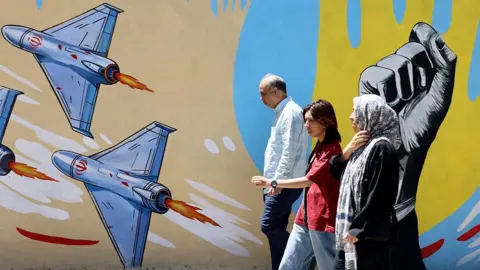
Talks between Iran and the US continue but Tehran has publicly refused to cede ground
The United States and Iran have both signalled that they would prefer not to go back to the war that has been on hold since the ceasefire was announced on 8 April.
Neither side has allowed the steady drumbeat of military exchanges between them to end the talks being mediated by Pakistan, Qatar and others.
The United States still has powerful naval and air forces within striking distance of Iran.
It is safe to assume that the Iranian regime will have kept its forces on high alert and will be using the ceasefire to re-organise and repair damage done by the US and Israel.
Armed tension in the area in and around the Gulf opens up a clear risk for both sides of miscalculation and misperception.
The US is trying to keep the pressure on the Tehran regime to make concessions by demonstrating that they are close by and capable of causing great damage.
The Iranians are reminding the US that their determination to resist is undiminished and, if necessary, they will attack American bases and the wider infrastructure of the Arab gulf.
The first objectives on what would be a long and perhaps unreachable road to a wider deal between the US and Iran is a continuation of the ceasefire and an agreement on a "memorandum of understanding" on the agenda of more talks between them.
Getting to that is proving difficult.
The Iranians will require a price, perhaps in the form of sanctions relief or unfrozen assets to reopen the Strait of Hormuz, which looks to be a prerequisite for serious negotiations.
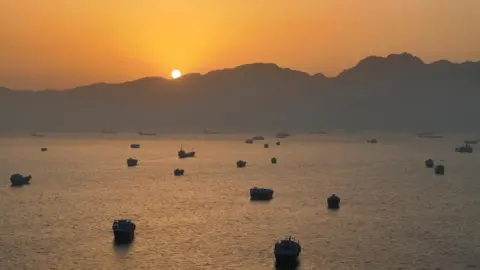
Only a trickle of ships is getting through what had been a vital and busy waterway. Iran closed it after it was attacked by the US and Israel on 28 February.
 Reuters
Shipping traffic through the Strait of Hormuz has ground almost to a halt
Saudi Arabia is piping some oil to its Red Sea ports, and the United Arab Emirates (UAE) has a pipeline to terminals on its small patch of coast that faces the Gulf of Oman, beyond the Strait of Hormuz.
But the rest of the world has still lost around 20% of its usual supply of oil and gas, as well as other vital exports.
Keeping the Strait closed spells disaster for much of the world economy. The US no longer depends on Gulf oil, but petrol prices in America are still set by the global oil market.
Donald Trump is in a bind. He is enmeshed in the consequences of the gross blunder he made by going to war assuming an easy victory.
The US president and his close ally Prime Minister Benjamin Netanyahu of Israel fatally underestimated the degree to which the Islamic regime was prepared to resist and ride out their attacks.
Trump has no easy way out and the Iranian regime wants to keep it that way.
He needs to get the Strait reopened. The war against Iran is deeply unpopular in the US and re-escalating it will turn even more Americans against it.
Trump's problem is that the concessions Iran will require to reopen the Strait are opposed by hawks in his own Republican Party and by his own desire to parade a victory.
The US president is deeply allergic to any adverse comparison between any deal he makes with Iran, even an arrangement to extend the ceasefire for more talks, and the nuclear deal made under Barack Obama in 2015. Trump condemned it and in his first term in the White House pulled the US out.
Iran's rulers believe with some justification that they are fighting for the existence of their regime.
It is pretty clear that more strikes from the US with or without Israel are not going to budge them on that.
 EPA
EPA
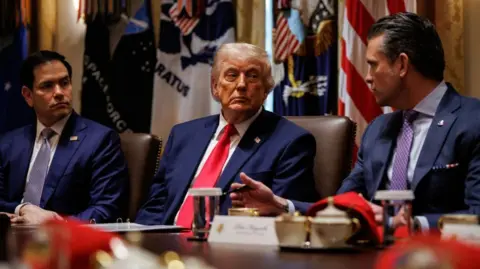
Trump and his senior cabinet members are trying to balance getting concessions from Tehran while ending to war quickly to avoid political ramifications
The wealthy Arab oil states of the Gulf have suffered long term economic damage and do not want to suffer any more.
Their model for business and the long-term development of their countries depends on a foundation of the Gulf being a stable hub for the global economy and safe for foreign investment.
The war has inflicted a severe blow and restoring their aura of stability will take years.
Qatar is a full mediating partner, along with Pakistan, in the diplomatic attempt to restart talks.
The United Arab Emirates and Saudi Arabia have responded to Iran from different angles.
The Emiratis have doubled down on their strategic relationship with the Israelis, who deployed the Iron Dome missiles defence system to the UAE, along with Israel Defense Forces soldiers to operate it.
It has emerged that the Saudis have attacked Iran, they say in retaliation for Iranian attacks. But significantly, senior Saudi sources say they made it clear to Tehran that they were acting independently, not as part of the US-Israel coalition.
When Donald Trump and Benjamin Netanyahu went to war with Iran on 28 February both men said that their countries' considerable air power would be enough to remove the Islamic regime in Tehran.
They misunderstood the nature of a regime that has survived for almost half a century despite severe tests imposed by war, sanctions and isolation.
Now the US and Israel are living with the consequences - and so is the rest of the world.


