1 hour ago
1
1 hour ago
1

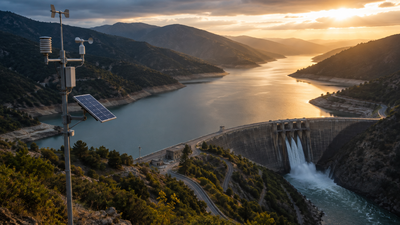
Representative Image (AI-generated)
California’s water problem is often framed around the need for more storage, new infrastructure and expensive construction. But a new study suggests that part of the answer may already be sitting behind the state’s existing dams.
By using better weather and water forecasts to decide when reservoirs should release or retain water, California could potentially make substantially more water available each year without constructing another reservoir. The research, published in Environmental Research: Water, estimates that Forecast-Informed Reservoir Operations (FIRO) could increase water availability by about 315,000 acre-feet annually, equivalent to more than 100 billion gallons.
The researchers estimate that the additional agricultural and urban water supply could generate about $145 million a year in direct economic benefits, with the broader estimated range reaching roughly $100 million to $200 million annually.
The primary study was led by researchers from Scripps Institution of Oceanography at UC San Diego and other institutions.
Making existing reservoirs work harder
The basic idea behind FIRO is relatively straightforward.
Reservoir operators traditionally have to balance two competing needs: keeping enough empty space to protect downstream communities from floods while retaining enough water to meet future demand. That can be difficult in California because much of the state's water arrives during a relatively small number of powerful winter storms. Atmospheric rivers can deliver huge amounts of precipitation within a short period, rapidly changing conditions from drought concerns to flood threats.FIRO attempts to give reservoir operators better information before making those decisions. Instead of relying primarily on fixed operating rules or calendar-based schedules, operators can use improved forecasts of atmospheric rivers, rainfall and reservoir inflows. If forecasts indicate that a major storm is approaching, water can potentially be released beforehand to create additional storage space.
On the other hand, when forecasts indicate that significant inflows are unlikely, operators may be able to retain more water instead of releasing it simply because traditional rules require additional flood-control space. The objective is therefore not simply to store more water. It is to make storage decisions more responsive to what the weather and watershed are actually expected to do.
20 reservoirs examined
The study examined 20 major California reservoirs identified as having no prohibitive barriers to further FIRO assessment.
Together, they represent more than 20 million acre-feet of storage capacity, roughly half of California's surface-water storage capacity. Using historical reservoir storage records, researchers estimated how much additional water could potentially have been retained if forecast-informed operations had been available.
Their central estimate was approximately 315,000 acre-feet of additional water per year.
In particularly wet years, the potential could rise to nearly 500,000 acre-feet, or about 162 billion gallons, enough for more than a million households, according to the researchers. The economic value also varies depending on water conditions. The primary study estimates approximately $145 million per year in direct benefits on average. Its modelling found estimated annual benefits of about $206 million in moderately wet years, compared with roughly $100 million in dry years and $134 million in wet years.
More than a water-supply benefit
The researchers stress that the economic estimate is conservative because it focuses mainly on direct benefits to agricultural and urban water users. Other potential benefits were not fully included in that calculation. These could include improved flood-risk management, environmental flows, hydropower generation, fisheries and recreation. Evidence already shows that forecast-informed operations can produce significant results.
At a FIRO project, officials said the approach had allowed enough water to be safely retained to supply approximately 250,000 homes for a year, with an estimated economic value of around $125 million.
Not a replacement for new projects
The findings do not suggest that California can solve its water challenges simply by changing reservoir operations. The researchers examined a more ambitious scenario in which forecast-informed operations increased water availability by 5% of gross reservoir capacity.
That could produce approximately 1 million acre-feet of additional water and nearly $460 million in direct agricultural and urban benefits, but achieving that level would depend on individual reservoir conditions, improved forecasts, operational changes and potentially targeted infrastructure improvements.According to the researchers, detailed assessments of individual reservoirs are needed before wider implementation. Those assessments would need to consider operational constraints, costs, environmental effects and the full range of benefits. FIRO is ultimately presented as one tool within a much larger water strategy. Conservation, groundwater recharge and new infrastructure would still have roles to play.
But the study suggests that California may be able to obtain considerably more value from reservoirs it has already built simply by combining them with better forecasting and more flexible decision-making.