3 weeks ago
35
3 weeks ago
35

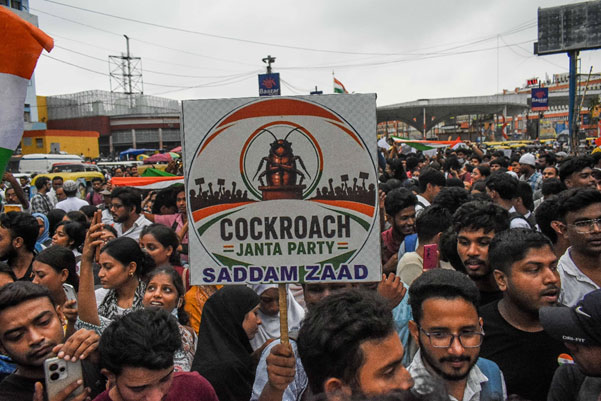 Supporters of the Cockroach Janta party rally against the Minister of Education in Kolkata, India, 24 July 2026. Credit: Debarchan Chatterjee/NurPhoto via AFP
LONDON, August 21 (IPS) - India’s strongman leader, Narendra Modi, has just been forced to do the thing he likes least: making concessions in response to protests.
It all started on 15 May, when the country’s Chief Justice, Surya Kant, told a courtroom that unemployed young people who protest and speak out on social media are like cockroaches. The remark, revealing the establishment’s contempt for the country’s young people, spectacularly backfired. Within days it had spawned a nationwide movement, the Cockroach Janta Party. Its central protest demand was the resignation of Education Minister Dharmendra Pradhan. Pradhan quit on 25 July. But that may not be enough to satisfy the demand for change the movement has unleashed.
Birth of a movement
India has more Gen Z people than any other country. Around 407 million Indians, some 30 per cent of the population, are aged 14 to 29. They face extraordinary competition to access education and struggle to find jobs.
Kant’s remark sparked a fire. Communications strategist Abhijeet Dipke asked on social media: what if all the cockroaches came together? That question kickstarted a viral movement under a name, the Cockroach Janta Party, that playfully echoes that of the ruling Hindu nationalist party, the Bharatiya Janata Party (BJP). What began as a satirical website quickly became a movement. Within two weeks, it had 22 million Instagram followers.
The cockroach movement fits into a broader global pattern. Recent years have seen Gen Z mobilise in numbers in many countries where governments are demonstrably out of touch and economies and political systems fail young people. Movements are characterised by collective leadership, mass protests and strategic use of social media. India’s time to join the wave had come.
The movement soon found its galvanising cause. India’s education system relies on make-or-break entrance exams, with results deciding the career prospects of millions. In the medical college exam, some 2.2 million students compete for 130,000 places. Families make sacrifices and students spend years preparing. But corruption means questions are often leaked in return for bribes. Two weeks before Kant’s outburst, the national medical college entrance exam paper was leaked and the exam was cancelled. Students despaired. Then they got angry.
Protest prevails
Protesters camped out for weeks in central Delhi, demanding Pradhan’s resignation. Volunteers supplied food, water, medicines and camping equipment. The movement broadened well beyond Gen Z, with people of all ages joining. Sonam Wangchuk, an environmental and education reform activist previously jailed for protesting, further raised the protest’s profile with a weeks-long hunger strike.
For seven weeks the government tried ignoring the protesters, and when that failed, it turned to violence. After authorities forcibly hospitalised Wangchuk, thousands of protesters marched from the protest site to parliament. Security forces responded with pellet guns and teargas, beat protesters and bystanders with batons and wooden sticks and detained many. The violence, widely documented on social media, was shocking for a country that prides itself on being the world’s biggest democracy. It was impossible to ignore, sparking protests in other towns and cities. The government was finally forced to hold talks.
Looking ahead
The government has promised fast-track courts for exam leakers and a review of the exam and education systems. In return, the movement called off the protests, having also secured a promise that no protester would face repercussions. But that’s not the way of a government that has long repressed dissent. Modi’s administration has a track record of detaining activists, using force against protests, censoring critical voices and passing restrictive laws. India has recently been added to the CIVICUS Monitor Watchlist because of its deteriorating civic space. Since the cockroach protests ended, police have detained and harassed hundreds of students and reportedly targeted their families.
Pradhan’s resignation was a remarkable event. The government had never before responded to pressure by sacking an unpopular minister. But the BJP doesn’t appear to have learned much. During a recent by-election campaign, its national president, Nitin Nabin, described protesters as ‘a virus and a cockroach gang devoted to breaking the country’.
Modi may have bought breathing space, but the underlying problems remain. The causes are both economic, with high youth unemployment and evident inequality, and political, with a high-handed government that doesn’t listen to young people or respect their right to dissent. Further protests look likely. One, sparked by similar corruption complaints over a civil service entry exam, has mobilised in Jharkhand state.
This isn’t the first time Modi’s government has bent to pressure. In 2021, sustained farmers’ protests forced it to drop farming law changes. Modi’s support fell in the 2024 general election, forcing him to rely on coalition partners. More recently, his party looked to be on the up again, winning power in West Bengal state for the first time in April following controversial changes to the electoral roll that removed over nine million names, disproportionately Muslim voters and others less likely to support the BJP. But it has just lost the by-election where Nitin Nabin repeated the cockroach slur.
The cockroach movement may present Modi’s biggest challenge to date, because it cuts across class, party and religious divides, making it much harder to dismiss. The BJP built its base among Hindus by vilifying Muslims, yet at the Delhi protest, people from both religions prayed side by side. The movement’s social media cut-through is also significant. It bypassed a conventional media largely co-opted by the BJP that typically parrots its lines and downplays other viewpoints.
The government should read the room, but there’s every chance it will learn the wrong lesson and go after protest leaders. That will be a recipe for further protests and a repeated cycle of state violence and criminalisation. If India is to live up to its promise as the world’s biggest democracy, it must deepen democratic freedoms, recognise the value of dissent and acknowledge that the young people it branded cockroaches have much to contribute to their country’s future.
Andrew Firmin is CIVICUS Editor-in-Chief, co-director and writer for CIVICUS Lens and co-author of the State of Civil Society Report.
For interviews or more information, please contact [email protected]
© Inter Press Service (20260821055241) — All Rights Reserved. Original source: Inter Press Service