5 months ago
30
5 months ago
30

Lucy Hooker,Business reporterand Laura Cress,Technology reporter

 Getty Images
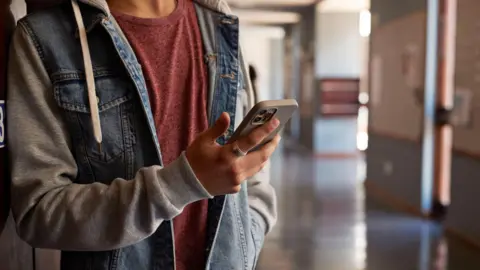
A public consultation on whether to ban social media for under-16s is being launched on Monday, inviting young people and their parents and guardians to submit comments ahead of a government decision on the proposal.
The debate over a minimum age for social media use has been fired up by Australia's decision last year to ban children from a range of platforms including Instagram, Snapchat, YouTube and TikTok.
Technology Secretary Liz Kendall said the consultation would help establish how young people could "thrive in an age of rapid technological change".
As well as gauging opinion on an outright ban, the government wants the public's views on less dramatic interventions.
- Whether platforms should be required to switch off addictive features like infinite scrolling and autoplay
- Whether mandatory overnight curfews would help children sleep better
- Whether children should be able to use AI chatbots without restriction
- How age verification enforcement should be strengthened.
Alongside the consultation, pilots will be conducted testing some of the proposed interventions to provide "real-world evidence" of their effectiveness, the government said.
"The path to a good life is a great childhood, one full of love, learning and play. That applies just as much to the online world as it does to the real one," said Kendall.
"We know parents everywhere are grappling with how much screen time their children should have, when they should give them a phone, what they are seeing online, and the impact all of this is having.
"This is why we're asking children and parents to take part in this landmark consultation," she said.
The government is hoping to prompt a wider public debate on the issue for the duration of the consultation through community events involving MPs, influencers and schools.
"Everyone with a view" is invited to take part, the government said, including parents, carers, young people, those who work with children, civil society organisations, academics and industry.
Different versions of the consultation are available for young people and parents and carers to make them more accessible.
An academic panel is also being asked to assess the growing body of evidence, including from Australia's recent experience.
The consultation will close on 26 May, with the government planning to respond "in the summer".
In the UK, some experts and children's charities have warned against the idea - but it has strong backing elsewhere.
In an open letter to the prime minister, Labour MPs said "successive governments" had done "too little to protect young people from... unregulated, addictive social media platforms".
Conservative leader Kemi Badenoch has previously said her party would introduce an under-16s social media ban if it was in power.
Liberal Democrat education spokeswoman Munira Wilson has said there is "no time to waste in protecting our children from social media giants". She said holding a consultation risked "kicking the can down the road yet again".
The Molly Rose Foundation welcomed the consultation, saying it was a "crucial opportunity to decisively strengthen online safety laws and stand up for children and families".
The charity was established by the family of Molly Russell, who took her own life in 2017 at the age of 14 after viewing self-harm and suicide content on platforms including Instagram.
But several other charities and campaign groups, including the NSPCC, have said a full ban on social media for under-16s risks "unintended consequences" and have called instead for stronger enforcement of existing child safety rules.
"It would create a false sense of safety that would see children - but also the threats to them - migrate to other areas online," the organisations wrote in a joint statement in February.
Sonia Livingstone, a professor of social psychology at the London School of Economics, told the BBC: "What everyone wants to see is better safety from Big Tech companies, and then children could express themselves and connect online as they want to."
Social media platforms have come under more scrutiny recently as governments and regulators study the effects their content and design have on children's wellbeing.
In February the EU told TikTok it must change its "addictive design" or face heavy fines, a move which the Chinese-owned platform said it would challenge.