3 months ago
46
3 months ago
46

Just now
Ruth CleggSenior health reporter

 BBC
BBC
"Get ready with me to go to my best, best friend's house," Ellie-May says enthusiastically at the camera.
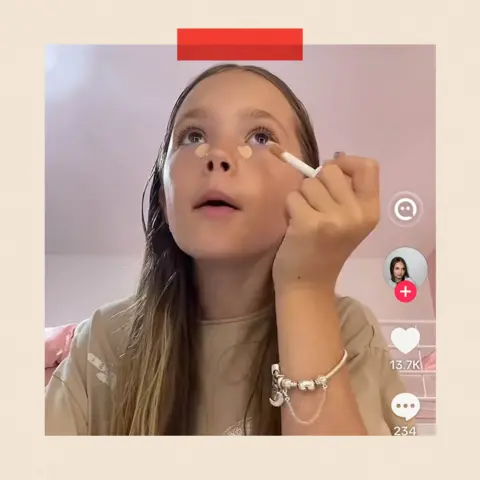
The then 10-year-old smiles and explains her multi-step skincare routine on TikTok.
"I love, love, love, love, love this toner," she says, as she rubs the translucent liquid into her skin. Next, it's a serum designed to make your skin glow, "Oh my god it's so glowy," she gushes.
She makes a "smoothie" out of her fluffy yellow cream, rubbing blobs on the back of her hand and mixing it with a tinted moisturiser.
As she talks, she carefully dabs concealer under her eyes and adds some pink blush and highlighter to her cheeks. Then she curls her lashes and applies mascara and lip gloss.
She's ready, she says, well, shortly after she's blow dried and straightened her hair.
Ellie-May is now 13. She's been using skincare and advertising it since she was eight years old. What began in lockdown as a bit of fun has become a main source of income for her family. They have social media accounts across Facebook, TikTok, YouTube and Snapchat. Ellie-May's own TikTok account has more than 330,000 followers.
Her mum Sophie, who has five other children, says they make over £50,000 a year from posting content on their various platforms.
"Being content creators has transformed our lives," Sophie says as they sit on a video call with me outside their house in the south east of England. "So many other young kids just wanted to know about Ellie's skincare routine and, well, it just took off."
 Sophie
Ellie-May's TikTok account has more than 330,000 followers
Type in the words "children and skincare" into various social media search engines and you won't struggle to find videos of hundreds of other young girls - some as young as three or four - enthusing over skincare products and make-up, or doing "get ready with me" or "after school" skincare videos where they talk about their plans for the day while using cosmetics.
Skincare products being marketed to girls is nothing new. While the scrubs and cleansers of past decades promised a spot-free complexion, girls today are using a wider variety of sophisticated products - many of which contain anti-ageing ingredients - in the hope of achieving flawless skin.
Some girl skincare influencers describe themselves as "brand ambassadors", showcasing products from the likes of Bubble, Drunk Elephant, and P. Louise. There are K-Pop Demon Hunters-themed skincare packs for a "glow-boosting routine" for "skin that looks luminous".
While there are products clearly targeted at children, there are also brands that are popular with young people, which say they do not want to be associated with this part of the market. A source close to Drunk Elephant, for example, says it is not a "youth-focused" brand, and that it is trying to educate its customers about how to use its products responsibly.
Bubble and P.Louise did not respond to requests for comment.
As well as young influencers like Ellie-May, there are many more young girls who have multi-step skincare routines embedded in their day. A snapshot by Pai, a skincare brand, of 1,500 nine-to-12-year-olds suggests that nearly half are using multiple skincare products weekly, with half of those saying that they use it to fix what they perceive to be problem skin.
It has become a multi-billion-pound industry. The market is rapidly growing and it is showing no signs of slowing down. But some - including regulators - are calling for caution.
"Women in their 30s and 40s have long been targeted by skincare companies, telling us that ageing is a problem and selling us a solution," Brooke Erin Duffy, associate professor and social media researcher at Cornell University, says.
"But this is a marked shift. Now young girls are being put under that same pressure."
As this industry continues to boom - encouraged by content on social media platforms - is it a bit of harmless fun or are girls being permanently conditioned to think there is something wrong with the way they look? And what does it tell us about how girls today think of themselves?
A new term has been coined by dermatologists and academics: cosmeticorexia, which they define as having an unhealthy obsession with achieving "flawless" skin from a young age, leading to an obsessive use of cosmetic products. Prof Giovanni Damiani, an Italian dermatologist from the University of Milan (IT), was so perturbed by what he saw as the compulsion of some of his younger clients he began to investigate what was happening.
He interviewed 55 of his patients, aged between 8 and 14 years old. Those who displayed signs of cosmeticorexia, he explains, were mobile-phone obsessed, and would spend hours watching skincare videos on social media. They would also use up to 10 different skincare products daily, and they would not socialise - even with family members - without wearing make-up.
 Getty Images
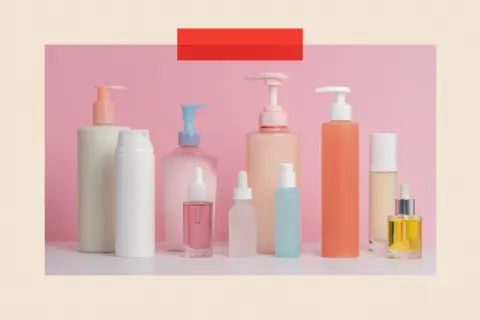
Skincare has become a multi-billion-pound industry
The Italian Competition Authority (AGCM) has just launched two investigations into the beauty company, LVMH, which owns the Sephora and Benefit cosmetic brands. The AGCM is examining whether the brands failed to make it clear that their products are not intended for children and adolescents, and whether they are encouraging their purchase through "covert marketing strategies involving young micro-influencers".
A spokesperson for LVMH says it is cooperating with Italian authorities and it "reaffirms" its "strict compliance with applicable Italian regulations".
The spokesperson added that "as conversations around younger consumers and skincare continue to evolve", they are continually enhancing "the quality of advice provided by our beauty consultants to better support and guide all our consumers".
LVMH does not have any products or marketing campaigns "specifically targeting young people" and they only work with influencers over the age of 18, they said.
The Advertising Standards Agency (ASA) in the UK says it is monitoring developments in Italy closely and it's confirmed that it is looking at whether there is evidence of similar issues occurring, although it says, "we're not taking any formal regulatory action at this stage".
These products are not cheap. One study examined 100 TikToks made by under 18s, and found that the average cost of the skincare routines they had posted was £125. Depending on use, they might need to be replenished every three or four months.
Cleanse, tone, prime, moisturise, serum, eye cream, face mist, and repeat, as children - some of them of primary-school age - seek the Korean "glass skin" look.
"The irony? They've already got it - when you're little, your skin is in perfect condition," says consultant dermatologist, Dr Jean Ayer, an NHS consultant and private dermatologist based in Stockport.
"Your skin barrier - which keeps toxins out and keeps moisture in - is beautifully preserved… That's youth, that's the beauty of skin."
Ayer, who has been practicing for nearly 20 years, says more children than ever are now using cosmetics. Her consultations vary massively, on one end of the spectrum she has parents asking her for the best skincare regime for their young child, to children as young as eight coming into her consultation room with severe reactions to the beauty products they've been using. She says parents are often horrified, but they can't convince their child to stop using so many different products.
"It is quite terrifying," Dr Ayer says, "This stuff is designed for the anti-ageing market. At best, they don't need these products. At worst, they contain harmful ingredients that can damage delicate young skin."
She says she's seeing an increase in younger clients with acne and contact dermatitis - a type of eczema triggered by contact with a certain substance - due to the various ingredients in these skincare products being used by children.
Many of them contain active ingredients which can have a biological effect on skin cells, therefore changing how the skin functions. One of the most powerful is retinol, which works by speeding up skin cell turnover, which can help reduce fine lines and wrinkles. In children, this process is already happening at a high rate, so retinol offers no real benefit and can overstimulate the skin.
This can lead to "retinol burn" where their protective skin barrier gets damaged. Children can end up with soreness, eczema‑like rashes or long‑term sensitivity.
There are many other ingredients in these products which can potentially harm young skin, Ayer warns, and that once a child develops a contact allergy, they may not be able to ever use a product containing that ingredient without a reaction.
She says dermatologists are also seeing an increase in young people with frontal fibrosing alopecia, where the front hairline starts to recede. She says there is a small but growing school of thought which suggests that this could be down to the surge we are seeing in the application of various face creams at such a young age.
The UK cosmetics industry says it recognises that advice and support is needed to make sure that young children are using age appropriate products. The Cosmetics Toiletry and Perfumery Association (CTPA), which represents many skincare companies, has recently released a guide for parents after carrying out a survey where 40% of parents asked - nearly 1,000 - admitted to knowing less about skincare than their child.
Dr Emma Meredith, director-general of the CTPA, says it does not support young people using anti-ageing products or complex and unnecessary routines.
"Our aim is to ensure that products are used appropriately for each age range, helping young people understand how to develop healthy and age-appropriate skin hygiene habits and supporting parents in discussions with their children," she says.
Ellie-May's mum, Sophie, says she checks the ingredients in her daughter's products. Some people have criticised her on social media for letting her daughter unbox creams that contain strong chemicals such as retinol, but, she says, she knows it's harmful and she won't "let it anywhere near" her daughter's skin. She is also careful not to reveal details such as where her daughter goes to school or where they live, and keeps a close eye on replies that are sent to their accounts.
 Sophie
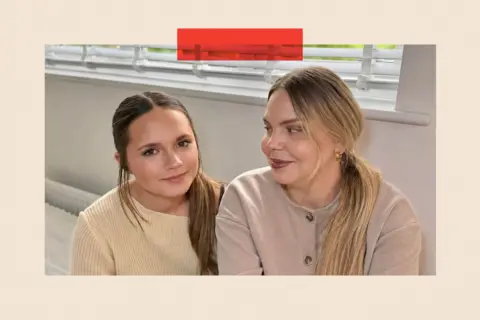
Ellie-May's mum Sophie says she checks the ingredients in her daughter's products
Ellie-May attends brand launches with big beauty companies, where she tries different products and mixes with other content creators, which she says is fun. She and Sophie are preparing to launch their own vegan skincare brand, targeted at the younger end of the market.
Ellie-May seems both older and younger than 13. She is softly spoken, thoughtful and articulate, sometimes looking to her mum for answers. She has long, manicured nails and she's wearing make-up, but it's natural-looking. "Wearing make-up now makes me feel normal," she says.
While Sophie says their success on social media has enriched their lives, there is concern from some psychologists that these self-aware, social-media-savvy, beauty-obsessed young people will grow up with a distorted view of how they should look and how they should be in life.
Alberto Stefana is an Italian psychologist who co-wrote a paper on cosmeticorexia with Damiani. He says children are "developing their self-identity" and they might struggle to "accept their true image" as they grow older.
"The children who become obsessed with skincare tend to be driven by what they see on social media.
"So their self-esteem becomes based on how many likes they get or what people have said in their comments."
As so-called cosmeticorexia is such a recent phenomenon, it is difficult to know the if there are any potential long-term psychological impacts, but Stefana says his latest research indicates there are crossovers with body dysmorphic disorder (BDD), a mental health condition that causes persistent and intense shame and anxiety over perceived body defects.
And even now, at such a young age, he warns, he has seen signs of anxiety and embarrassment in children as young as seven or eight years old who are displaying symptoms of cosmeticorexia.
He says it can be so acute that "they do not want to go to school, because they feel so much shame. And that shame comes from comparing themselves to others on social media and not feeling beautiful enough."
 Getty Images
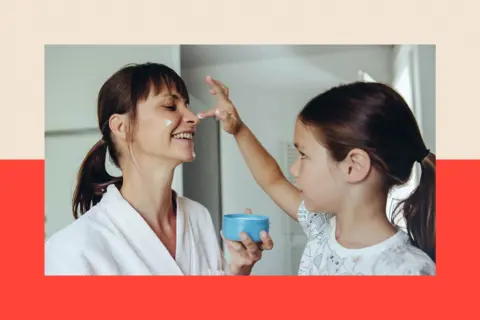
"Women in their 30s and 40s have long been targeted by skincare companies," says Brooke Erin Duffy
Jessica Ringrose, a professor of sociology of gender and education at University College London, agrees. "Children are seeing this content and then thinking it represents the 'good life', the ideal way of being.
"And if they can't achieve this 'perfect look' or this 'perfect life' that's being sold to them then they think they are failing in some way."
TikTok says it has special safeguards to protect teenagers online and it does not allow targeted advertising to under 18s. It also says it gives support and information to parents to help keep their children safe and that it regularly hears from teenagers about how to improve its offer through the platform's youth council. It also says that young people also use TikTok as a way of educating themselves about skin health with dermatologist-backed advice.
Meta, which owns Instagram and Facebook among other platforms, did not respond to a request for comment.
Ringrose and the other experts I have spoken to say this is not just an issue with social media companies, the responsibility also lies with the skincare brands selling the products and the parents themselves.
Ringrose adds: "When you have a child acting as a brand ambassador and promoting this world to other children it legitimises it."
But at the same time, we live alongside, and often inside an ever-expanding digital world. Isn't this just an added, but inevitable complexity of growing up? Children - and in this case, young girls - are just learning a way of surviving, maybe even thriving, online?
Stefana disagrees, he says children and young people are spending so much time and money striving towards a look, an aesthetic, that only exists in the digital world, not in reality.
"Even the idea of what is attractive and what is unattractive is becoming warped," he says.
"The filters and the use of AI on social media posts mean some of the images children are seeing are not even real, so they are aspiring to something that does not even exist."

BBC InDepth is the home on the website and app for the best analysis, with fresh perspectives that challenge assumptions and deep reporting on the biggest issues of the day. Emma Barnett and John Simpson bring their pick of the most thought-provoking deep reads and analysis, every Saturday. Sign up for the newsletter here