
 7 months ago
31
7 months ago
31

Faisal IslamEconomics editor

 Getty Images
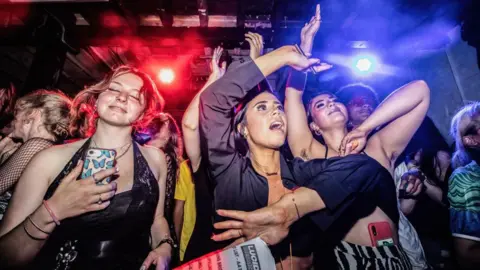
Manchester is known for its music scene
There is a buzz around Manchester that is difficult to truly understand unless you spend time there. It seems an entirely different space to the general despondent economic vibe across much of the country.
I was born and brought up in Manchester, wrote my first pieces of journalism about grand regeneration plans from the late 1990s and even I am shocked by how strategies put in place decades ago, and supported by central governments across the political spectrum, are now flowering.
At a time when the UK economy has been spluttering along for some years, this place smells of growth, and it looks like growth too.
Look up and there are cranes and dozens of new skyscrapers. Look down and there are thousands of young workers, graduates and apprentices, local and global, who work in offices and facilities, that were simply not there a decade ago.
At a BBC roundtable of local business leaders last week, the messages sounded like a different era and a different country to much of what we hear.
Sean Morton, chief executive of the London-listed but Manchester-based On the Beach, said the pace of development of the central Ancoats district has been "staggering".
Lawrence Newman, chief executive of Beauty Tech Group, pointed to the city's five universities and "the stickiness of people wanting to live here post-university".
And Emma Thackray of drinks manufacturer Hip Pop said Manchester's burgeoning food and hospitality scene meant "it's a place where a brand like us, in a new and emerging drinks category, can really test and trial".
 Getty Images
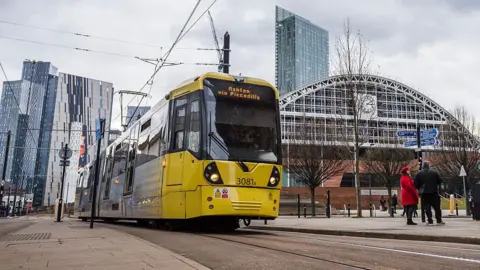
Manchester's tram system has seen rising passenger numbers
Buzz is the right word for a city that has the bee as its emblem, and the numbers behind the anecdotes are solid. At 3.1% annual growth sustained over 10 years, Manchester's economy has performed twice as well as that of the UK as a whole.
The transport infrastructure is filling up with the Metrolink tram system setting repeated records for usage. The much-derided delayed opening of a new music arena has now given way to the city's hotels and bars being kept busy throughout the week with concert goers.
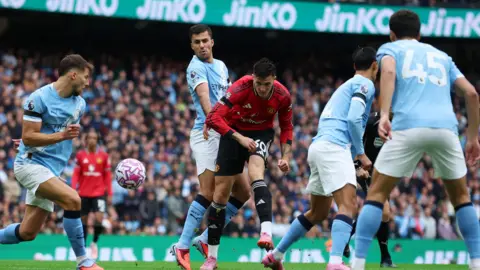
At heart it has been an exercise in what economists call "comparative advantage" and "agglomeration" - a collection of things. Manchester has young people, workers, space and lots of globally important cultural assets, from music to football and cycling.
Above all, it has long had Europe's biggest university campus. Everything comes back to this. The knowledge and the educated workforce are the essential raw ingredient upon which this growth has emerged. By some way, the University of Manchester has the highest number of applications in the UK.
Until the past decade, what was missing was the good jobs to keep a critical mass of that attractive workforce in the city. But now the city boasts major hub employers such as Bank of New York, IBM, Booking.com, and government services such as GCHQ.
In turn, that has helped create and sustain service-sector businesses and jobs too, especially to a previously sparsely populated city centre.
Overall Manchester's population increased by 9.7% between 2011 and 2021.
The centre of Manchester is now believed to have a population of around 100,000, and some developers see that reaching 250,000 by 2035. For context, in 1990 it was put at just 500.
 Getty Images
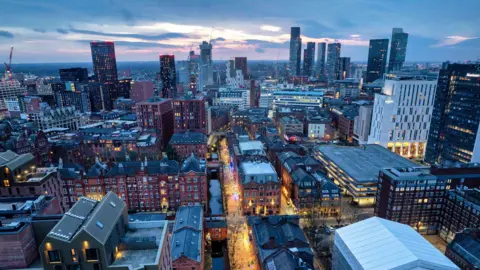
Many of the city's tallest building were not there 10 years ago
Manchester has had a boom in high-rise blocks in recent years. New developments piercing the grey sky is something the Mayor of Greater Manchester, Andy Burnham, points out to me as he reveals a reversal in the trend of educated young northerners making the journey "down south".
"I was part of the influx out in the 80s, when people had to leave here to get on in life. Now we have a net inflow of young Londoners into Greater Manchester, which, we're really proud about."
In 2024, the latest year for which there is official internal migration data, 13,000 Londoners moved to Greater Manchester, more than the 11,800 making what was the more typical journey the other way.
"It's an exciting proposition for any young person, in terms of city-centre living and everything that comes with that, in terms of the music scene here, and obviously, a new public transport system that makes makes living here affordable," says Burnham.
The trends in productivity are also interesting. The city of Manchester has seen incredible growth in the size of the economy per head, so taking into account rising population. The measure of GVA (gross value added) per capita was £61,589 in 2023, almost trebling since the turn of the century.
Burnham was at pains to acknowledge the cross-party backing received from central government over decades - from Labour, the Conservatives and the Conservative-Lib Dem coalition - and from within the collection of councils that make up the Greater Manchester Combined Authority.
 Reuters
Football teams City and United are two big cultural assets for the city
Some important business voices who have questioned economic policy at a national level, for example on National insurance and strengthened workers rights, do say that the mayoral ability to coerce and hold together economic enthusiasm has greatly helped Manchester's growth.
It was George Osborne who created the combined mayoralties and started the transfer of what might have appeared relatively modest powers, over transport for example.
Clearly every city retains the problems of 21st Century urban life. Homelessness in particular has been stark, with Shelter calculating 1 in 61 people in the city experiencing homelessness, higher than almost anywhere outside of London. It is the flipside of growth in property developments. While new social housing is being built, is there enough of it and other public services to sustain rapid increases in population?
And then there are the problems about how much this new prosperity spreads beyond the city centre to the towns and villages across Greater Manchester.
Burnham is also trying to use the city's sporting cachet to attract the globe's biggest contests. A Great North Olympic bid was announced last week with cross-party support from fellow mayors, keen to upend the logic that the International Olympic Committee would only give a UK Games to London.
 Getty Images
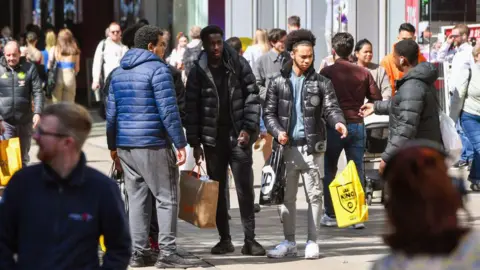
Market Street is one of Manchester's main shopping destinations
But could the Manchester model really apply across the country? There are certainly lessons about having a plan and a strategy, buying in cross-party support for long-term decisions, and involving public and private sectors.
The role of universities and transport investment is also critical, but not every town and city in the UK has the same raw materials, for example in terms of sheer number of young graduates. There are limits here.
Andy Spinoza, who wrote Manchester Unspun, a detailed account of the city's recent transformation told through the lens of popular culture, says the city has "a unique hand".
"Devolution, airport, universities, diverse economy and culture. Whatever Manchester-ism is, it is a special sauce hard to replicate elsewhere."
He points to the near half a billion pounds paid in dividends over two decades from the partly council-owned international airport, and the role of former council leader Richard Leese and chief executive, the late Howard Bernstein.
"As city region mayor, Andy Burnham has added public control over transport and skills to bootstrap some benefits from the boom for Mancs, but it's a familiar refrain that priced-out residents need to feel it trickle down to them and the outer towns," he adds.
Manchester's growth should give pause for thought to much of the rest of the country. Something important is happening here, outside of the obsessions and daily ups and downs of Westminster. And it shows the returns to ambition, boundless optimism, and sense of long-term strategy. The Mancs are on to something.
Additional reporting by Jeevan Nerwan


