46 minutes ago
3
46 minutes ago
3

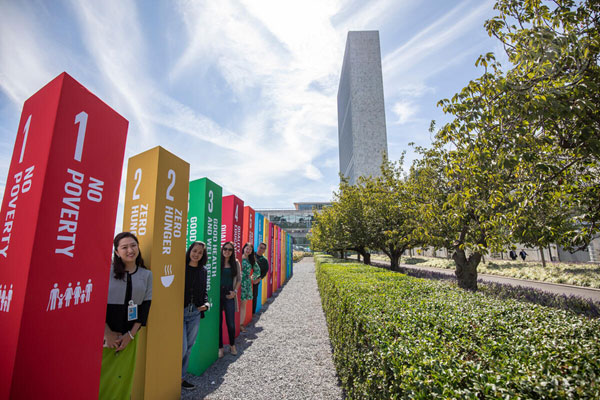 UN staff members at the SDG Action Zone outside UN Headquarters in New York, 2019. Credit: UN Photo/Laura Jarriel
BRUSSELS, Belgium / MONTEVIDEO, Uruguay, September 9 (IPS) - When the UN High-level Political Forum on Sustainable Development (HLPF) ended in New York in July, it took two recorded votes for states to pass a ministerial declaration that, until recently, would have been adopted without controversy. Uruguay, speaking for the Group of 77 developing countries plus China, pushed through the deletion of a reference to the agreement reached at the COP28 climate summit. Israel forced a vote on a paragraph about self-determination for people under occupation. Russia dissociated itself from the passage on peace and security. The wrangling revealed the extent to which the consensus that in 2015 saw all 193 UN states agree the Sustainable Development Goals (SDGs) – a common blueprint to end poverty, tackle climate change and build accountable institutions by 2030 – has been eroded.
The problem goes beyond this latest session. Progress is tracked through Voluntary National Reviews, the self-assessments states present at the Forum. Thirty-six countries did so this year. But the process asks nothing of states beyond showing up. There’s no independent verification of data, and governments aren’t required to consult civil society. States that restrict civic space at home face no consequences. Seventeen of the 36 states that presented reviews this year are rated by the CIVICUS Monitor as having repressed or closed civic space.
A forum built to hold states accountable has become a stage on which the least accountable governments may perform compliance, while the civil society groups meant to keep them honest are locked out of the room.
In the room but not at the table
Where civil society can act, it supports delivery of the SDGs. Sustained advocacy delivered Colombia’s ban on child marriage in 2025 and continues to drive the campaign against female genital mutilation in The Gambia. In Nepal, local organisations have made monitoring the goals more inclusive by supplying data on excluded communities that official statistics miss.
Yet the HLPF gives civil society little formal standing. Civil society was in the building all week — CIVICUS co-organised sessions on civic space and the SDGs, supported a global forum on the future of multilateralism and ran a workshop on the post-2030 agenda — but it didn’t get a seat at the table where decisions are made.
Showing up can also be dangerous. In 2025, most civil society representatives from El Salvador withdrew over fears of reprisals. Activists elsewhere describe reprisals for exposing gaps between official reporting and reality on the ground, often with little practical support from the UN despite guidelines that are supposed to protect them.
SDG 16 on peace, justice and strong institutions is meant to be the foundation for the other 16 goals, and its Target 16.10 commits states to protecting fundamental freedoms. But it’s routinely ignored. The CIVICUS Monitor has tracked year-on-year regression in civic space conditions since the SDGs came into effect. Where civil society can’t operate freely, it’s no surprise if the goals it should help implement and monitor aren’t being met.
Falling short
The UN Secretary-General’s 2026 report on the SDGs made clear how delivery is falling short. It found that out of 139 targets with reliable trend data, only 15 per cent are on track, while a further 15 per cent have regressed below their 2015 baselines.
But rather than take responsibility for their failures, powerful states are using the lack of progress as a pretext to demand less ambition. The USA has dismissed the SDGs as an infringement on national sovereignty. Speaking at an event during the Forum, Russia’s representative said that the goals’ ambitions had proven ‘quite far away from reality’, blaming the design of the goals rather than states’ failure to deliver. For many states, an ambitious rights-based agenda is no longer a promise to keep, but a commitment to be backed away from.
Yet evidence suggests that when political will exists, change can come. The UN’s Asia-Pacific review presented at the HLPF showed that the number of children in child labour fell from 49 to 28 million between 2020 and 2025. What holds back achievement of the SDGs is not flawed design, but political choices.
As negotiations begin on what comes after the goals’ 2030 deadline, some states and UN officials favour extending the current goals, on the reasonable logic that reopening them in today’s political climate risks producing something weaker. But the framework agreed in 2015 wasn’t built for a world of growing authoritarianism, accelerating climate breakdown, coordinated backlash against gender equality, increasing militarisation, collapsing multilateral cooperation and rapid technological development. A post-2030 agenda will have to take account of all this, along with the financial strain on the multilateral system.
Forus, a network of national civil society platforms, has mapped three scenarios for the post-2030 process – continuity, reset or fragmentation – and insists that whichever prevails, accountability, civic space and financing reform must sit at the centre. Several upcoming moments will reveal the direction of travel. Next year’s Commission on the Status of Women and Economic and Social Council’s Youth Forum, along with the SDG Summit and the 2028 Pact for the Future review, all offer opportunities that must be seized to bring civil society into the process, identify where implementation is failing and match ambition with achievement.
Samuel King is a researcher with the Horizon Europe-funded research project ENSURED: Shaping Cooperation for a World in Transition at CIVICUS: World Alliance for Citizen Participation.
Inés M. Pousadela is CIVICUS Head of Research and Analysis, co-director and writer for CIVICUS Lens and co-author of the State of Civil Society Report. She is also a Professor of Comparative Politics at Universidad ORT Uruguay.
For interviews or more information, please contact [email protected]



© Inter Press Service (20260909161910) — All Rights Reserved. Original source: Inter Press Service