5 months ago
20
5 months ago
20

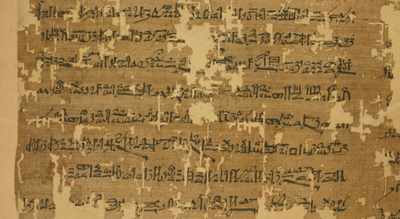
Resurfaced 3,300-year-old Egyptian document hints at biblical giants being real/ Image: British Museum
A 3,300-year-old Egyptian manuscript held by the British Museum has resurfaced at the centre of a renewed debate over whether the Bible’s references to giants were rooted in historical encounters rather than myth.
The document, known as Anastasi I, has been in the museum’s collection since 1839 but has recently drawn fresh attention after being highlighted by the Associates for Biblical Research, a faith-based research group in the United States.The papyrus, dating to the 13th century BCE, is a letter written by an Egyptian scribe named Hori to another scribe, Amenemope. It describes the dangers of travel and warfare, including encounters with a group known as the Shosu.
According to the text, some of these people were described as measuring “four cubits or of five cubits, from head to foot,” a height that, using the standard Egyptian cubit of roughly 20 inches, would place them between about six feet eight inches and eight feet six inches tall.
Biblical parallels and scholarly scepticism
Supporters of the biblical link also point to the wider context of Genesis chapter six, which frames the Nephilim as central to the moral collapse that precedes the story of Noah and the Flood.
The passage describes the Nephilim as “mighty men which were of old, men of renown”, born at a time when God saw that “the wickedness of man was great in the earth”, prompting the decision to cleanse creation through floodwaters, sparing only Noah and those with him in the ark.
In this reading, the giants are not a footnote but part of the explanation for why the Flood occurred at all. The theme resurfaces in Numbers 13:33, where Israelite scouts report encountering the “sons of Anak”, saying: “We were in our own sight as grasshoppers, and so we were in their sight,” reinforcing the idea that unusually large and fearsome figures were remembered as shaping early biblical history.
Ancient text or exaggerated warning?
The Anastasi I letter states: “The narrow defile is infested with Shosu concealed beneath the bushes; some of them are of four cubits or of five cubits, from head to foot, fierce of face, their heart is not mild, and they hearken not to coaxing.” Researchers at the Associates for Biblical Research argue that the passage is significant because the letter places a strong emphasis on accuracy and real-world hazards, suggesting it was not intended as fantasy.
Other ancient Egyptian sources are sometimes cited alongside it, including the Execration Texts, which refer to “people of Anak”, and reliefs from the Battle of Kadesh that depict Shosu figures as unusually large. However, many historians and biblical scholars urge caution. Critics argue that Anastasi I is widely understood as a satirical or instructional text, with Hori mocking Amenemope’s lack of knowledge about geography and military logistics rather than recording literal ethnography.According to the Daily Mail, the late scholar Dr Michael Heiser and others noted that heights approaching seven or even eight feet, while rare, are not unknown among humans today and do not require a supernatural explanation. Mainstream historians identify the Shosu as a nomadic group from the Levant and stress that there is no archaeological evidence, such as skeletal remains or oversized dwellings, to support the existence of a race of giants.The British Museum itself treats the papyrus as a historical document illustrating aspects of military life and travel in the ancient Near East, and does not draw conclusions about biblical giants. As with many ancient texts, the debate ultimately rests on interpretation, and on how much weight should be placed on a single evocative line written more than three millennia ago.