4 months ago
32
4 months ago
32

Norberto ParedesBBC News Mundo, Caracas, Venezuela

 BBC
BBC
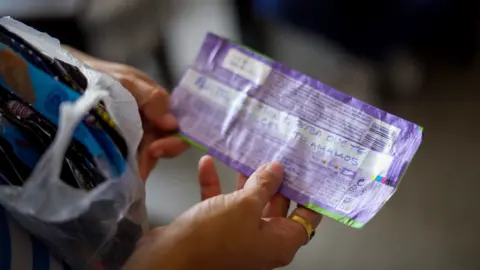
Ángel Godoy's family smuggled a message to him inside the wrapper of a chocolate bar
In a small flat in a social housing complex near Caracas, Adriana Briceño holds up what looks like a piece of rubbish, but hidden on the old chocolate bar wrapper is a message.
The words scrawled on it were written by her son and are addressed to Ángel Godoy, the boy's father and Briceño's husband, while Ángel Godoy was a prisoner in Venezuela's notorious El Helicoide jail.
"Daddy, take this to sweeten things a little," reads the blue ink. "We love you."
Originally built in the 1950s as a luxury shopping centre, El Helicoide was never completed and was later taken over by Venezuela's feared intelligence services.
It became a symbol of government repression.
A United Nations investigation documented it was where people who had been arbitrarily arrested or forcibly disappeared were taken and, in some cases, tortured.
Recently released detainees like Godoy have described brutal conditions in interviews with the BBC.
He is one of the hundreds of political prisoners arrested under President Nicolás Maduro and held in Venezuela's vast detention system, sometimes for years.
More than 600 people have been released since Maduro was seized by US forces in a military operation at the start of January, but according to prisoners' rights group Foro Penal, hundreds more are still behind bars.
Godoy is one of two inmates who has described to the BBC the punishment cells, enforced isolation and threats to family members that they faced before they were released.
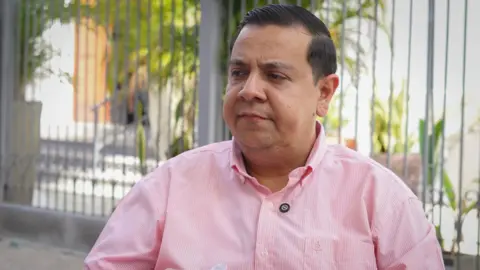
Rights activist Javier Tarazona was held for 1,675 days
"They handcuffed me, beat me, insulted me, and put a balaclava on me as they put me inside a patrol car," says rights activist Javier Tarazona, as he describes the moment he was arrested in July 2021.
He knew he was on the radar of Venezuela's state security agencies, but he still found it difficult to process what was going on.
"The first few hours were terrible," Tarazona says, recalling the beginning of an ordeal that would last more than four and a half years.
After his arrest, he was taken to a tiny punishment cell, where all new prisoners were sent. It was infested with rats and cockroaches, and smelt "nauseating".
Tarazona, the head of human rights NGO Fundaredes, came to the attention of the authorities because he had called for a formal investigation to be launched into alleged links between high-ranking Venezuelan government officials and guerrilla groups in neighbouring Colombia.
He was arrested alongside his brother, José. The pair were held together with another activist in a tiny cell.
The room was so small, they had to take turns if they wanted to lie down, and placed a piece of cardboard over a sewer hole as a makeshift mattress.
Prisoners' rights group Foro Penal says these small punishment cells, known as "little tigers", are a common feature of the Venezuelan prison system.
"We spent 46 days there," Tarazona says. "Then they decided to move us to another space off the same hallway, which was a little bigger, but just as disgusting - just as depressing."
They could not see daylight and had no way to work out if it was day or night. The guards used to give them meals at irregular hours to mess with their sense of time, he adds.
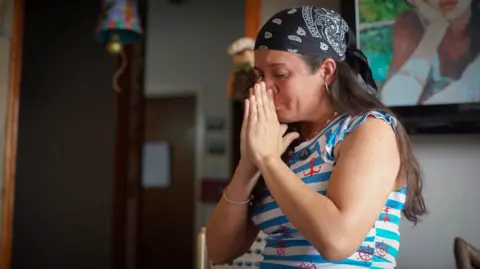
Adriana Briceño passed messages to her husband, Ángel Godoy, in prison on sweet wrappers
For Godoy, the biggest strain was not the conditions he was kept in but being separated from his loved ones - "the torture of not knowing where your family members are, how they are, because they cut you off - they isolate you from the world".
The political activist says he was detained without warning outside of his home by a large group of security officials.
He was then held without any contact with his family for 96 days. "I have to assume the aim is to break you," he says of that period.
After more than three months had passed, he says one of the prison staff told him that the authorities were considering allowing his wife, Adriana, to phone him, but only if she agreed to tone down her presence on social media and in the press.
Adriana Briceño says that following her husband's arrest she was fired from her job at the state-run telecoms company without being given a reason, even though she had worked there for 21 years.
She said that being alone at home with her son made her feel so vulnerable, she decided to move. "I was terrified that people might show up and break into my home."
For the first few weeks after her husband's arrest, she did not even know where he was being held.
It took 25 days for officials to finally confirm that he was inside El Helicoide, and only then was she allowed to take him clothes, medicine and bed sheets.
It took even longer - 96 days - for her to be granted regular visits.
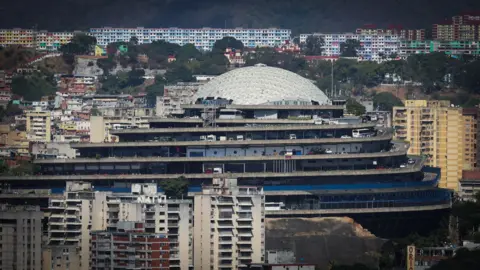 Miguel Gutiérrez, EPA/Shutterstock
The spiral-shaped El Helicoide building was designed to be a shopping centre, but ended up becoming a notorious prison
Tarazona says his family also came under pressure from the authorities.
"In the middle of an interrogation, an official said: 'Do you know this woman?'"
The official was holding a photo of Tarazona's 70-year-old mother, whom authorities had arrested.
Tarazona says the man then issued a threat: "Give me the video I'm asking for, or your mother will go to jail."
The prison authorities wanted Javier to agree to be recorded accusing other activists of committing crimes.
"I always refused," he says. "I always refused because I knew my mother would overcome that ordeal." Hours later, she was released.
Another issue weighed on Tarazona's mind, though. He felt responsible for his brother ending up in jail alongside him.
His brother was not part of the NGO Tarzona had been running. He had just been driving him on the day of the arrest.
"I felt a great deal of guilt," Tarazona explains. "My brother kept telling me that because of my fight, he was paying for something that wasn't his responsibility. And that was a burden."
Both Tarazona and Godoy deny committing any of the crimes they were accused of and say they never received proper legal representation after they were detained.
Tarazona says he was denied the right to hire his own lawyer and was only allowed to see a court-appointed one seven months after he was imprisoned, even though he was facing charges of treason, terrorism, and incitement to hatred.
During his 1,675 days in detention, he says he saw a lawyer fewer than five times.
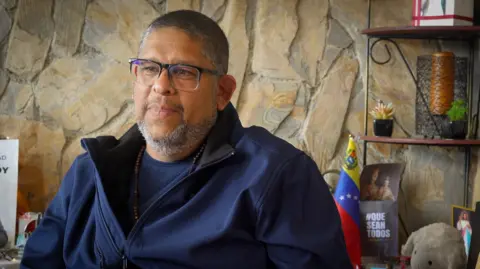
Ángel Godoy says being isolated from his family was the worst part of his ordeal
Godoy was charged with terrorism, hate crimes, and incitement to armed action, but says he never saw the case file against him and never knew who his defence lawyer was, despite being held for over a year.
BBC Mundo contacted Venezuela's attorney general, the ministry of information, and the ministry of defence for comment on the allegations made by former prisoners, but had not received a response by the time of publication.
Tarazona says he has not allowed the experience to make him angry. During his imprisonment, the guards discovered a book and some letters he had been writing.
As punishment he was placed in an isolation cell.
"I found light in that ordeal and from that pain," he explains. "I found an opportunity to reflect and work on forgiveness.
"I left convinced that Venezuelans need to move towards reconciliation, to come together again, because this situation we are living through is a tragedy, a trans-generational trauma."
Back at her family home, Adriana Briceño holds up an old T-shirt with a few sentences scrappily scrawled on it in pen.
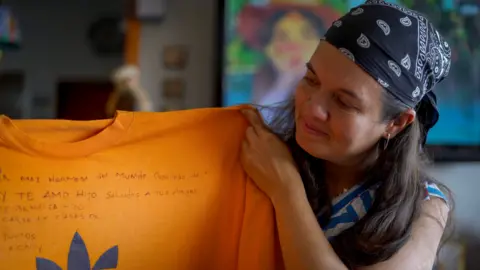
Adriana Briceño holds up a T-shirt with a hidden message on it that was sent to her by her husband while he was in jail
The messages on chocolate bars were how the family would send notes to Godoy in prison, and this was how he would reply – by writing on dirty laundry taken out of the jail.
"Adriana, you are the most beautiful woman in the world," it reads. There is also message to his son: "Go and excel in your classes, okay?"
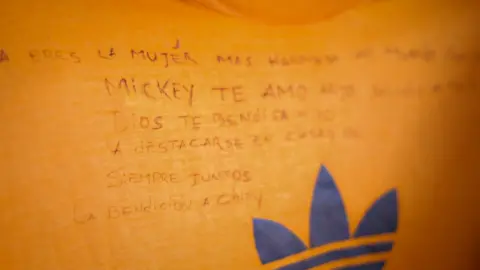
A hidden message written on a T-shirt by prisoner Ángel Godoy for his family
"Ways of sending messages like this emerged in El Helicoide," Godoy says. "They served as a bridge between many prisoners and their families."
Though he had been allowed visits from his wife following the agreement they made with authorities, these secret, personal messages still meant a lot to them.
Venezuela's interim president, Delcy Rodríguez, told the country's parliament in January that El Helicoide would be turned into a social, sports and cultural centre for police families and communities in the surrounding area.
While the release of prisoners from the jail has been welcomed, some rights groups have described this move as an attempt to whitewash the facility's past.
Like Tarazona, Godoy hopes the country can move forward peacefully.
"After all that abuse, after all that cruelty, after all that evil, it seems unbelievable that I'm asking people, [that] I'm asking my fellow political prisoners, too, to get that out of here, out of our hearts," he says. "Every trace of hatred, of resentment, of bitterness, of discontent."
"Let the country's interests come first, regardless of political party or ambition. Let us move forward without hatred, resentment, or bitterness to build that wonderful Venezuela."
Produced and edited by Peter Ball