1 month ago
36
1 month ago
36

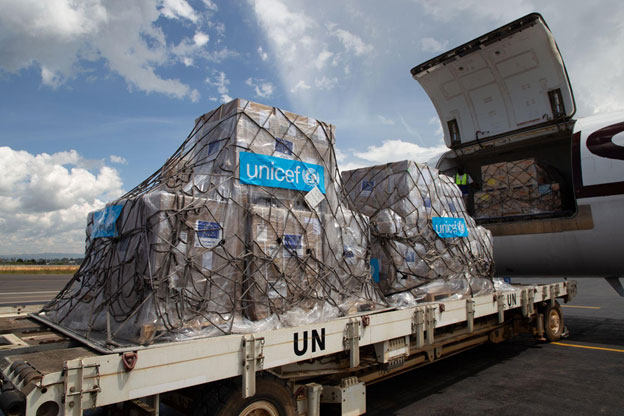 UNICEF unloads emergency humanitarian supplies in the Democratic Republic of the Congo in response to the Ebola outbreak. The shipment includes protective equipment, hygiene kits, medicines, and medical supplies to support frontline health workers and nearly 100,000 people. Credit: UNICEF/Ndomba Mbikayi
 UNITED NATIONS, July 6 (IPS) - A new assessment from the United Nations Development Programme (UNDP) warns that the Ebola outbreak could cost Africa USD 3.6 billion, push 985,000 people into poverty, and put 300,000 jobs at risk.
The new analysis shows that the damage extends well beyond just those infected, disproportionately harming vulnerable populations and creating trade disruptions, transport delays, border restrictions, declining consumer confidence, along with interruptions to informal markets.
Currently, the Bundibuygo species of Ebola has no vaccine or treatment, and garners a fatality rate around 50 percent. The Democratic Republic of The Congo (DRC) records 1307 confirmed cases and 377 confirmed deaths as of June 30th, according to the DRC Ministry of Health. Separately the US Center for Disease Control and Prevention (CDC) recorded 20 confirmed cases and 2 confirmed deaths in Uganda, along with 1 confirmed case and no deaths in France.
According to Dr Abdirahman Mahamud, Director of Health Emergency Alert and Response Operations at the World Health Organization, the new virus only took 37 days to reach 250 deaths, while in 2014 and 2016, during the West Africa outbreak, it took 78 days, and in 2016-2019 it took 130 days to reach the same amount of deaths. “This is the largest number of confirmed cases in the first month of an Ebola disease outbreak in Africa,” said Dr. Mahamud.
Ahunna Eziakonwa, UN Assistant-Secretary-General and UNDP Regional Director for Africa says “Ebola does not stop at the hospital gate. It affects livelihoods, education, food security, trade, public finances and trust. If we treat this Ebola outbreak solely as a health challenge, we risk missing the much larger development emergency unfolding around it.”
This indicates that this outbreak could affect much more than just health. Rather it can be a challenge for all forms of livelihood, among disrupting the movement of goods, food, and money: the backbone behind resilience.
“Ebola is more than a health crisis. It touches every aspect of daily life, bringing uncertainty and fear.” Says Ugochi Daniesl, Deputy Director General for Operations at the International Organization for Migration (IOM)
UNICEF notes that children make up 15 percent of confirmed cases, and over 25 percent of deaths, making children almost twice as likely to die compared to adults. UNICEF Executive Director Catherine Russel says that “Children are especially vulnerable because they depend on caregivers and cannot distance themselves from a sick parent or sibling in the same way that an adult can,” revealing a stark reality where more than 130 children have lost one or both parents in the Ituri region, the origin of the current outbreak.
While much of the outbreak looks dark, the WHO Director General, Dr Tedros Adhanom Ghebreysus said on June 24th, “With support from the WHO and the Africa CDC, laboratory capacity has increased from 30 tests a day at the central laboratory in Kinshasa to over 2000 tests a day in nine labs across three provinces.”
The Director General also said that more than 100 people have recovered since, noting that early detection and supportive care can help patients survive the disease. He added “But we could save many more lives with therapeutics. And preparations are now complete for a trial of two therapeutics that is expected to start in DRC next week (The Week of June 28th). The trial will evaluate whether two antivirals, MBP134 and remdesivir, can help to reduce mortality in patients with Bundibugyo virus disease, alone or in combination. We thank the United States and Gilead Sciences for donating doses for the trial.”
The WHO Director General affirmed that “With early detection and supportive care, many can survive this disease.”
The clinical trial opened enrollment for Ebola patients in the DRC on July 2. The trial is coordinated by WHO, the Institut National pour la Recherche Biomédicale (INRB) in the DRC, the Institute of Tropical Medicine in Belgium, and the University of Oxford in the United Kingdom, in coordination with international research, clinical and humanitarian partners. The trial will be integrated into clinical care, and will allow for additional treatments to be added as they become available.
IPS UN Bureau Report
© Inter Press Service (20260706060404) — All Rights Reserved. Original source: Inter Press Service