43 minutes ago
1
43 minutes ago
1

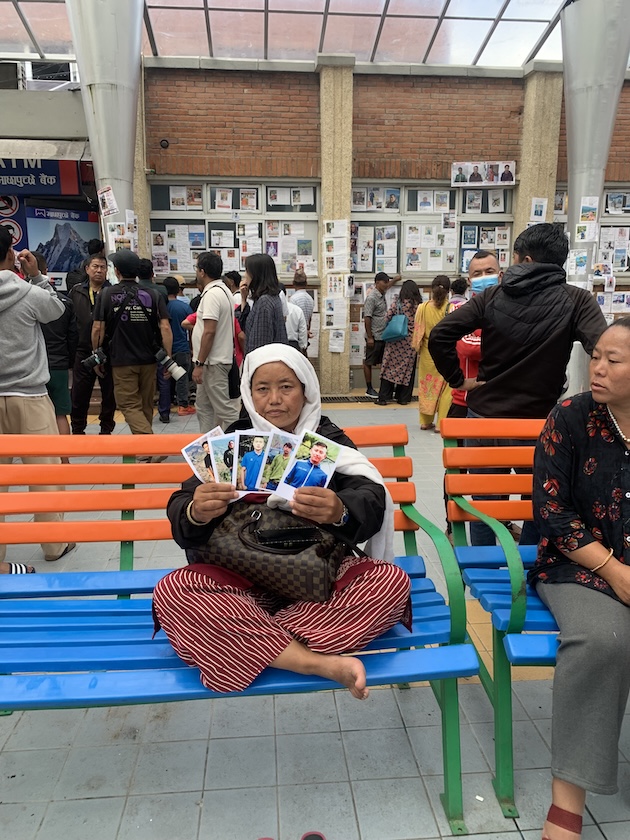 Hit Kumari Tamang searches for missing family members, including her son, at a hospital in Kathmandu, India. Credit: Raman Paudel/IPS
KATHMANDU, September 2 (IPS) - On Sunday afternoon, Mingma Tamang, 29, rushed into the TU Teaching Hospital’s emergency ward, where a rescue team had just brought in an injured person in the Rasuwa flash flood – but she soon left grim-faced.
Mingma, who has been searching for her husband, Manoj Tamang, 20, missing in the flood, moved towards the hospital’s reception area, her eyes circling the wall where hundreds of photos of unidentified bodies hang.
She entered the hospital carrying her husband’s photo in her hand. She again walked out of the gate with tears in her eyes.
After her husband Manoj went missing in the devastating flood, locally referred to as a ‘Himalayan tsunami’, in Rasuwa, Nepal, one of the major ports to China, she spent each day trudging through the hospitals’ emergency wards and mortuaries in the capital, Kathmandu.
With her head covered by a colourful flowered scarf (Fulbuttey Rumal, commonly used as a love metaphor in Nepali literature), the newlywed, six-month-pregnant woman has searched in vain.
Living in a small town named Tarkeshwor, located near the capital, Kathmandu, Mingma had bid farewell to her husband, Manoj, with a warm hug last Saturday.
Manoj, a driver by profession, imports freight vehicles from China through the Kerung border in Rasuwa.
“On Wednesday morning, a few hours before the flood in Rasuwa, my husband called me around 7 am (local time). After a short formal conversation, I hung up,” she recalls about the last time she heard his voice.
“When the news of the flood came around 9.30 am local time, I immediately called him, but the phone was already disconnected. Then I called the other members of Manoj’s team one by one, but no one was connected. Finally, my father-in-law answered a call, but at that time he was not in a condition to talk.”
Manoj and his father, Tikaram Tamang (42), and three nephews are in the same profession.
Only Tikaram managed to escape just seconds before the flood came sweeping away thousands.
The death toll, according to the National Disaster Risk Reduction and Management Authority (NDRRMA), is 1,003 with 3,916 people missing, including 583 foreign nationals. China reported 16 deaths and 546 missing, including 261 foreigners, as of Sunday.
“I was just walking around Kerung, a port town. My son was inside the container, and some others were having tea; some were in the truck. Suddenly, something like a thick cloud came towards us with a loud noise from above. It came as fast as an eagle’s wings covering a chicken,” Tikaram recalled.
“In the steep and narrow market, I couldn’t even guess what that thing was. I ran upstairs. If I had been even 10 seconds later, I would have been swept away by the flood. When I looked back, people were running away crying and screaming. As I looked, the entire market had been covered in floodwaters. I could only sit on the small ledge above the market and watch. When I remembered my son and nephews, my mind blanked.”
According to Tikaram, the devastating flood hit him along with his entire family so badly that he was unable to speak about it or make any decisions until the day after the flood.
“Not only five members of my family, but at least 20 of my relatives and very close young individuals have also disappeared before my eyes in the flood. In such a condition, I couldn’t control my emotions and mind. I didn’t know what I did or where I walked. There has been no news of them for six days now.
The lack of information has meant that he hasn’t been able to perform last rites.
On the sixth day after the flood, Tikaram arrived back in Kathmandu and visited all hospitals where flood-hit injured were being treated.
He had spent the previous five days walking about 400 km along the river from Rasuwa to Nawalparasi district in the hope he would find his son Manoj and his colleagues.
Tikaram finds he cannot think about the future after losing many people along with all his property.
In recent days, thousands of residents displaced by the floods are living in tents provided by the government.
The government hasn’t released the data on how many residents require resettlement.
Many affected people want the rescue teams to move faster with their rescue and relief efforts.
They point to a single team from the Nepalese army digging out a hydropower tunnel using an excavator, where more than 600 people are believed to have been trapped for the last six days.
“I am disappointed that the government fails to search our family members. I want all district leaders, including federal leaders, to search for our people. But rescue workers are visible only on social media and in the sky, flying helicopters. It’s already the sixth day, as the hope of life is very low. The government is doing a very slow search and rescue operation. If a skilled team had been brought in from abroad and deployed for the rescue operation since the first day of the flood, many people would have been rescued. Even today, six days later, no rescue has been done,” Tikaram said.
Tikaram added that the government focuses on relief distribution rather than on the rescue of the people trapped.
Hit Kumari Tamang (42) is searching for her son Milan Tamang, 26, who went missing from the Kerung Border during the flood.
He had called his mother on the phone the night before the devastating flood. Hit Kumari recalls that they talked for minutes about their family expenses.
When the news appeared on social media on Wednesday morning, Hit Kumari called Milan to verify whether he was safe. But didn’t get a connection.
“He was a pillar of my family, arranging the monthly financial expenses. Now I don’t know what will happen. Even more than the financial expenses, the major loss is that my son went missing. If the rescue team had worked promptly on day one, my son would have returned. I have no hope now, as it’s already the sixth day of the incident,” Hit Kumari said, getting deeply emotional.
Many complained that the technology and the skilled manpower of a small and financially weak Himalayan country seem to be insufficient.
Independent writers, including experts, have criticised government efforts.
“Unimaginable damage cannot be faced by showing arrogance. It is the responsibility of the ruling party to get off the horse of arrogance and lead the work of mobilising the entire national strength. Why were foreign rescuers not allowed to come to the rescue for three days?” says Yadav Devkota, an independent writer.
“Those who tried to pick up the bodies from the riverbank were stopped, saying that there was no order from above,” Devkota claims, saying that aid is being withheld until orders come to distribute it.
Pranaya Magar, a technician who has been deployed in the rescue operation, wrote a Facebook status that has now been removed, saying that the government spread its small efforts rather than focusing on skilled rescue work.
“It has been six days since we started the rescue operation. Even the hydro tunnel access has not been built. If we had been given three or four excavators and a breaker from day one, we would have been able to rescue them by now. Three excavators worked day and night, but only on the news. Only one worked in the field,” Magar stated.
Magar later removed his Facebook status, citing that he faced hate speech and social media attacks.
While the Nepal government initially rejected foreign offers to help with dealing with the flood crisis, it has agreed to allow Chinese and Indian experts in to help with rescue support.
On Sunday evening, Prime Minister Balendra Shah posted a Facebook status that almost 21,000 security personnel, along with civilian workers and volunteers, were involved in the rescue operations.
Dharmaraj Upreti, Executive Chief of the National Disaster Risk Reduction and Management Authority (NDRRMA), agreed that there have been some delays due to geographical complexity and lack of infrastructure.
Upreti added that technical challenges have emerged in the rescue operation due to damage to tunnels and remote mountainous areas.
Badly Affected Indigenous Community in Himalayan Region
According to the latest national census of Nepal, the Tamang community in the Rasuwa district, close to the China border, has a population of 33,000, or 69.6% of the district population. Known as the guardians and protectors of nature, the Indigenous community of Rasuwa blames climate change for the disasters.
While the government has yet to release factual data on loss and damage, including the families at risk and displaced by floods in the area, the issue of resettlement is now a new crisis.
Fear for the Future
Back in Kathmandu, Mingma Tamang wonders aloud about whether she will survive without her loved husband, extended family, house, and land. She is afraid that she is going to give birth to a new baby after a few months.
“I am going to give birth to a new baby in a few months. But I have no idea when this baby will ask me where his home is. Who is his father? In such a condition, I will not be able to answer. When I think about the future, I only feel fear and uncertainty. I do not know whether I will be able to eat or not. What will I feed the new baby?” asked Mingma.
Dr Sudeep Thakuri, Associate Professor, Central Department of Environment at Tribhuvan University, warned that there are more than 1,500 glacial lakes in Nepal and even more such glacial lakes in Tibet, which are connected to Nepal and affect Nepal. He also warned that about 200 lakes in this area seem to be in a risky situation.
In an interview with Onlinekhabar.com, Thakuri said that this event has started at an altitude of more than 5,000 metres.
“The glacier on the northern side of Lamtang Lerung was at an altitude of almost 5000 metres. On the north side of it, there is a river valley located at an altitude of 3,000 metres. The iceberg fell about 2,000 metres below, from 5,000 metres to 3,000. On the one hand, there is the force of gravity; on the other hand, the size of the fallen iceberg is also large. It must have fallen very quickly. It seems that it was able to gain momentum due to the very steep place.
Thakuri also argued that Nepal should demand compensation from the international community for this, stating that damage should be minimised by mapping vulnerable areas, implementing an early warning system, and implementing land-use policies.
IPS UN Bureau Report
© Inter Press Service (20260902163603) — All Rights Reserved. Original source: Inter Press Service