3 months ago
45
3 months ago
45

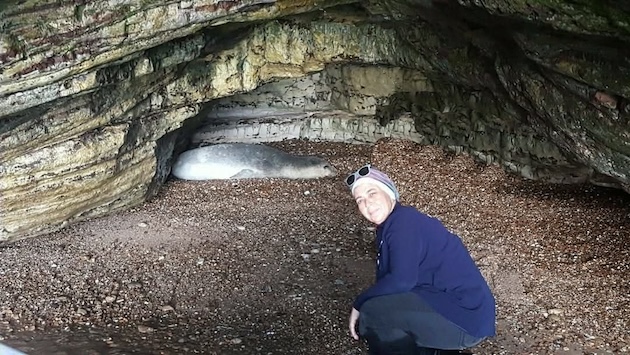 Iffat Rachid Edriss leads environment campaigns in Lebanon. Here she is at Raouche, Beirut, the only monk seal cave in Lebanon where Operation Big Blue Association was called in on a seal rescue mission. Credit: Iffat Rachid Edriss
SAMARKAND, Uzbekistan, June 4 (IPS) - For three decades, Iffat Rachid Edriss walked Lebanon’s coastline with a clear purpose: protecting the sea she loves.
She organised cleanups, conducted research, and helped rescue marine species, including turtles, seals, and dolphins. Through wars, economic crises, and environmental challenges, her work continued largely through community effort.
“We worked very hard and kept our land and marine litter-free,” Edriss says.
Then came the Israel-Hezbollah war.
“In a few days, everything changed,” she recalls. “The weapons, the attacks and the destruction, the debris and litter everywhere, the trees were gone and the soil is contaminated.”
Now, the veteran environmentalist finds herself in Samarkand at the 71st Council Meeting of the Global Environment Facility (GEF), carrying a very different message. Instead of discussing conservation projects, she is advocating for funding to restore ecosystems damaged by war.
“In normal times, we do not need a penny from anyone, but we have been thrown into a different situation now. Now we need support – to restore our land, our water and our environment,” she told IPS.
Edriss’s story reflects a broader concern shared by civil society organisations gathered at the meeting: communities facing environmental crises often struggle to access the very funds created to support them.
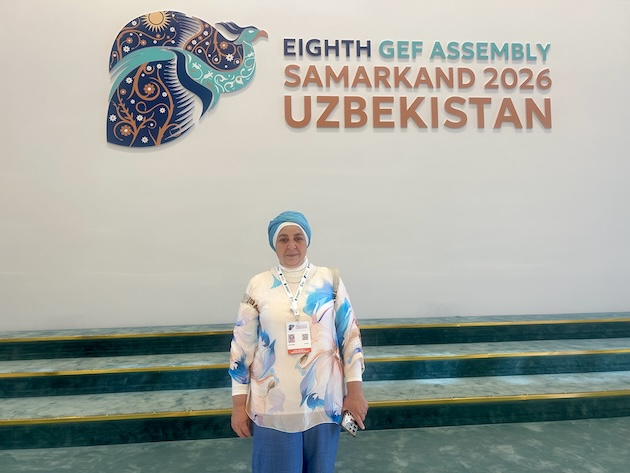 Iffat Rachid Edriss of Lebanon, who is attending the 71st GEF Council meeting and the 8th GEF Assembly, raises her voice for greater, faster funding support to restore the environment in her war-torn country. Credit: Stella Paul/IPS
Access Barriers Persist
Today, Edriss manages the Blue Stone Project, contributes to Lebanon’s public beach strategy, and leads the Ocean Literacy Hub in Beirut. Before the conflict, her team had developed an innovative solution to marine pollution by incorporating collected marine litter into construction materials.
“With the American University of Beirut, we proved that we could use up to 5 to 10 percent marine litter in construction materials,” she says. “You reduce the use of gravel as a natural resource, and you get rid of the marine litter.”
But those innovations are now overshadowed by a much larger challenge.
“Now there are weapons, chemicals and heavy metals. This will cost billions,” she says. “We need to work on soil and water restoration and greening Lebanon.”
The debate over how to finance such restoration efforts has become increasingly urgent as countries gather to negotiate contributions to GEF-9, the facility’s next four-year funding cycle covering 2026-2030.
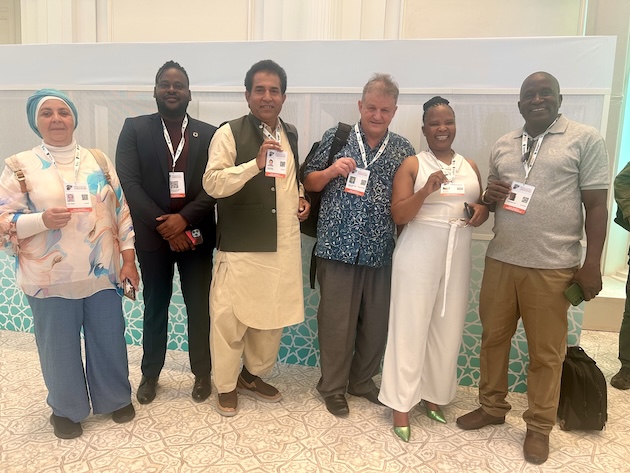 Faisal Parish (third left) with other members of the GEF CSO Network from Asia, the Middle East and Africa. One of their responsibilities is to collect and share feedback with GEF on its current fund disbursement and implementation process. Credit: Stella Paul/IPS
According to Faisal Parish, Chair of the GEF Civil Society Organization (CSO) Network, the replenishment has already secured significant commitments.
“The current pledge is 3.9 billion dollars. We hope by the end it will get to at least 4.5 billion,” Parish says.
Yet for civil society groups, the size of the fund is only part of the story.
“How that money will be dispersed and how quickly and whether it will reach the right levels – those are the key questions,” Parish says.
The GEF funding process involves multiple stages, including concept development, council approval, project design and implementation through a network of partner agencies such as UN agencies and development banks. While these safeguards are intended to ensure accountability, they often slow the delivery of funding to communities on the ground.
“To be frank, one of the barriers is the multiple levels of implementation,” Parish explains. “Some entities do not have easy mechanisms to give money directly to civil society.”
The challenge becomes even greater in countries where national institutions have limited reach into local communities.
“Many governments do not have the national-level mechanism to reach really down to the community,” he says.
Indigenous Funding Models
These concerns are particularly acute among Indigenous Peoples and Local Communities (IPLCs), who are expected to play a central role in achieving global biodiversity targets. Although GEF-9 includes a target that at least 20 percent of funding should reach Indigenous Peoples and local communities, many representatives fear progress remains too slow.
Giovanni Reyes, who leads the GEF Indigenous Peoples Advisory Group (IPAG), believes the current system is too cumbersome.
“We are already getting closer to 2030, and no significant funding is flowing yet into our territories,” Reyes says. “Can we cut the intermediary and the complications of layers?”
Reyes argues that Indigenous-led organisations should be trusted to manage and distribute funds directly.
“The ideal situation is when funding goes directly to Indigenous-led mechanisms that have demonstrated capacities to do regranting,” he says.
Reyes points to existing Indigenous-led financing mechanisms, such as the Nusantara Fund in Indonesia, the Indigenous Peoples of Asia Solidarity Fund in the Philippines, the Mesoamerican Territorial Fund in Latin America, and the global Indigenous-led network, as examples of models that could deliver resources quickly and effectively to local communities.
This issue was something that was discussed in detail during the Council sessions and GEF’s Interim CEO Claude Gascon commented at a press conference, “We also know that countries need more resources faster and with less complexity, which is why the GEF-9 also includes policy reforms to make partnerships simpler, more accountable, and more efficient.”
On the third day, the council approved two Global Biodiversity Framework Fund project proposals from India and Papua New Guinea focused on Indigenous Peoples and local communities.
In the first, the GEF assembly approved USD 12.4 million, with USD 30.3 million in co-financing, for a project aimed at developing three state spatial biodiversity plans and bringing at least 200,000 hectares of landscapes outside protected areas under improved management practices – it’s expected to benefit 30,000 people.
The second, a USD 6.4 million GEF-financed project with co-financing of USD 16.7 million, is expected to empower Indigenous people and local communities in Papua New Guinea through the sustainable management and conservation of 700,000 hectares across critical ecosystems in three highland provinces.
In the next investment cycle, GEF-9, it will also allocate USD 100 million to an Indigenous Peoples and local communities Conservation Initiative, which is four times more than in the previous GEF investment cycle.
Questioning Gender Mainstreaming
However, concerns about inclusivity go beyond funding flows.
The discussions highlighted a broader concern among civil society groups: whether the people these projects are designed to benefit are adequately represented in their design and implementation.
A representative from the CBD Women’s Caucus pointed to the India proposal as an example of where greater transparency is needed. While supporting the project’s objectives, she questioned how women would participate in decision-making and how they would access and benefit from the proposed investments.
“The GEF guidance to advance gender equality in GEF projects and programs, which was published in 2018, requires updating and realignment with the evolved KMGBF (Kunming-Montreal Global Biodiversity Framework) mandates for gender and inclusive approaches,” she told delegates.
For civil society groups, the problem is not just who gets the money but who decides how to use it. They say more openness would help people see whether projects really include local communities and respond to their needs in a fair and accountable way.
Transparency emerged repeatedly throughout the meeting. Participants argued that communities need better tools to track where funding goes and whether promised benefits actually reach the ground.
“Let’s see the data and then let’s make that publicly available in that country,” Parish says. “More transparency at the country level and local level is important.”
Improved monitoring systems, participants argued, would help build trust, strengthen accountability and allow communities to provide feedback when projects fail to deliver expected results.
‘It’s Too Complex’
Young people attending the meeting expressed a different challenge: understanding a highly complex funding system while preparing to become future partners in environmental action.
“I really don’t understand the GEF funding process. It’s too complex. So, I am here to learn,” said a youth delegate from Zimbabwe. “But I do think we have to learn to be accountable if we are to partner with GEF and receive funding.”
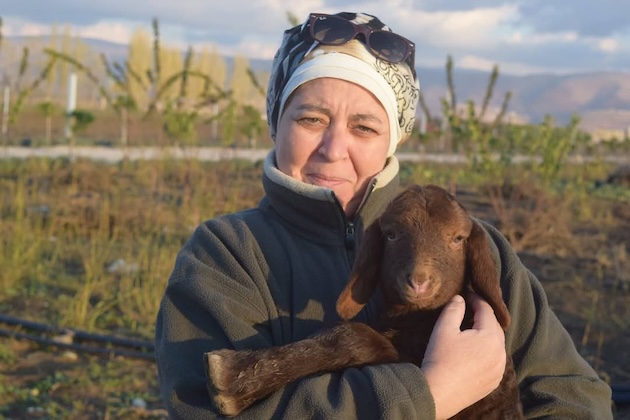 Iffat Rachid Edriss poses with a goat on one of her environmental campaigns. Her organisation used to be self-sufficient, but she now finds herself in Samarkand lobbying for funds to clean up the environment, which is now littered with ordnance from the conflict in Lebanon. Credit: Iffat Rachid Edriss
For Edriss, however, the situation at home leaves little room for delay. Coastal ecosystems continue to degrade, while local efforts to cope are limited without external support. “We have to move forward,” she says, “but we cannot do it alone.”
Her experience points to a broader concern raised by many in civil society: whether international climate and biodiversity finance can move quickly enough to match the pace of loss on the ground – before the damage becomes irreversible.
Note: The Eighth Global Environment Facility Assembly is underway until June 6, 2026, in Samarkand, Uzbekistan.
This feature is published with the support of the GEF. IPS is solely responsible for the editorial content, and it does not necessarily reflect the views of the GEF.
IPS UN Bureau Report
© Inter Press Service (20260604024612) — All Rights Reserved. Original source: Inter Press Service