
 6 months ago
32
6 months ago
32

Bethany BellBerlin reporter

 Tristar Media/WireImage
More than 250 prominent German women have called on the government to act in response to the Collien Fernandes case
Germany says it wants to make pornographic deep fakes a criminal offence, after a TV star accused her former husband of spreading sexualised images of her online.
Collien Fernandes, 44, has filed a legal complaint in Spain against her former husband, 50-year-old actor Christian Ulmen.
The case, reported by Der Spiegel last week, has sparked a big debate in Germany about digital violence on the internet. More than 250 prominent German women have called on the government to protect people from "digital sexualised violence".
Ulmen's lawyer, Christian Schertz, said in a statement that Der Spiegel's reporting was "unlawful for several reasons" and that they were taking legal action.
Much of the reporting constituted "inadmissible reporting based on suspicion", the statement said. "Secondly, untrue facts are being disseminated on the basis of a one-sided account," it continued.
Christian Ulmen is not facing charges and is presumed innocent.
In a post on Instagram, Collien Fernandes said that for around 10 years fake social media accounts had appeared, featuring pornographic images of her, and she repeated her accusations against her former husband.
In an interview with German public broadcaster ARD, Fernandes said she wanted "to highlight the gaps in the law". Germany, she said, was "an absolute haven for perpetrators".
She told ARD she had taken legal steps against her former husband in Spain, where they used to live together "because women's rights are significantly better there than in Germany. This applies not only to online abuse but also to domestic violence".
"And in this case, once we identified the perpetrator, we also discovered that the offence had taken place in Spain," she added.
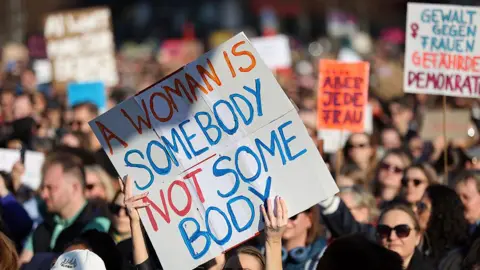 Maryam Majd/Getty Images
Thousands of people joined a demonstration in support of Collien Fernandes at the weekend
The case has touched a nerve in Germany.
Among 10 points proposed by 250 leading women from politics, culture and business are for the principle of "yes means yes" to be enshrined in German law, making any sexual act without explicit consent a criminal offence. They also want the offence of "femicide" to be brought into the penal code.
A recent study by the Federal Criminal Police Office said that one in five women and one in seven men had experienced digital violence in the last five years.
It said the victims "tend to be relatively young – over 60% of 16 to 17-year-old women and around 33% of 16 to 17-year-old men have been victims of digital violence in the last five years".
Only 2.4% of cases of digital violence were reported to the police, it said.
Justice Minister Stefanie Hubig has announced plans for a draft bill to crack down on sexualised deep fakes, particularly against women.
In a statement, she said it was "a debate that affects society as a whole, not just women. Men must also be part of the discussion".
"We intend to make the production and distribution of pornographic deep fakes a criminal offence in future," she said.
"We also want to make it easier for those affected to defend themselves in court and obtain justice more quickly, so that the humiliation and degradation they are subjected to cannot continue to be spread online," she added.
On Sunday several thousand people held a demonstration in Berlin against sexualised digital violence, and in solidarity with the victims.
Collien Fernandes was not there in person, but supporters read out a statement from her at the Brandenburg Gate, in which she called for the "walls of silence" to be torn down.
There has been a significant reaction to the case on social media.
Josephine Ballon, the managing director of Hate Aid, a non-profit organisation in Germany which aims to support victims of digital violence, told the BBC the technology to produce deep fakes was easily available.
"Now we have AI image generators all over the place, nudification apps that are available for free in app stores and also in browsers."
"If we have a criminal law that's actually criminalising this behaviour, we can also say that these apps are no longer allowed because they are offering illegal services".
Josephine Ballon said criminalising such behaviour was the minimum that "we can do, because this also shows that we as a society, we have values, we have rules, we have human decency."


