6 months ago
21
6 months ago
21

Victoria Derbyshire,,BBC Newsnightand Laura Gozzi,

 BBC
BBC
Gisèle Pelicot, the woman at the centre of France's largest rape trial, has told BBC Newsnight she was "crushed by horror" on discovering that, for years, her husband had repeatedly drugged her unconscious and invited dozens of men to rape her.
"Something exploded inside me," says Ms Pelicot, 73, of the moment she realised the scale of her husband's crimes. "It was like a tsunami."
In an extensive interview ahead of the publication of her memoir, A Hymn To Life, she describes how phoning her three children with the news of what she had discovered about their father was possibly the toughest experience of her life.
She recalls the moment she decided to waive her legal right to anonymity, and how she has never regretted that decision. She also reveals she still has unanswered questions she wants to ask her now ex-husband - the man she refers to as "Mr Pelicot" - in jail, where he is serving a 20-year term.
Warning: This article contains accounts of rape and sexual abuse
The Hôtel de Ville in central Paris, with its ceiling frescoes and rich wood panelling, is a far cry from the drab courtrooms in which Ms Pelicot was last seen publicly, during the four-month trial that shook France.
She describes the moment that marked the beginning of what she calls her "descent into hell".
She had accompanied her husband, Dominique Pelicot, to a police station near their home in Mazan, southern France. He had been summoned for secretly filming underneath women's skirts in a supermarket.
Ms Pelicot was taken aside by a policeman, who started asking her a series of increasingly probing questions. What kind of man was her husband? A great guy, she answered. Had they had ever engaged in swinging? No, of course not, she protested.
"He told me: 'I am about to show you something you won't like.' I didn't understand right away."
The officer showed her two photos of a lifeless woman lying on a bed. They were among thousands of pictures and videos her husband had taken of her while she was drugged.
"I didn't recognise myself," she says. "This woman was lying on the bed as if she were dead. There are men next to her. I didn't understand who they were. I didn't know them. I'd never met them."
Watch: "I am a survivor" Gisèle Pelicot tells BBC Newsnight in extensive interview
She pauses, fiddling with her red-framed reading glasses. As she recounts the shock that engulfed her, her voice grows quieter but never falters.
Police told Ms Pelicot that she had been repeatedly raped by dozens of men. Although her husband had recorded, labelled and neatly catalogued the videos of the rapes on a hard disk, many of the men could not be identified.
She was advised by the police not to be alone after receiving this news. She went home in a daze and phoned a friend. "I told her: 'Dominique is in custody because he raped me and had me raped.' That's when I used the word rape. It was after five hours of questioning that I put words to Mr Pelicot's crime."
Her three grown-up children - David, Caroline and Florian - also had to be told what their father had done.
"I was well aware that for my children it was going to be immensely difficult," says Ms Pelicot. She now believes making those three phone calls was the hardest thing she has ever had to do.
She remembers Caroline's reaction: "I heard my daughter scream. It was almost inhuman, that scream."
She remembers David, her eldest, being in a state of shock, and Florian, the youngest, immediately asking how she was.
"They realised I was alone, and that I might do something stupid. For them, too, it was like an explosion."
Her children travelled to be with her in Mazan the following day. All three have since recalled destroying or throwing out the family's belongings - from furniture to photo albums - in an attempt to cancel their father's existence.
Their mother stood by and watched.
"I told myself that my life was in ruins, that I had nothing left apart from my children."
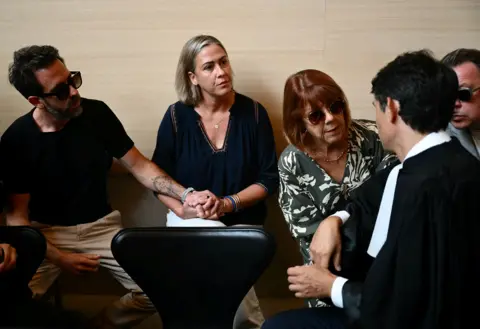 CHRISTOPHE SIMON/AFP
"It took us a long time to rebuild ourselves": Ms Pelicot says the revelations took their toll on her children Florian (left), Caroline (centre) and David (far right)
Since David's birth, when Ms Pelicot was in her early 20s, her children had been the centre of her life. Motherhood became a way to leave behind a childhood steeped in sadness.
"I lost my mother at a very young age, my brother and my father too," she recalls. "So I needed to rebuild everything I had lost."
In the interview, Ms Pelicot talks of her beloved parents, whose marriage profoundly shaped her own understanding of love.
She was nine when her mother died of cancer, plunging her father and the family into grief they never truly recovered from. Meeting Dominique Pelicot - 19 years old, handsome and just as bruised by a tough upbringing - had provided her with a chance to start anew. They married in 1973.
"We were very in love, and we threw ourselves into life. And we started a family, because that was the main goal for me," she recalls in a steady voice.
By 2011, Ms Pelicot had started suffering from memory loss. She attributed this to neurological problems, but she was also suffering from persistent gynaecological issues. These were later proven to have been caused by the sedatives she was plied with, and the strangers who came to rape her multiple times a week.
She consulted a number of doctors. Her husband was by her side throughout the inconclusive examinations. He was also there every morning after the night-time assaults.
"It was inconceivable that this man who shared my life could have committed these horrors," says Ms Pelicot. "I would get up and have breakfast, and he would look at me in the eye. And I don't know how he could have betrayed me for so many years."
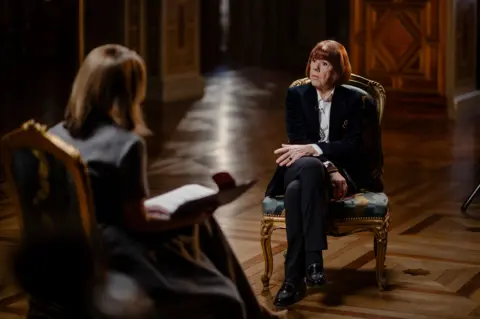
"It was inconceivable that this man who shared my life could have committed these horrors," says Ms Pelicot
She would later learn that, alongside the drugs, her husband had given her powerful muscle relaxants, so that the next day she would not feel any pain for what her body had been put through.
She now believes her abused body was close to giving up, and that her survival was at risk.
"It is hard for me to recognise that he had no mercy," she says.
The revelations have taken their toll on the whole family, says Ms Pelicot.
"It's wrong to think that such a tragedy brings a family together. It took us a long time to rebuild ourselves."
Her daughter Caroline, in particular, has been condemned to a "perpetual torment", she says, as photos of her asleep in her underwear were found on her father's laptop.
"The incestuous look he cast on his daughter, I found utterly unbearable."
Ms Pelicot's ex-husband has given contradictory explanations for those photos. Caroline is convinced he drugged and raped her too, but lack of additional evidence means he has never been prosecuted.
Relations between mother and daughter were strained during the trial, and Caroline said she felt like a "forgotten victim". At various times - both before and after the case – Ms Pelicot lost touch with some of her children.
"It took Caroline time, because she's filled with hatred and anger - feelings I don't have," Ms Pelicot says. "I have neither hatred, nor anger. I felt betrayed and outraged by Mr Pelicot, but that's just how I am."
Ms Pelicot says she and her daughter are now repairing their relationship.
"Each of us needed time to find our own path. Today, we're trying to bring each other peace, and I hope we're on the right road to healing."
Revelation was to follow revelation. In 2022, police informed Ms Pelicot that her husband had admitted to the attempted rape of a young woman. He was also being investigated for the killing of a 23-year-old estate agent in Paris in 1991 - an allegation he denies.
That her husband could be a murderer as well as a serial rapist is almost too much for Ms Pelicot to contemplate.
"I dare hope he is not the perpetrator of this heinous crime, because otherwise it would once again be a descent into hell, both for me and for his children."
While the investigation was taking place, she relocated to the quiet Île de Ré, a small island off France's Atlantic coast. "I really wanted to stay in the shadows," she says. "I absolutely didn't want anyone to know who I was."
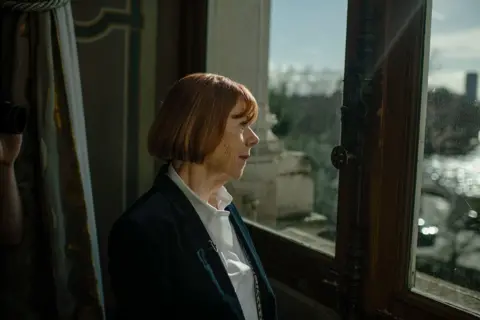
While the investigation was taking place, Ms Pelicot says she "wanted to stay in the shadows"
As is the case for rape victims in France, Ms Pelicot was entitled to a closed-door trial - full anonymity, no media. She had pushed back on suggestions from her daughter to have an open hearing, worried about cementing her status as the victim of a heinous crime.
Then, walking on the beach, four months before the case began, something within her shifted.
A closed hearing would mean the men on trial would also benefit from anonymity, she realised. Moreover, it would leave her outnumbered - 51 men and 40 lawyers versus her, her small legal team, and her children.
'If I was able to do this, all victims can too'
"For more than four years, I carried this shame," says Ms Pelicot. "And I felt that it was like a double punishment for victims, and a suffering we imposed on ourselves."
Her lawyers gave her a week to decide whether she truly wanted to open the trial up to the public and the media. She only needed one night. "By the next morning, I knew," she says.
It was an extraordinary choice.
"I have never regretted my decision, not once," she says. "It was also a message to all victims who don't dare to do the same… It could give them some of the strength I found in me.
"Because," she says without hesitation, "within us we have resources that we don't even suspect. And if I was able to do this, all victims can too. I am convinced of this."
In 2024, the Pelicot trial exploded into full view of France and the world.
The ability to let the light shine through the depravity Ms Pelicot was subjected to - the "filth", as she repeatedly calls it - is a testament to her resilience.
Every day, she held her head high as she walked into the Avignon courthouse. A throng of women assembled outside to show their support, and she acknowledged them with a slight nod and a hand on her heart.
Surrounded by dozens of cameras, Ms Pelicot says they gave her "unbelievable strength".
"For me, they soothed what was happening within the courtroom," she says. "On my own, I think it would have been difficult."
Even Queen Camilla reached out from the UK to express her admiration with a personal letter, which surprised her. "I felt moved and very honoured... I am grateful to her," she says.
 Manon Cruz/REUTERS
Ms Pelicot pictured addressing the media after the verdict in December 2024
Throughout the interview, Ms Pelicot is composed and assured. Then, she is shown videos of French women, filmed by Newsnight, thanking her for her choice to have an open hearing.
"Thank you for being so brave," says one woman.
"We are here to support you! Life is beautiful, madame!" says another.
As one beaming face follows the next, Ms Pelicot, for the first time, wipes away a tear.
"It touches me enormously because these are the faces I met during the trial," she says. "I saw them putting up posters, I saw their collages, I saw the banners."
"They were truly exceptional," she smiles.
Watch: Gisèle Pelicot shown messages of support for courage during rape trial
In the courtroom, Ms Pelicot and her family sat through nearly four months of veiled insinuations and open accusations of complicity from both the defendants and their lawyers. "You go through hell in a courtroom. You're really humiliated," she says.
At the time, this led her to label what was unfolding as the "trial of cowardice". Now, too, her voice rises slightly as she recalls those moments.
"They didn't want to own up to what they had done," she says of the 50 men her husband had allowed to abuse her. She feels they acted as if they had committed a petty crime and refused to accept that she could not have given consent.
 AFP/Anadolu/EPA/Getty Images/Reuters
Numerous demonstrations took place across France in support of Ms Pelicot
"Then, the video attesting to the truth would be shown," she says. "We could see that man raping me. He'd be asked those questions again, and would reply: 'No, I didn't rape her, I didn't have any intention of raping her.'
"So where are we supposed to go from there?" she wonders aloud, exasperated.
"I think that as far as they're concerned, they couldn't have raped me because Mr Pelicot was there and had given his consent. Therefore, they didn't consider it rape," she concludes.
The argument was rejected by the seven judges who oversaw the case. All the defendants were found guilty. Her former husband (their divorce was finalised shortly before his trial) was given a maximum sentence of 20 years. The other 50 men were jailed for terms between five and 15 years.
As Ms Pelicot speaks, a tall bespectacled widower named Jean-Loup watches on discreetly. She met him on Île de Ré in 2023. "We had this stroke of luck," she says, her voice measured and warm. "We fell in love like teenagers, when neither of us was expecting it."
They have been a couple ever since. "Life put a man on my path who has the same values, the same principles as me - and who has also been through many ordeals in his life."
"So you see," she continues, her head tilting to one side, "life always holds beautiful surprises. It's brought a lot of colour into our lives."
It has been almost six years since Ms Pelicot was shown the photos of a woman who looked "dead". The question of why her ex-husband subjected her to years of abuse still looms large. Dominique Pelicot admitted in court he wanted to "subdue an unbreakable woman".
"He would have liked me to participate in swinging sessions and I always refused because I have a sense of modesty," she says. "I think he found a way around it by subduing me."
But how he could have brought himself to do what he did is a different question. "I might ask myself this for the rest of my life," she says.
Ms Pelicot says she intends to visit him in jail to ask him what he may have done to their daughter Caroline, and the murder case he has been linked to.
"I need to meet him to have answers. I don't know if I will, but I need to look at him straight in the eye."
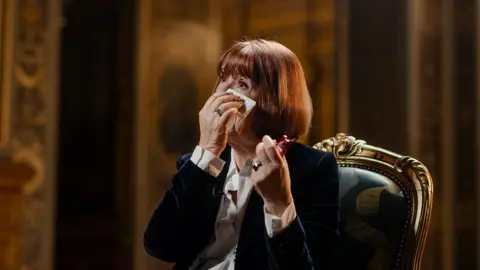 Dmitry Kostykov/BBC
Ms Pelicot says she was "touched enormously" by the support she received from French women thanking her for her choice to have an open hearing
Meanwhile, the rebuilding of her life continues. "I am healing," she says.
She resists the idea of entirely disavowing the life she led with her ex-husband.
"In order to live, I have needed to think that the 50 years I spent with Mr Pelicot were not all just a lie. Because otherwise, it's as if I'd been dead. As if I no longer existed."
During one of the rare times she took the stand in court, Ms Pelicot told her ex-husband that his betrayal had been "immeasurable".
"I always tried to lead you towards the light, but you chose the depths of the human soul," she said.
It is a sentiment she echoes now. In life, she says, "you always have to choose, to decide which path to follow. There is the good and the bad."
"As for me," she concludes in her poised voice, "I have always chosen to walk toward the good."
A list of organisations in the UK offering support and information with some of the issues in this story is available at BBC Action Line