
 5 months ago
40
5 months ago
40


 Javier Sánchez/Getty Images
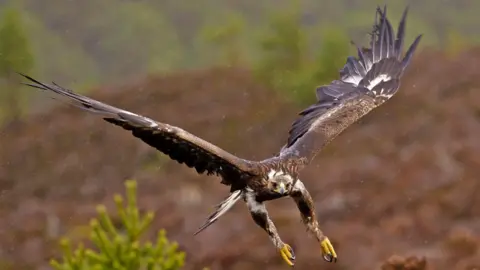
Golden Eagles will once again be a permanent feature of English skies, as the government pledges £1m to back the reintroduction of the species as early as next year.
Britain's second largest bird of prey was wiped out in England during the 19th Century after a concerted campaign of hunting.
Forestry England will now launch a public consultation alongside the charity behind the successful return of the species to the Scottish border.
Restoring Upland Nature said they have seen widespread support for the return of the "impressive" species but farming communities have previously raised concerns about the threat this predator could pose to lambs.
They are one of the fastest animals on the planet, reaching speeds of up to 200mph as they dive, and have razor-sharp vision - able to spot a rabbit moving three miles away.
And yet, these apex predators were hunted to extinction in England and Wales because of their perceived threat to livestock and grouse.
After years of research by Forestry England into appropriate environments, and a successful re-enforcement of the species along the Scottish border, the government is now backing a parallel project in Northumberland.
"Aside from being Britain's second largest bird of prey with an impressive two-metre wingspan, the golden eagle is a keystone species that can play a vital role in nature recovery more widely," said Environment Secretary Emma Reynolds.
The government has backed a number of species reintroduction programmes over the years as part of efforts to reverse this trend including re-establishing pine martens, beavers and whitefaced darter dragonflies.
Ed Parr Ferris, species recovery manager at Forestry England, said bringing golden eagles back to the country's landscape can help to control mesopredators - ones that occupy the middle of the food web - like foxes and badgers.
"Golden eagles are impressive and beautiful birds, and one of our only remaining apex predators in Britain. Any predator applies a pressure on a system to balance all the different other animals that are living in that place ... allow[ing] space for rarer animals to survive and to thrive."
The study led by Forestry England looked at 28 possible locations for new populations, and of those, eight were identified as providing the right climate, landscape and minimal potential for disturbance - with Northumberland the favourite. Some of the others include:
- North Pennines
- The Lakes
- Yorkshire Dales
- Bowland
- South Pennines
- North York Moors
- South West
Watch a golden eagle being released into the wild in Scotland
Over the last eight years 28 chicks from the Scottish Highlands and Orkney Isles have been brought down to the Scottish border and successfully established.
Some of these birds have been temporarily migrating into England, but the study estimated that without further support it would take 20 years for the birds to naturally expand and settle further south.
Restoring Upland Nature (RUN) - the charity behind the Scottish border re-establishment scheme - will lead the £1m programme in England over the next three years.
There will first be a period of public consultation with landowners and farmers, but chicks could be brought in as early as next summer explained Dr Cat Barlow, CEO of RUN.
She said this next step was not just important for the species but also to engage people more broadly on the issue of nature recovery.
"It is really difficult to get people excited about peat restoration. But something like a golden eagle can get new audiences excited, and get them aware of how the whole ecosystem can work together," Dr Barlow said.
But Prof Davy McCracken, professor of agriculture ecology at Scotland's Rural College said 18 months was unlikely to be long enough for a consultation.
"You've got to remember that land managers and farmers who may be most concerned about being impacted, have very intensive periods of seasonal activity - times when they can't necessarily engage effectively in any consultation."
National Farmers Union North Regional Board Chair and a farmer himself William Maughan said "thorough, meaningful and clear" engagement with farmers was crucial for the project's success.
"Farmers cannot be expected to carry the cost, risk, and responsibility of poorly implemented reintroduction projects," he said.
 Phil Wilkinson
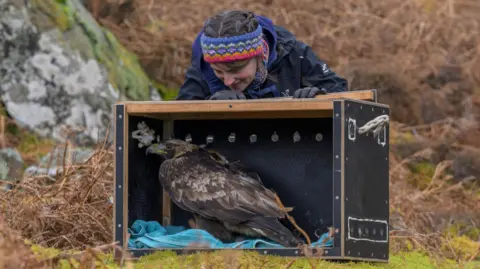
Golden eagles reintroduced on the Scottish borders, like Hamlet, have faced persecution
The return of eagles to UK skies has not always been met with positive responses.
Ed Parr Ferris said that golden eagles are very different, with different behaviours.
"We do recognize they can take small lambs very occasionally as a part of their diet, but that's rare, and it's far more likely that they'll be taking carrion," he said.
The feasibility study said that current research estimates golden eagles would be responsible for between 0.15% and 3% of all lamb losses in their hunting range.
Dr Cat Barlow said that changing the perception of golden eagles can be difficult but the Scotland project showed it was possible.
"It started from quite a challenging start point. There has been a lack of trust between the shooting community, for example, and conservationists and raptor workers."
She said by hiring a retired gamekeeper they had managed to bring a lot of people onside and shooting estates are now helping to build artificial nests.
Prof McCracken said farmers could take some "comfort" from the success of the Scotland project but can understand their ongoing concerns because of discussions around reintroducing other carnivorous predators like lynx.
"We have a tendency to look at things in isolation," he said. "One species on its own might not have a major impact. It's just being aware there may be cumulative effects [...]having two or three additional species reintroduced."
The potential for conflict between animals and humans remains ever present. In February, one of the birds relocated to the Scottish Borders - Hamlet - was found with pellet wounds.
And the government has opted not to share the exact release location that is being considered in Northumberland for the safety of the birds.


