3 weeks ago
29
3 weeks ago
29

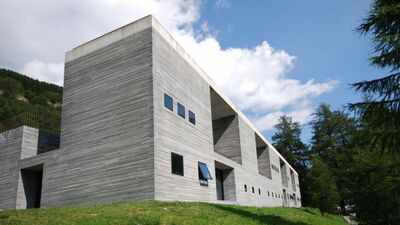
Image Credit: By Micha L. Rieser
Deep within the Swiss Alps, 1,200 metres above sea level, lies the small farming village of Vals. This remote location hosts a structure that challenges traditional architectural limits, the ‘Therme Vals.
’ Designed by Peter Zumthor and completed in 1996, this thermal bath complex was not built to stand out but rather to get mixed into the rugged mountain landscape. By utilising the only thermal spring of the region, Zumthor created a spa that feels more like a natural sanctuary than a hotel. The project, as described in the study ‘A Phenomenological Approach Towards the Architecture of Peter Zumthor,’ focuses on creating a natural atmosphere. Through the clever use of 60,000 local stone slabs, the building connects the visitor with the rugged mountain landscape.
How did the architect protect the heart of the Swiss Alps
One of the greatest hurdles of this project was the ‘location’ itself. As Scott Murray explains in ‘Material Experience: Peter Zumthor's Thermal Bath at Vals,’ the building sits on a steep hillside, which required a design to avoid overpowering the landscape. Rather than building a tall tower, Zumthor chose to connect the structure with the land by burying it partially underground.It was a necessity, not a visual choice, to protect the natural hot springs that have existed since the late 19th century.
To maintain this connection with the mountain, the roof was covered with wild grasses, which made the building nearly invisible when viewed from the nearby high ground. This approach ensures that the mountain remains the primary focus, while the building remains a quiet, baby structure within the slopes.
Why this modern building feels like an ancient cave
When visitors arrive, they do not see a typical hotel entrance. Instead, they come down from the lobby through a dark passage that leads to the centre of the baths.
According to Scott Murray’s research, this entrance is devoid of natural light and surrounded by stone, immediately giving the feeling of entering a dark, isolated cave.This cave-like feeling exists in other spaces as well. There is no fixed path to follow, guests are free to wander around at their own comfort, finding hidden pools and quiet corners just like in a natural cavern. The walls are built using a load-bearing mixture of natural stone and concrete, which Zumthor refers to as ‘poured stone.’
This technique creates the illusion that the building was not built piece by piece, but was instead carved out of a single, massive block of mountain stone.
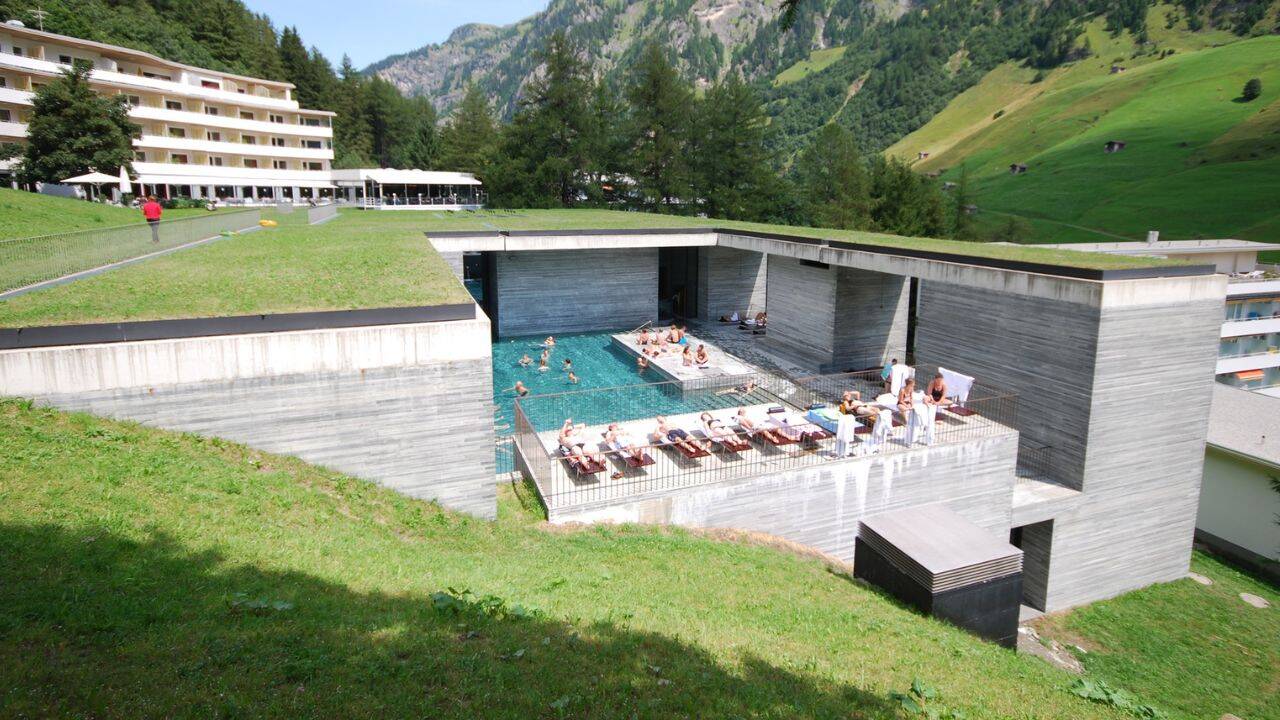
Image Credit: By Micha L. Rieser
What role does local stone from the mountain play in the experience
The primary material used is a local stone called ‘Vals gneiss,’ a bluish-grey rock from the quarries in the mountains nearby. As mentioned in the study, the authors highlight that the use of local materials allows the building to blend-in naturally with the surroundings.Some surfaces were polished smooth, while others were sandpapered, chiseled, or left split just as they came out of the quarry. This variety turns a simple walk through the spa into an exploration tour. Zumthor believes that ‘material is stronger than idea,’ meaning that the physical reality of the stone is more powerful than any architectural drawing. By combining this stone with the flowing water, the architect tried to create a ‘charming relationship’ where the stone loves the water and the water loves the stone.
The everlasting sensory atmosphere was Zumthor’s aim
The ‘Therme Vals’ is designed for every sense, not just the sight. The concept of ‘atmospheres’ in the study is broken down into factors like temperature and sound. For example, the ‘fire bath’ is kept at a hot 42 degree Celsius and is surrounded by red-painted walls to enhance the feeling of warmth. On the other hand, the ‘ice bath’ is kept at 14 degrees Celsius with blue walls, to provide a chilling effect.These temperature differences are not just for health, they can change how the visitor feels inside the space.
Instead of large, bright lights, Zumthor used very narrow, linear skylights that allow thin beams of sun to reach the stone walls, highlighting the texture of thousands of slabs.By protecting the thermal spring and hiding the structure within the mountain, Zumthor achieved a unique balance between human experience and natural preservation. Every one of the thousands of stone slabs serves a purpose, encouraging visitors to slow down and notice the simple beauty of light, water, and rock. As the study says, this project proves that when architecture goes beyond basic function to consider the human spirit, it can turn a physical space into a meaningful memory.
It remains a testament to how architecture can both respect the mountain ecosystem and carve out a small, perfect void for people to enjoy.