
 6 months ago
58
6 months ago
58

Chris Baynesand Sabbiyah Pervez,BBC Yorkshire & Lincolnshire Investigations
 Supplied
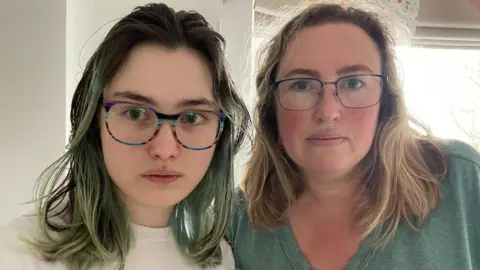
Christa (right) has been home-educating her daughter since 2020 after 14 schools said they could not meet her needs
A council plan to reduce the number of children being home- educated is "unequivocally unlawful," a leading education lawyer has said.
Barnsley Council aims to cut home education numbers by 30% in two years and is believed to be the only authority in England with a specific target.
One mother said it may force children back into a system that could "break them", while a campaign group said it had seen increases in "intimidating" child welfare investigations faced by parents who chose to educate at home.
The authority said it recognised the right to home-educate and the policy would not require parents "to do anything differently" but was intended to ensure families had a suitable school option.
Christa, who home-educates her teenage daughters in Barnsley, described the policy as "discriminatory".
The 47-year-old said she believed the target could "push children back into places that are damaging them and destroying them".
"They should be able to be educated wherever makes them safest," she added.
Christa began home-educating her daughter Ruth, now aged 15, six years ago as she was "hugely struggling" with mental health problems.
Ruth was diagnosed as autistic in 2019 and also has multiple health conditions.
When the family moved up from Hampshire in 2020, Christa tried to get Ruth back into mainstream education but 14 schools - some as far afield as Leeds and Nottingham - said they could not meet her needs.
She said choosing to home-educate had been "the hardest decision" but added: "The school system is broken."
Last month Barnsley Council warned it was facing "urgent and increasing pressure" on special educational needs and disabilities (SEND) provision, with rising demand fuelling "an acute shortage of local places".
The number of children on the waiting list for specialist placements in the borough increased from 55 to 121 between July 2024 and July 2025.
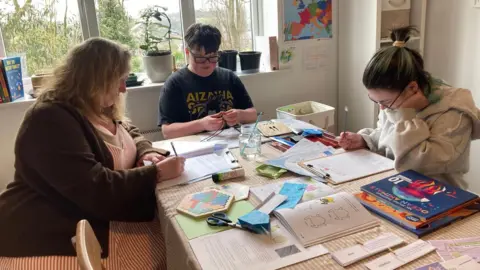
Christa said her daughters had "been able to thrive" in home education
Ruth told the BBC being at school had made her "really upset, stressed and anxious".
Now, she said, she was able to "learn at my own pace, in my own time, and I can take days off whenever I need to."
"It's just really nice to be in an environment that I'm familiar with and feel safe in and comfortable, which is something that I've never experienced at school."
Christa, who at one point was educating all three daughters at home, said it was hard work but had been "transformational" and sending them back to school would "break them".
Ruth agreed and said she would find it "awful" and "painful" to return to school.
Barnsley Council said it could not comment on individual cases but its home education policy did not require parents "to do anything differently".
A spokesperson said the target would "change how schools and the council work together to make sure that there's a school environment that meets children's needs" and address parents' concerns about a lack of suitable places.
They added: "We absolutely acknowledge parents' right to choose to educate their children at home.
"All we want to do is make sure that we've done everything possible to prevent families feeling that home education is their only option."
Barnsley has the 12th highest rate of home-educating out of all 154 councils in England that are responsible schools.
In October 2025, the authority recorded 822 pupils being educated at home out of a school population of more than 36,000 children.
A council report outlining its policy warned of "potential safeguarding risks" around home education and said and absence of formal school oversight could leave some children "vulnerable".
However, a senior council education officer told councillors in January that cases in which home-educated children were not appropriately educated were "by far the minority".
Parents who home-educate do not have to follow a timetable or curriculum or make their children take exams, but are legally required to ensure their child is learning sufficiently for their age, ability and needs.
Government guidance states parents who feel their child's current school is unsuitable should get help from their local council for alternatives before choosing home education.
There were 126,000 children in England being home-educated in October 2025, academic year, an increase of more than 14,000 on the previous year.
Barnsley hairdresser Kerry began home-educating 14-year-old son Kyle last year after six schools said they could not meet his special educational needs.
"It wasn't a choice I wanted to make," she said. "I wanted him to be in a school but in a setting that would be able to meet Kyle's needs."
The mother-of-three said Kyle's behavioural problems worsened after he began secondary school, leading to him being given detentions almost every day.
Kyle – who has been waiting more than three years for an autism assessment – has an education, health and care plan (EHCP), a legally-binding document which outlines extra support to be provided to a pupil with special educational needs.
It states he requires regular one-to-one sessions with a designated teacher, which his school - and the others she approached - said could not be provided.
The 41-year-old, who closed her salon to home educate her son, said she had been left "emotionally, physically, mentally exhausted".
"It's a battle that no parent should have to be going through," she added.
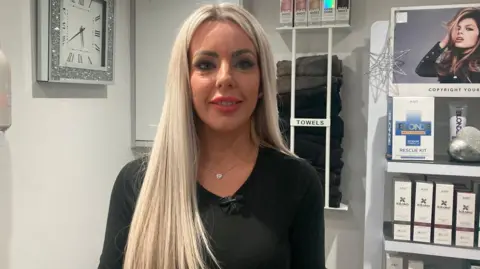
Kerry said she had "no option" but to home-educate her son
For some, home education is a lifestyle choice or driven by philosophical or religious beliefs. But in Barnsley the most common reason cited by parents is dissatisfaction with the school system, according to council data. Others have concerns about their child's health or bullying.
The BBC asked every council in England about their policies on home education. Of the 115 that responded, 110 said they had no aim to reduce the number of children who were home-educated.
Four wanted to reduce home education but had no specific target.
Several councils said it would be inappropriate, at odds with government guidance, and potentially unlawful to seek to dissuade parents from home-educating.
Michael Charles, a leading education and disability law solicitor, said Barnsley Council's policy was "fundamentally wrong" and open to legal challenge.
He told the BBC the target to reduce home education was "deeply concerning" because meeting each child's needs required an individual case-by-case assessment.
"A numerical target to try and reduce the number of young people who might be requiring home education is simply, in my view, clearly, unequivocally unlawful," he added.
Mr Charles said the council was "failing in their duty towards children" if parents felt they had no choice but to home-educate because schools could not accommodate their children.
Joey Nettleton-Burrows, policy and public affairs manager at the National Autistic Society, said many families were "not getting the right support".
He added targets to reduce home schooling were "unlikely to be legal" and "just do not fix the issues".
James Swallow-Gaunt, a SEND campaigner in Barnsley who has come into conflict with the council over his criticisms of the authority, claimed it was "becoming harder for parents to take children out of the mainstream education system" since the introduction of the 30% reduction target.
Mr Swallow-Gaunt, who runs a Facebook group supporting families of SEND children, said he had seen about a rise in reports of parents receiving visits from social workers and facing child welfare investigations.
"That's intimidating. That's a horrendous thing to go through," he added.
More from the investigations team
Hannah Kitching, leader of Barnsley Council's Liberal Democrat opposition group, said reducing home education rates should not be "a goal in and of itself".
She added she had sympathy for parents and council education staff who were both navigating a system which "desperately needed" reform.
A Department for Education spokesperson said most children "achieve and thrive best in schools" but home education could be "the right choice for some families, when it is suitable and in the child's best interests".
Additional data journalism by Ema Sabljak and Jonathan Fagg.


