
 5 months ago
37
5 months ago
37

2 hours ago
Ghazal Abbasi, Seamus Mirodan and Mohammad Zubair KhanBBC Eye, Punjab, Pakistan

 BBC
BBC
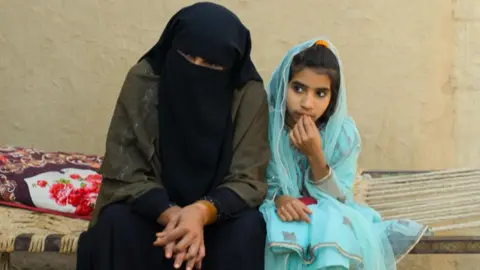
Asma, 10, was diagnosed with HIV despite her mother, Sughra, testing negative
Warning: This story contains details that readers may find distressing
Mohammed Amin was eight when he died shortly after testing positive for HIV.
His fevers were so bad that he insisted on sleeping in the rain, and he writhed in pain "like he'd been thrown in hot oil", says his mother, Sughra.
"He used to fight with me, but he also loved me," 10-year-old Asma says as she kneels at her younger brother's graveside.
Not long after her brother contracted the virus, Asma was also diagnosed with HIV. Her family believe both children contracted it from injections with contaminated needles during routine medical treatment at a government hospital in Taunsa, in the province of Punjab, Pakistan.
They are two of the 331 children that BBC Eye has identified as testing positive for HIV in the city between November 2024 and October 2025.
After a doctor at a private clinic linked the outbreak to the hospital, called THQ Taunsa, in late 2024, local authorities promised a "massive crackdown" and suspended the hospital's medical superintendent in March 2025 – but a BBC Eye investigation can now reveal that dangerous injection practices continued months later.
During 32 hours of undercover filming at THQ Taunsa in late 2025, we witnessed syringes being reused on multi-dose vials of medicine on 10 separate occasions, potentially contaminating the drugs inside.
In four of these cases we saw medicine from the same vial given to a different child. We do not know if any of the children were HIV-positive but this practice creates a clear risk of viral transmission.
Undercover footage shows hospital volunteer reusing syringe after injecting a child, potentially contaminating the medicine
"Even if they have attached a new needle, the back part, which we call the syringe body, has the virus in it, so it will transfer even with a new needle," said Dr Altaf Ahmed, a consultant microbiologist and one of Pakistan's leading infectious disease experts, after watching our undercover footage.
Despite signs on the hospital walls showing safe injection practice we filmed staff – including a doctor – injecting patients without sterile gloves 66 times, and a different expert told us our footage highlighted broader weaknesses in infection control training in Pakistan.
We also watched a nurse rummage through a medical waste disposal box without sterile gloves. "She is violating every principle of injecting medicine," said Ahmed.
But when we showed our footage to the hospital's new medical superintendent, Dr Qasim Buzdar, he refused to acknowledge it was genuine. He claimed it could have been recorded before he took over or that "this footage could also be staged", and insisted his hospital was safe for children.
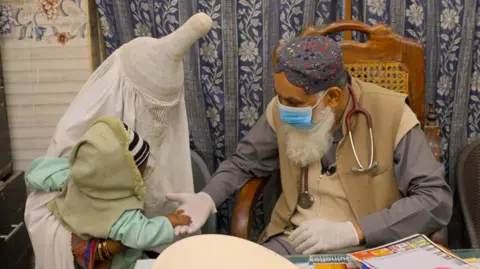
Dr Gul Qaisrani, a local private doctor, raised the alarm in late 2024
Dr Gul Qaisrani, a doctor at a local private clinic, was the first to spot the outbreak in late 2024 after noticing a rise in the number of children going through his clinic who tested positive for HIV.
Almost all of the 65 to 70 children he diagnosed had been treated at THQ Taunsa, he says.
He recalls one mother telling him that her daughter was injected with the same syringe as a cousin living with HIV, and that the syringe was then used on several other children. Qaisrani says a father told him he challenged syringe reuse at THQ Taunsa but was ignored by nurses.
BBC Eye has pieced together data from the Punjab provincial Aids screening programme, private clinics, and a data set leaked by police to identify 331 children who tested positive for HIV in the city of Taunsa between November 2024 and October 2025.
Out of a sample of 97 children with HIV whose families were also tested, only four of their mothers tested positive. This suggests very few of these cases were caused by mother-to-child transmission. The mother of Mohammed Amin and Asma, Sughra, tested negative for HIV – her husband died two years ago in a road traffic accident.
The provincial Aids screening programme data lists "contaminated needle" as the mode for transmission in more than half of all these 331 cases, including Asma's – for the others, the mode is not listed.
The Punjab government intervened in March 2025, when it said the number of cases was 106. THQ Taunsa Hospital's medical superintendent Dr Tayyab Farooq Chandio was suspended, but BBC Eye can reveal that within three months he was working with children again as a senior medical officer at a rural health centre in Taunsa's outskirts.
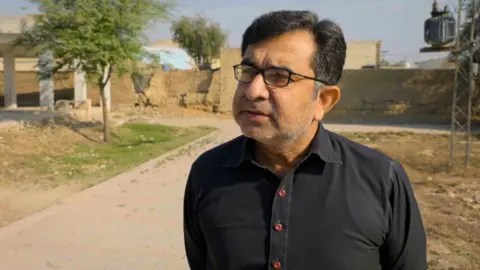
Chandio says that as soon as he found out about a HIV-positive case he took "whatever measures were required"
He told BBC Eye in an interview that he took "immediate" action after being notified of an HIV-positive case at THQ Taunsa, but he said the hospital was not the cause of the outbreak.
Chandio was replaced by Buzdar, who told the BBC that HIV was his "main focus" when he took the job in March 2025 and that he had a "zero tolerance" policy for unsafe infection control.
"We conducted training programmes for the paramedics and staff nurses on how to prevent and defeat HIV. The most important part is our section on infection prevention control. They have been properly trained in this," he said.
BBC Eye's evidence, however, proves that unsafe practices continued eight months later.
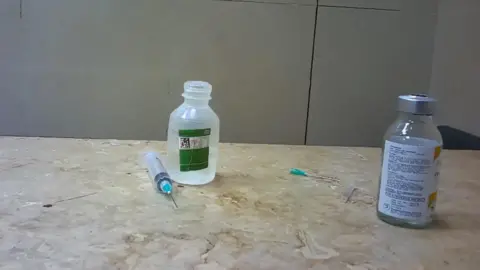
BBC footage shows discarded needles alongside syringes and open containers
Our footage from November and December 2025, filmed over several weeks, captured syringes and vials frequently left open alongside discarded needles on countertops that should be kept sterile.
Most children we saw being treated at THQ Taunsa were given injections via a cannula – a tube inserted into a vein – which further increases the risk of infection. By entering directly into the bloodstream, contaminated medicine can bypass the body's natural defences.
We also filmed one nurse pull a used syringe from under a counter with liquid for the last patient still inside. Rather than discarding it she hands it to her colleague, apparently ready to be reused on another child.
When we showed Buzdar our undercover footage, he insisted it had been filmed before his tenure or that it had been staged.
Watch: Hospital boss claims BBC footage of dangerous injection practices is either old or staged
When asked what he would say to local parents watching this footage, he said: "I can say to them with certainty, with confidence, that you should get your treatment done at THQ Taunsa."
In a statement, the local government said that "no validated epidemiological evidence" had "conclusively established THQ as a source" of the outbreak.
It added that a joint mission between the children's charity Unicef, the World Health Organization and the regional healthcare department had highlighted "the role of unregulated private practices" and "the contribution of unscreened blood transfusions".
But BBC Eye has been leaked the joint mission's April 2025 inspection report into the city's outbreak, which found many of the same issues as our investigation into THQ Taunsa.
"Conditions were especially concerning in the paediatric emergency room," the report says – this is one of the departments BBC Eye filmed in.
"Essential paediatric medications were missing, and unsafe injection practices were common. IV [intravenous] fluids were being reused, cannulas were unlabelled, and used IV sets were left hanging on stands. Hand hygiene was neglected – basins were blocked, and no sanitizers were available."
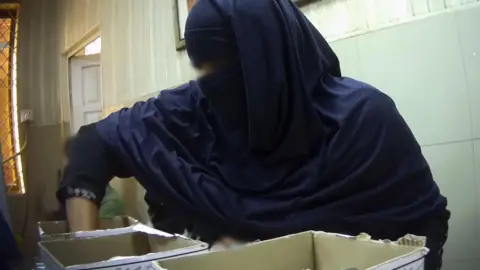
Our undercover footage shows a nurse rummaging through a medical waste disposal box with her bare hands
Dr Fatima Mir, professor of paediatric medicine at the Aga Khan University Hospital in Karachi, says our footage highlights weaknesses in infection control training in Pakistan. "We must warn our injectors: 'You have become an active instrument for passing disease.'"
Our investigation suggests that unsafe practices are in part driven by systemic pressures including a reliance on, and cultural preference for, injections as treatment.
Pakistan has one of the highest rates of therapeutic injections in the world, many of them medically unnecessary. Members of the general public ask for them, including for their children, and doctors happily oblige, says Mir. "They should keep the threshold for injection practice very high. Only give injections for life-threatening illnesses. For mild to moderate illnesses, use oral medication."
A shortage of medicines and supplies also fuels unsafe practices. The demand for injections can put a strain on resources, which are allocated in government hospitals through quota systems overseen by their superintendents. "They have a set number of supplies and are told they must make them last for the whole month," Mir says. "Are they seeing where corner-cutting is dangerous? And where the money should be spent?"
During our undercover filming we found that supplies were often missing on the wards, and that patients who could afford liquid paracetamol were told to bring their own. "They make us account for every little bit of medicine," one nurse said.
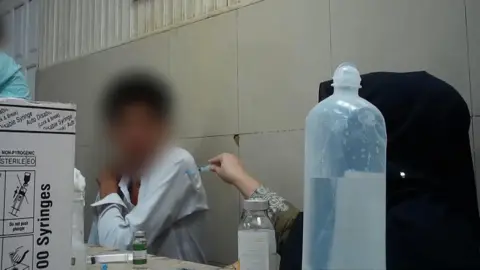
We filmed staff who failed to wear gloves and injected patients through clothing
The practices documented in THQ Taunsa mirror those in previous outbreaks elsewhere in Pakistan.
In 2019, hundreds of children in the town of Ratodero, in Sindh province, tested positive for HIV, most of them with parents who tested negative. Local paediatrician Dr Imran Arbani told the BBC that he found repeated clinic visits and multiple injections in their medical histories, "so it must have been transmitted in one or other of these medical settings". By 2021 the number of HIV-positive local children had risen to 1,500 – and even now, new infections are still occurring.
While we were filming in Taunsa a cluster of cases was reported in Karachi. In the SITE Town area, children treated at a local government hospital, Kulsoom Bai Valika Hospital, were later testing positive for HIV.
Among them was two-year-old Mikasha.
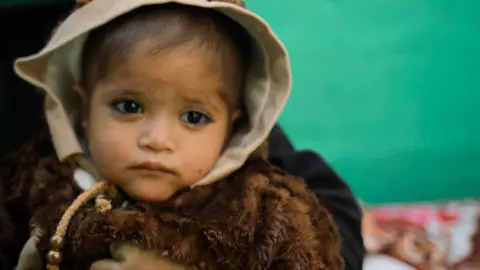
Mikasha, two, is one of the children in Karachi who has tested positive for HIV despite her parents testing negative
A family member said hospital staff used the same syringe on multiple children: "They filled the same syringe and gave it to one child, then filled it again and gave it to another," they told BBC Eye.
The hospital's medical superintendent Dr Mumtaz Shaikh said in an interview that "qualified doctors will never reuse" syringes, "so we have no concept of such things happening in government hospitals".
The federal health minister, however, has confirmed publicly that the outbreak of 84 cases was triggered by the reuse of contaminated syringes at the hospital.
When we put the findings of our investigation to the national government, a spokesperson said that it had "acted promptly within its mandate to investigate concerns [and] implement infection prevention control measures", with guidelines sent to health facilities in March 2025.
Back in Taunsa, Asma's family say she is losing weight, and she now faces a lifetime of treatment for a virus she should never have been exposed to.
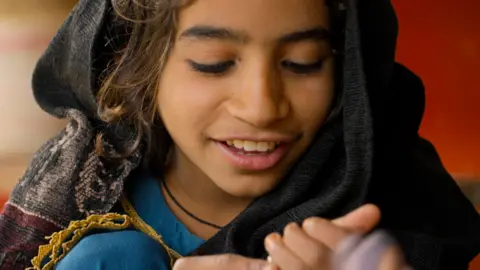
For those children like Asma who contract HIV, stigma can make life difficult
The stigma associated with HIV means that neighbours often stop their children from playing with her, leaving her isolated as well as sick, her family say. She asks her mother: "What is wrong with me?"
Standing at her brother's grave, Asma says she misses him. "He's with God now."
She tells BBC Eye she works hard at school.
"When I grow up," she says, "I want to become a doctor."


