1 year ago
65
1 year ago
65

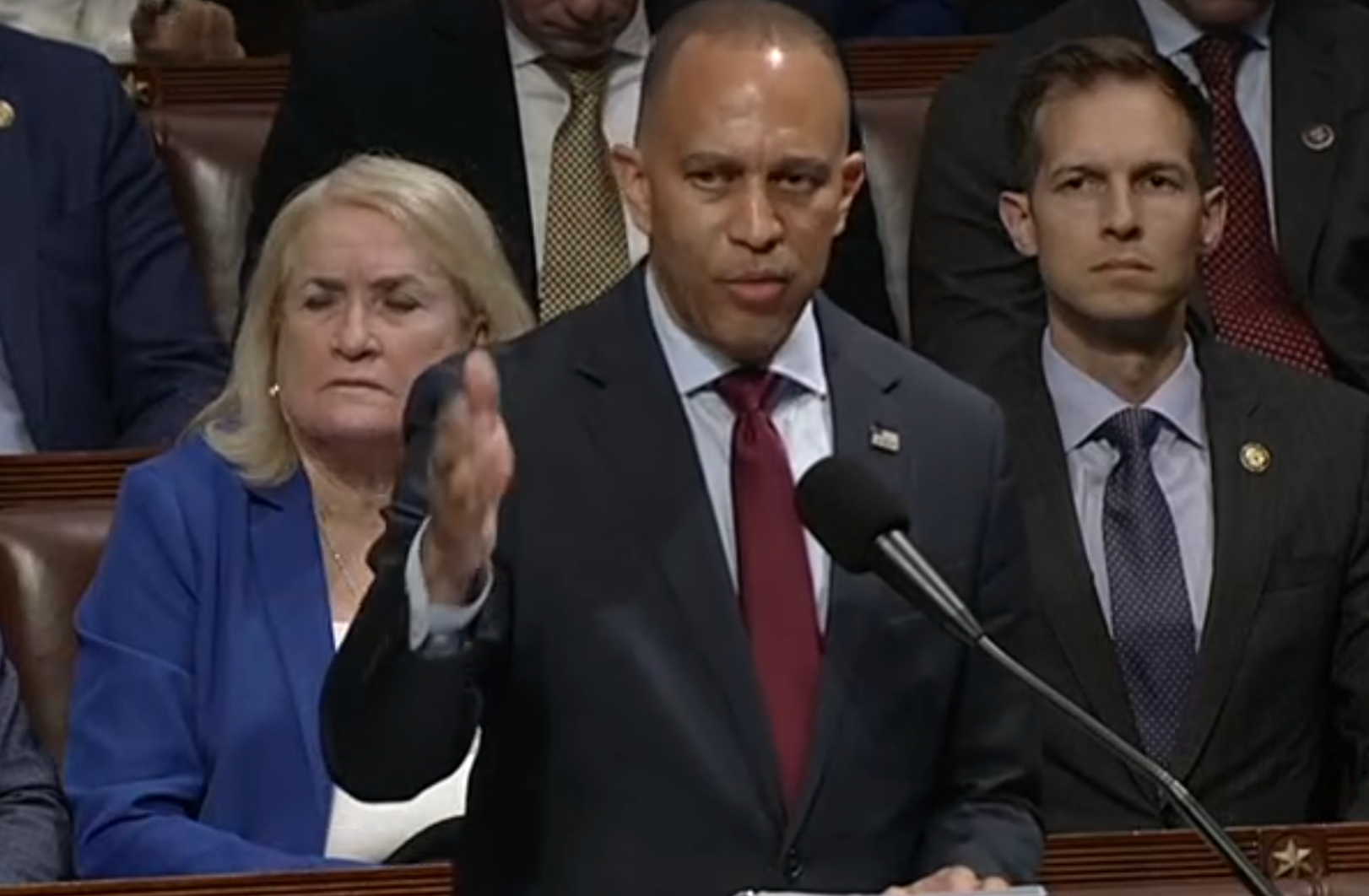
The House of Representatives on Thursday passed President Donald Trump’s “Big, Beautiful Bill,” which features sweeping cuts to Medicaid and nutrition assistance programs, after a whirlwind 24 hours of last-minute arm twisting of holdout Republicans — and a record-breaking floor speech from Democratic leader Hakeem Jeffries.
The final vote was a narrow margin of 218-214, with every Democrat and two Republicans —Kentucky Rep. Thomas Massie and Pennsylvania Rep. Brian Fitzpatrick — voting against the measure.
After Jeffries wrapped his eight-hour and 44-minute delaying tactic — which surpassed former GOP Speaker Kevin McCarthy’s “magic minute” speech record of eight hours and 32 minutes, set in 2021 when the House passed President Joe Biden's “Build Back Better Act” — the House finally commenced its vote on Trump’s bill.
The "magic minute" procedure grants members unlimited time to speak after debate on a bill has concluded.
It all came to a head after a day of grumbling from a handful of conservative Republicans who criticized the Senate version of the bill that was handed back to the House for passage in time for a Trump-imposed July 4 deadline so he could use the holiday to sign his cornerstone legislation.

But after meeting with the president and receiving promises from the White House — and an all-caps threat from Trump overnight — members of the hardline House Freedom Caucus, voted to push the bill through. Throughout the process, the group of rabble-rousers has often held out their votes, only to fold after speaking with Trump.
Still, Rep. Ralph Norman of South Carolina, a member of the Freedom Caucus, insisted this was not a concession. “The reason we have credibility, they know we’ll vote ‘no,’” Norman told The Independent.
Norman said that he was disappointed that wind and solar tax credits or the $7,5000 tax credit for electric vehicles from the Inflation Reduction Act, the signature climate law signed by Joe Biden, were not completely phased out in the legislation.
“With that being said, we had enough assurance that the president was going to deal with them in his own way,” Norman said. “I feel perfectly comfortable with that, which I wasn’t before.”
House members scrambled to make it to Washington after severe thunderstorms and inclement weather delayed travel for many from both parties. Some members drove to D.C. while Democrats held digital town halls to criticize the legislation.
The vote came after the Senate spent a marathon 27 hours in the two days beforehand voting on amendments before the measure was tied at 50-50. Vice President JD Vance came in to cast the deciding tie-breaker.
House Speaker Mike Johnson limited the number of amendments to get the bill to the president’s desk.

The bill’s passage did not come easy, though. In the afternoon, the House held a vote to amend the rules for passage of the bill, which turned out to be the longest in the chamber’s history.
But Republicans soldiered on. Speaker Johnson called into Fox News in between whipping votes to reassure people the bill could pass by the July 4 deadline imposed by Trump.
The rule vote finally passed at around 3.30am on Wednesday morning 219-213, with Pennsylvania Republican Rep. Brian Fitzpatrick the only member of the GOP to break ranks as the rest of the party’s holdouts were persuaded to fall in line to set up a final floor vote.
“The bill is going to pass, they're going to vote for it, they're not opposed to the bill,” House Ways and Means Committee Chairman Jason Smith told The Independent.
“Don’t allow perfection to get in the way of greatness,” he said. “And that is why they will vote for this bill, and that is why the president will be signed into law on July 4 and record that. See if I’m right.”
The bill is one of the most sweeping pieces of Republican domestic policy legislation in history. Not only does it extend the 2017 tax cuts that Trump signed in his first presidency; it also includes money to hire 10,000 new agents for Immigration and Customs Enforcement (ICE) and 3,000 Border Patrol agents, a core tenet of Trump’s promise to conduct “mass deportations” of undocumented immigrants. It also includes money to construct the barrier along the U.S.-Mexico border.
The legislation further allows for more oil exploration and a massive increase in military spending.
To pay for the increase, Republicans made massive cuts to Medicaid – the healthcare program that covers poor people, pregnant women, children and people with disabilities – and the Supplemental Nutritional Assistance Program, also known as SNAP or food stamps.
The bill would require able-bodied adults without dependent children to work for Medicaid benefits and, in the coming years, would cap the level at which states can tax medical providers such as hospitals and nursing homes.
The American Hospital Association warned it could lead to the closing of rural hospitals, which serve many Republican congressional districts.
The act also imposes work requirements for SNAP recipients for able-bodied adults without dependent children. But it lowers the age at which children are considered dependent to 14 years old and would require states with high rates of overpayment or underpayment to shoulder part of the cost of administering SNAP.
The legislation remains wildly unpopular, with polling showing a large amount of Americans disapprove of it.
Rep. Vicente Gonzalez Jr., a Democrat who represents a district that also voted for Trump in 2024, said his district would be hit hard by the legislation.
“But I still feel, unfortunately, that people don’t react until they feel the pain, and they’re going to feel it pretty quick for this with this bill,” he told The Independent.
Democrats will likely campaign against the bill in the coming months ahead of the midterm election, hoping to criticize the GOP for taking away healthcare benefits as a way to extend tax cuts.
Republicans for their part already do not want to talk about the unpopular parts of the bill. When The Independent asked Rep. Nick Begich of Alaska about the side deal brokered by his Sen. Lisa Murkowski to shield the state from many of the provisions for SNAP and Medicaid during the rule vote, he did not speak and bolted onto the House floor.