1 hour ago
7
1 hour ago
7

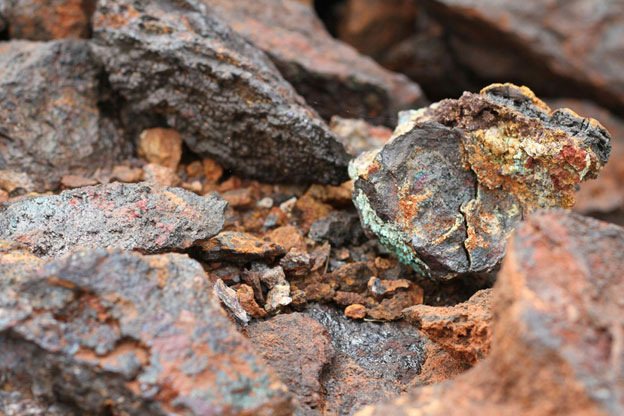 Ore containing copper, cobalt, and nickel, critical minerals that power the use of emerging technologies. Credit: Unsplash/Paul-Alain Hunt
UNITED NATIONS, October 8 (IPS) - The demand for critical minerals is accelerating as world powers scramble to stay on top of emerging technologies. Meanwhile, the environment and frontline communities are paying a steep price.
Such was the basis of the discussion held by the Oakland Institute on September 30, during their webinar: ‘How War and AI Fuel the Critical Minerals Race‘. The event convened experts and frontline activists to examine how artificial intelligence (AI) drives mineral extraction, transforms war technologies, and affects communities entrenched in protracted conflict.
Building on the Institute’s July report, RUSH: Global Scramble for Minerals Wages War on People and Planet, the event highlighted the correlation between rising military spending and the proliferation of AI systems. Panelists stressed that as the demand for critical minerals reaches new peaks, frontline communities bear the brunt of adverse environmental and social impacts.
Anuradha Mittal, founder and Executive Director of the Oakland Institute, noted that military operations account for less than 10 percent of total critical mineral use. Despite this, she warned that the global AI “boom” and increasing competition between world powers over strategic supply chains could trigger a sharp rise in extraction.
Expanding data centers will demand increasingly higher quantities of critical minerals, including copper, gallium, indium, palladium, magnesium, tungsten, germanium, and tantalum. Mittal projected that by 2030, data centers could require an additional 512,000 tons of copper, alongside a 37 percent increase in germanium and an 85 percent increase in gallium by 2033.
She highlighted the United States military-industrial complex as a specific area of concern, describing it as an “AI-first warfighting force.” Under the Trump administration’s proposed 2027 defense budget, military spending would reach a record high of 1.5 trillion USD, nearly twice that of 2023. As the U.S. races to counter China’s dominance across global supply chains, extraction, and processing, the Trump administration has enacted rapid measures to secure minerals internationally.
“Since 2025, the (Trump) administration claims to have signed 38 mineral agreements with countries ranging from Ukraine, India, the DRC, the Philippines, UAE, Australia, Argentina, and Saudi Arabia…Competition with China is bolstering this strategy,” said Mittal. “The Department of War has allocated 75 billion USD to AI-driven programs and another 9 billion to data centers, while the Pentagon requested 13.4 billion dollars in 2026 for autonomous systems. This has driven the U.S. to start stockpiling minerals as strategic assets.”
Other panelists detailed how the impacts of the critical minerals race extend far beyond the global scramble for resources. Frontline communities are not only subjected to environmental degradation, but those in conflict zones are routinely exploited by tech and defense corporations as testing sites for novel military technologies before they are introduced to global markets.
Leila, representing the U.S.-based and Palestinian-led advocacy group Adalah Justice Project (AJP), warned that Gaza has served as an “enormous blueprint for AI-powered war,” noting that Israeli companies have historically used the enclave to test emerging technologies relating to surveillance.
“We have facial recognition drones, different kinds of spyware companies that can hack into phones, and all kinds of AI-assisted targeting programs that, of course, we really learned about through the last couple of years in the genocide,” said Leila. “These tools were developed and tested by Israeli companies in real time, and then sold to the world as sort of ‘battle-proven.’”
Leila also stressed the urgency of the Deadly Merger, a legislative proposal in the U.S. National Defense Authorization Act (NDAA) to expand the integration of the U.S. and Israel’s military technology, intelligence, and surveillance systems. AJP posits that the Merger could intensify violence against Palestinians, drive heightened surveillance in the U.S., and impose a “new techno-fascist world order.”
Katerina Canyon, Executive Director of Peace Economy Project—a non-profit organization that advocates for the redirection of military spending toward human needs—introduced the concept of a “peace economy”, where critical resources are used to strengthen healthcare and social infrastructure rather than fund military operations.
Canyon stated that rare earths, lithium, cobalt, nickel, graphite, and other critical minerals are not only necessities for the proliferation of AI but also are cornerstone resources for the green energy transition. She emphasized that a peace economy must prioritize an equitable environment for civilians over military defensives.
“For nearly fifty years, our organization has challenged militarism and asked what would happen if public resources were directed toward human needs rather than preparation for war,” said Canyon. “My core argument is simple: critical minerals are not politically neutral. The same mineral can become part of a wind turbine, an electric bus, a medical device, or a missile guidance system. Geology does not make that distinction; policy does, government budgets do, procurement decisions do, and industrial strategy does.”
“So the real question is not simply whether we need critical minerals; it is what kind of economy are we building around them,” she continued. “A peace economy starts with a different definition of security. One centered on whether people have safe communities, have healthcare, clean energy, transportation, housing, and a livable environment.”
IPS UN Bureau Report



© Inter Press Service (20261008075216) — All Rights Reserved. Original source: Inter Press Service