1 month ago
30
1 month ago
30

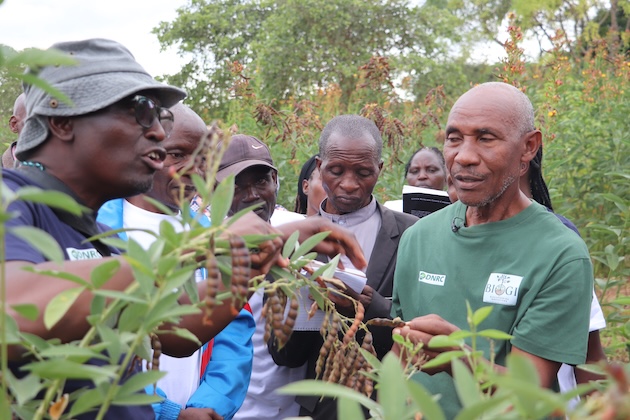 Ferdinand Wafula (left) explains a point to farmers during an exchange visit in Makueni, Kenya. Credit: Isaiah Esipisu/IPS
MAKUENI, Kenya, July 15 (IPS) - At Yumbuni Village in Kenya’s Makueni County, farmers from Vihiga and Kakamega counties have travelled over 560 kilometres to join their colleagues in Kathonzweni Ward and see the progress of experiments being carried out on different homemade organic fertilisers and other farm inputs.
“In a special way, we are conducting community-led agroecology research, comparing the performance of different on-farm-made biofertilisers in three counties: Kakamega, Vihiga and here in Makueni,” said Ferdinand Wafula, Coordinator of Bio Gardening Innovations (BIOGI), a local non-profit organisation coordinating the activity with support from the Agroecology Fund and the Drylands Natural Resource Centre (DNRC).
On Daniel Mulinge’s farm, members of the Yumbuni Community-Based Organisation (CBO) have strategically planted some of the most commonly used drought-tolerant crops, such as pigeon peas, cowpeas, bush beans, and open-pollinated maize varieties, among others, on different small blocks and in rows.
Each row is labelled based on the type of biofertiliser used during planting, among them bokashi, solid biostimulants, inoculated compost and composted manure, with a control line, planted without any form of fertiliser.
“Unlike in conventional farming, where nutrients from synthetic fertilisers are introduced to dead soils so as to feed the plant directly, here, we are giving life to the soil using organic fertilisers so that the soil can eventually feed the plant,” said Mulinge, who is one of the Lead Farmers in Makueni.
After planting, each row is monitored from the time of germination, with all features recorded in terms of germination rate for each row and the strength and length of the shoots. The next record is taken during flowering, to determine which lines flower first and at maturity. For bush beans for example, they count the number of healthy plants in each row at maturity, the number of pods on each bush, and the number of beans in each pod.
They also record the weight of 100 beans from each row to determine which biofertiliser delivered the best quality.
“This is a practical farm model for agroecology transition, and through this exercise, farmers are finding practical answers through hands-on, farmer-led experimentations that strengthen their understanding and their confidence,” said Wafula. “Our objective is to identify practical actions that are needed to scale successful agroecolocal innovation from the existing few farmers to the entire community,” he said.
According to the Heinrich Böll Foundation, soil degradation in East Africa is a silent crisis. The organisation points out that over 40 percent of soils are degraded, which threatens the region’s agricultural foundation and resilience. Yet, among other reasons, the problem is caused by unsustainable farming practices.
But according to BIOGI, use of biofertilisers can easily heal the soil over time, reduce and eventually eliminate dependence on expensive synthetic fertilisers, conserve soil moisture and facilitate adaptation to the climate crisis.
So far, in the first season, bokashi biofertiliser is emerging as one of the best inputs in both the Makueni dryland ecosystem and the tropical environment of Kakamega and Vihiga counties.
Unlike traditional composters, bokashi is a fertiliser made by fermenting organic matter in an oxygen-free environment. The process uses an activator made of micro-organisms like lactic acid bacteria or yeasts to help decompose waste by promoting fermentation. They break down organic matter while inhibiting the proliferation of bacteria responsible for putrefaction.
This is a technique that originated from Japan, with farmers using kitchen wastes to make small quantities of bokashi for kitchen gardens. But in Kenya, farmers are now producing it in larger quantities and even selling it in agro-vets.
“For the beans, lines that were planted using bokashi were able to give between 20 and 25 pods per bush, followed by those planted using compost manure, which yielded up to 18 pods per bush on average,” said Mulinge. The same trend was observed in Vihiga and Kakamega.
“Bokashi has performed well on vegetables such as kale, pumpkin and scallions in Vihiga County,” said Julius Asitiba, one of the farmers who travelled for the knowledge exchange trip.
According to Wafula, these findings will be of great value to county governments that have unveiled their agroecology policies. “I call upon county governments to invest in such farm inputs and research so that farmers do not have to depend on imported inputs that are often affected by geopolitics,” he said.
The ongoing community-led research was designed for three long rainy seasons for both ecologies of Western and Eastern Kenya, considering that seasons are not constant in terms of amount of rainfall, among other climatic factors.
“This is just the first season,” said Wafula. “We intend to repeat the experiments for two more seasons so that we generate as much data as possible.”
Beyond documenting the performance of biofertilisers, farmers are also sharing indigenous knowledge on pest control and the conservation of biodiversity.
According to Mulinge, pests in all the trials in Makueni are controlled using biopesticides made from locally available materials that include hot chilli, leaves from the neem tree, garlic and onions, Mexican marigold and even tobacco leaves.
IPS UN Bureau Report
© Inter Press Service (20260715123842) — All Rights Reserved. Original source: Inter Press Service