5 months ago
17
5 months ago
17

Charlie BucklandBBC Wales

 Yeti Television/BBC Cymru Wales
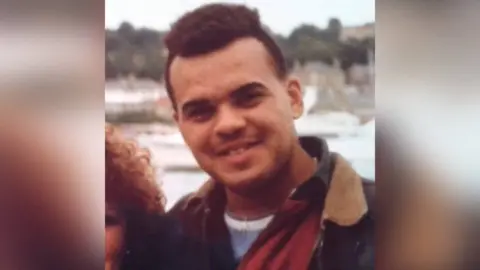
Tyrone France, 31, who was known as "baby bear" was shot dead and burned in a forest popular with campers in 1996
Warning: This story discusses graphic details of human remains and death which some people may find distressing
Known as "baby bear" by his loved ones, Tyrone France was 31 years old when he was murdered under the pretext of a drug deal at a beauty spot in 1996.
Gwent Police were alerted to what was left of a fire at Wentwood Forest, near Newport, on Saturday 11 May and arrived to discover teeth, 343 small fragments of charred bone and spent bullets.
Popular with campers, it wasn't unusual to find remains of illicit campfires and animal bones at the forest, but by chance, forestry workers raised suspicions and the police began the "painstaking" investigation to try and identify the remains.
What they uncovered would both shock and devastate Tyrone's family, who described his death as "horrific" and recalled Tyrone as being a "cuddly little baby bear".
Now, nearly 30 years on, a new documentary has revealed how pathology helped uncover the "brutal and pitiless murder" of France, said to expose the "dark underbelly" of the drugs and gangs culture in Newport the time.
"All the papers were interested in were that he was a drug dealer, a womanizer," said Tyrone's sister, Tarnia.
"He was bubbly, he was charming, he always had a smile on his face... and that's how he got his nickname baby bear."
 Yeti Television/BBC Cymru Wales
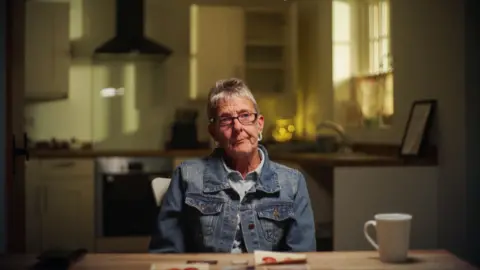
Tyrone's sister Tarnia says her family couldn't believe what happened to her brother
Det Chris Parry was one of the detectives first called to the scene.
He told the BBC One Wales series: The Truth About My Murder - Bones in the Forest: "At the front of it was what appeared to be half a skull, well burnt.
"The police surgeon said in her opinion it was a human skull, which was quite incredible."
To preserve the evidence, officers erected a scene tent and created a grid of 50cm squares, allowing them to collect every piece of bone they could identify in the ashes.
"Parts from the head would be in one place, parts from the feet would be in a different area, so you get a consistency to see a bit of the picture as to how the body was lying when it was burnt," said Parry.
"In total we found 343 fragments of bone, we had no idea who the person is. We didn't even know if it was male or female.
"The one obvious thing was that there wasn't a whole body there. To see that sort of thing is unusual."
DNA profiling was in the early stages so it couldn't be used, but Dr Richard Shepherd, former Home Office forensic pathologist, said evidence from the body led them to the truth.
Large parts of the body were missing, including the torso, and the fractures represented 5-10% of the body - with many coming from the thigh bone.
Piecing them together is a complex process but, once assembled, Dr Shepherd said pathologists discovered the fracture was due to expansion and heat - one intense enough to fracture the densest bone in the body, indicating an accelerant had been used.
The femur also gave the police their first lead - an approximate height of the victim - as pathologists confirmed the bones belonged to a someone between 5ft 11in and 6ft 1in.
 Yeti Television/BBC Cymru Wales
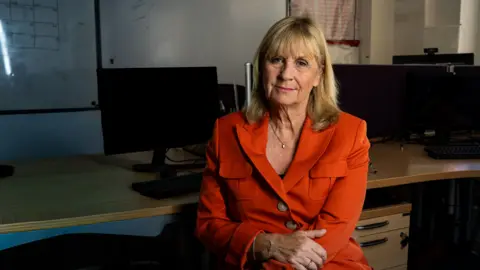
Former chief reporter at BBC Wales, Penny Roberts says she remembers the case "really clearly as it was so unusual"
Despite the intense blaze, it hadn't burned long enough to destroy everything and officers found a pin badge, keys, a watch face and strap and a bullet head.
The keys had a charm that read: "My body is my own, but I am prepared to share it."
A public appeal then led to a breakthrough.
Parry said the police received phone calls from two women saying they believed the body to be that of their boyfriend and ex-boyfriend, Tyrone France, who had recently gone missing.
The keys were taken to the last known address for Tyrone, confirming his identity, but a motive was still unclear.
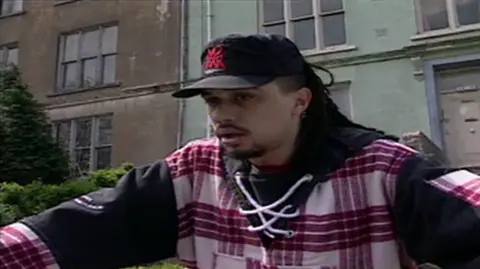
A friend of Tyrone, Chris Jenkins, described him as a "great guy" who "gets on with everybody"
A third witness, Jason Preece, then came forward claiming to be the last to see Tyrone but when inconsistencies emerged, he offered a new story involving a planned drug deal, an unexpected shooting and two other men - Simon Spring and Dylan Watcyns.
Preece told police he and Tyrone picked up Spring and Watcyns and claimed Spring ordered Tyrone out of the car.
He said there was a row that quickly escalated into Spring shooting Tyrone once, then again, in an "execution manner" said Parry.
"It was almost a gangland killing."
 Gwent Police
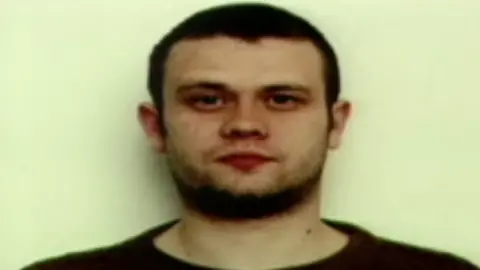
Simon Spring used a legally registered fire arm to commit the murder of Tyrone
While Spring had no previous convictions, he owned a firearms certificate and a police raid at Spring's home found three firearms, including a 9mm pistol, which matched the shells found at the scene.
Penny Roberts, a former BBC Wales reporter who covered the case, said Spring borrowed £2,000 just two months earlier to buy the guns and "liked to pretend he was an enforcer of a shadowy gang called the firm".
A father to a two-year-old at the time, Roberts said Spring appeared to be a "devoted family man", but had a darker side.
Watcyns claimed Spring forced him at gunpoint to make a bonfire over Tyrone's body before he and Spring dropped Preece to the flat and returned to the fire.
He claimed he thought Spring was going to assault Tyrone - not kill him.
"Despite it being a raging fire, the body wasn't going anywhere. They decided they would wrap the body in a wet carpet and take it to the River Usk," said Parry.
"When we got there we saw what looked like a log of wood and that transpired to be a torso, which had stayed exactly where it had gone in. Which was quite remarkable."
How forensics pieced together mystery of bones at beauty spot murder
A small section of hip was left of the torso, and there was enough bone in the femur and the hip for pathologists to match them together, confirming it was the same individual.
With scientific truth it was one body, dental records then confirmed the body was Tyrone.
Two bullet wounds to the torso were also able to establish one clear wound track, shown to enter through the lower back, through spinal cord, the heart and out through the chest wall.
The shot would have paralysed Tyrone and caused an immediate haemorrhage of the heart, leaving him unconscious, Shepherd said.
"A killing that seemed more like a fanciful description of a scene of a killing from a Hollywood movie, turned out to be true," he added.
 Gwent Police
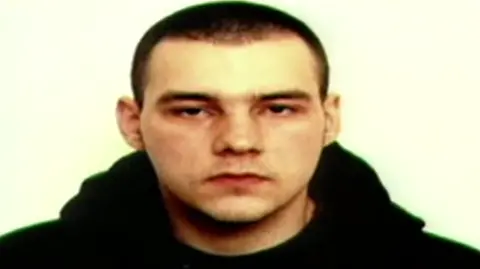
Dylan Watcyns was sentenced to seven years imprisonment in 1997 for his involvement in Tyrone's murder
Preece, Spring and Watcyns all denied murder but Spring admitted manslaughter on the grounds of diminished responsibility.
Spring and Preece were found guilty of murder to life in prison with a minimum sentence of 18 years in 1997, while Watcyns was sentenced to seven years for manslaughter.
The court heard that Spring was paranoid Tyrone was "stalking him" and he had been shot at - though there was no evidence to suggest that.
Judge Justice Curtis described it as a "brutal and pitiless murder" and that the three had lived in a "twilight world" that was "completely overrun with drugs" in Newport.
 Gwent Police
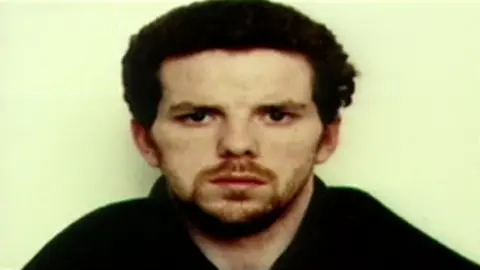
Jason Preece came forward as the last witness, but his initial account of events didn't add up
"These three men - and in particular Simon Spring - seem to be just living out their fantasies as enforcers of macho hard men who worked for shadowy organisations," said Roberts.
"Tragically, these fantasies they had, these images of themselves as being tough enforcers led to the death, the execution - and it was an execution - of Tyrone France."
Recalling the trial, Tarnia described it as "horrific".
Tyrone and Tarnia grew up on the Isle of Wight, his mum was English and his dad was from St Vincent in the Caribbean.
"He was very cheeky... but when he was cheeky, they all loved him for his cheekiness," she smiled.
Growing up in 1980s Britain, Tarnia recalled him having "a lot of stick" and he struggled with the prejudice he received, getting into trouble with the police for being an "easy target" she said.
Aged 21, Tyrone left the Isle of Wight for Southampton and then Birmingham before arriving in Newport in 1992.
Tyrone was described as a well-known character in Newport who was "well liked" and known to the police as a local, minor drug dealer - but his murder shocked the community.
"Mum was devastated, because that was her baby boy," said Tarnia.
Preece was released from prison on bail in 2012, followed by Spring in 2014.
- The first episode of The Truth About My Murder begins on BBC One Wales on February 3 at 10:40pm, with all six episodes available on BBC iPlayer from Tuesday