1 hour ago
2
1 hour ago
2

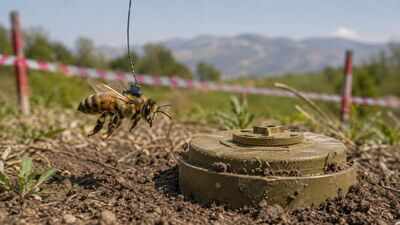
Croatia was still dealing with the hidden legacy of the Balkan wars when scientists began looking to an unlikely ally: honeybees. Years after mines had been buried across fields, forests and rural land, uncertainty over their locations continued to complicate farming, development and everyday life.
Traditional mine-clearance teams faced the difficult task of finding explosives that could remain underground for decades, sometimes without accurate records showing where they had been placed.AP reported that Zagreb University researchers wondered whether bees, with their remarkable ability to detect scents, could offer an extra layer of protection. By training the insects to associate the smell of TNT with food, they hoped the tiny foragers could help flag ground that might warrant a closer inspection.
Honeybees became an unexpected tool for finding land mines in Croatia
When Croatia prepared to enter the European Union in 2013, the country was carrying a problem that had little to do with its better-known landscapes of forests, mountains and the Adriatic coast. Large areas remained suspected of containing land mines planted during the Balkan wars. Around 750 square kilometres of Croatian territory were believed to be affected, with many of the devices laid during the fighting in the early 1990s.
The problem was not simply a matter of clearing old military equipment from abandoned ground. Mines had been placed in many locations without reliable records or detailed maps. Years later, that uncertainty made it difficult to know whether an apparently cleared piece of land was genuinely safe.For people living around suspected minefields, the issue could intrude into ordinary life. Farming, development and tourism could all be restricted by the possibility that explosives were still underground.
Scientists taught honeybees to follow the scent of TNT
At Zagreb University, professor Nikola Kezic and a group of younger scientists were investigating whether honeybees could help locate traces of TNT.The experiment relied on a familiar feature of bee behaviour. The insects are exceptionally good at detecting smells, and they can learn to associate particular scents with food. The researchers used that ability to create a simple association between TNT and a sugary reward.Several feeding stations were placed around the testing area. Only some contained traces associated with the explosive. The bees were then allowed to forage and researchers observed where they concentrated. The insects tended to gather at the stations connected with the TNT scent rather than distributing themselves evenly among the different options.As reported by AP, "The experiment is to condition our bees on the smell of TNT.
This scent, it's coming from the TNT. In the centre of this scent, we put the reward. We put sugar solution as a reward to condition the bees that they can find food just in the middle of smell of TNT scent."
The real challenge was turning individual bees into a reliable swarm
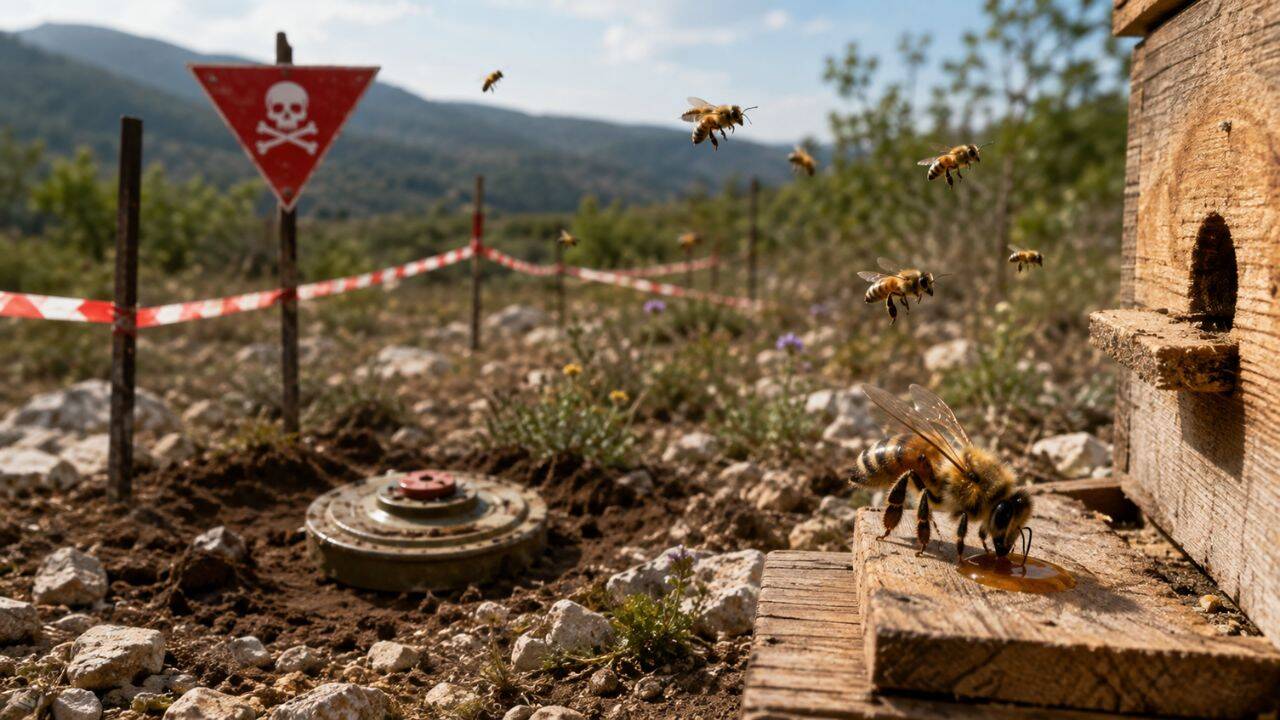
Teaching an individual bee to recognise a smell was not necessarily the biggest challenge. A colony can contain thousands of insects, and controlling their behaviour as a group is considerably harder. The researchers also needed to work out how the bees' movements could be interpreted in an outdoor setting and whether their behaviour remained reliable outside the controlled conditions of an experiment.Instead, the bees were being considered as a way of checking areas that had already undergone clearance. The idea was to watch where the insects gathered and use that information to identify places that might deserve another inspection.Heat-sensitive cameras were part of the proposed approach. By tracking the bees from above, researchers hoped to see whether clusters of insects could reveal the location of lingering explosive traces without putting people directly into the search area.
Why the scent of TNT mattered
TNT odour can become harder to detect as time passes, leaving only very small traces around an old explosive device.Kezic said American scientists had previously explored the use of bees for mine detection, but TNT had not been part of those experiments. That made the Croatian work different in an important respect, since TNT was among the explosives commonly associated with the mines left from the Balkan conflicts.The researchers therefore had to establish whether bees could detect the faint chemical signature that might remain after years underground. The initial tests suggested they could.
Thousands of mines had been left behind
As reported, Croatian officials estimated that roughly 90,000 mines had been planted throughout the country during the four-year conflict. The human toll had continued long after the fighting stopped. Government figures cited at the time put the number of people killed by mine explosions since the beginning of the Balkan wars at about 2,500.
Hundreds of others had been injured.Dijana Plestina, who headed Croatia's government de-mining bureau, described the suspected minefields as a continuing burden for communities and businesses. Land that could otherwise be used for agriculture or development remained restricted, while the possibility of an accident hung over places where residents knew mines might still be present.The danger was particularly difficult because the passage of time did not make the explosives disappear.
Dogs and rats had already been doing similar work
The idea of using animals to locate explosives was not entirely new. Dogs and rats had been used in mine detection because of their ability to identify chemical odours. But there is an obvious physical difference between those animals and bees. A dog or rat has enough weight to potentially trigger certain mines.