4 hours ago
8
4 hours ago
8

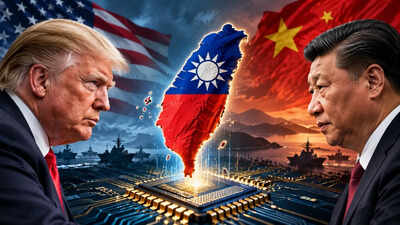
Trump, Xi and Taiwan sit at the centre of a global semiconductor race, with the island producing most of the world’s advanced chips
The latest meeting between US President Donald Trump and Chinese President Xi Jinping has once again put Taiwan at the centre of the world's most consequential geopolitical and technology rivalry.Xi pressed Trump during their Washington talks to adopt what Beijing calls the "correct position" of opposing Taiwan independence, according to a Chinese readout. Taiwan rejected the demand, saying Beijing had no right to determine the island's future. The exchange came as Washington continues to balance its longstanding support for Taiwan with its broader effort to manage relations with Beijing.The Taiwan question, however, is about more than territory, military power or competing political claims.
It is also about one of the most important foundations of the modern global economy: semiconductors.Taiwan produces the overwhelming majority of the world's most advanced chips, with Taiwan Semiconductor Manufacturing Company, or TSMC, at the centre of that ecosystem. These chips power smartphones, artificial intelligence systems, high-performance computers, data centres, automobiles and increasingly sophisticated military technologies.
As Stanford University Hoover fellow Eyck Freymann told Rest of World, “The economic shock from a serious Taiwan disruption would dwarf anything we’ve seen in the postwar period.”The question is therefore not simply what would happen if China and Taiwan entered a military confrontation. It is why Taiwan became so important to the global chip industry, why TSMC is so difficult to replace, why the company depends on technology and suppliers across several countries, and why the US, China and India are all trying to reshape the semiconductor supply chain.
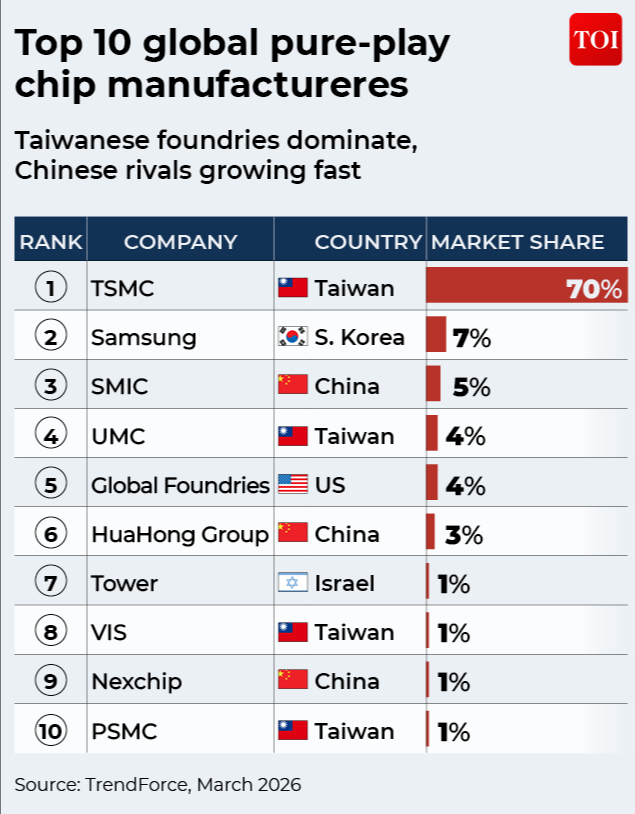
The world’s top semiconductor manufacturers powering everything from smartphones to AI data centres
The island that became a semiconductor chokepointSemiconductors are the building blocks of modern electronics. They allow computers to process information, smartphones to function, vehicles to operate sophisticated electronic systems and AI data centres to perform enormous numbers of calculations.But semiconductor manufacturing is not concentrated in one country. The supply chain is divided among economies with different strengths.The US has major capabilities in chip design, software and electronic design automation. Taiwan dominates advanced manufacturing. South Korea is a major force in memory. Japan is important for semiconductor materials and equipment. The Netherlands is home to ASML, the key supplier of advanced lithography systems.
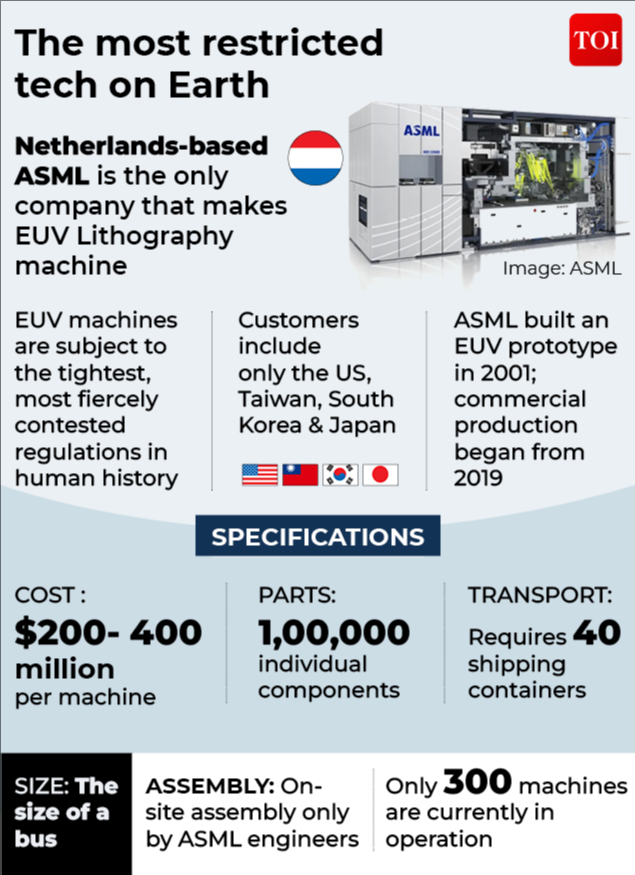
EUV lithography is at the heart of the race to control the world’s most advanced chips
Taiwan's importance comes from the concentration of advanced manufacturing on the island. Government data says Taiwan accounts for more than 60% of global chip production and nearly 90% of advanced chips.
TSMC is at the centre of that ecosystem.TSMC's scale illustrates why it is difficult to replace. In 2025, the company manufactured 12,682 products using 305 process technologies for 534 customers. Its chips served sectors including high-performance computing, smartphones, automobiles, the Internet of Things and consumer electronics. Its manufacturing capacity exceeded 17 million 12-inch equivalent wafers during the year.The company therefore sits between some of the world's largest technology companies and the physical production of their chips.
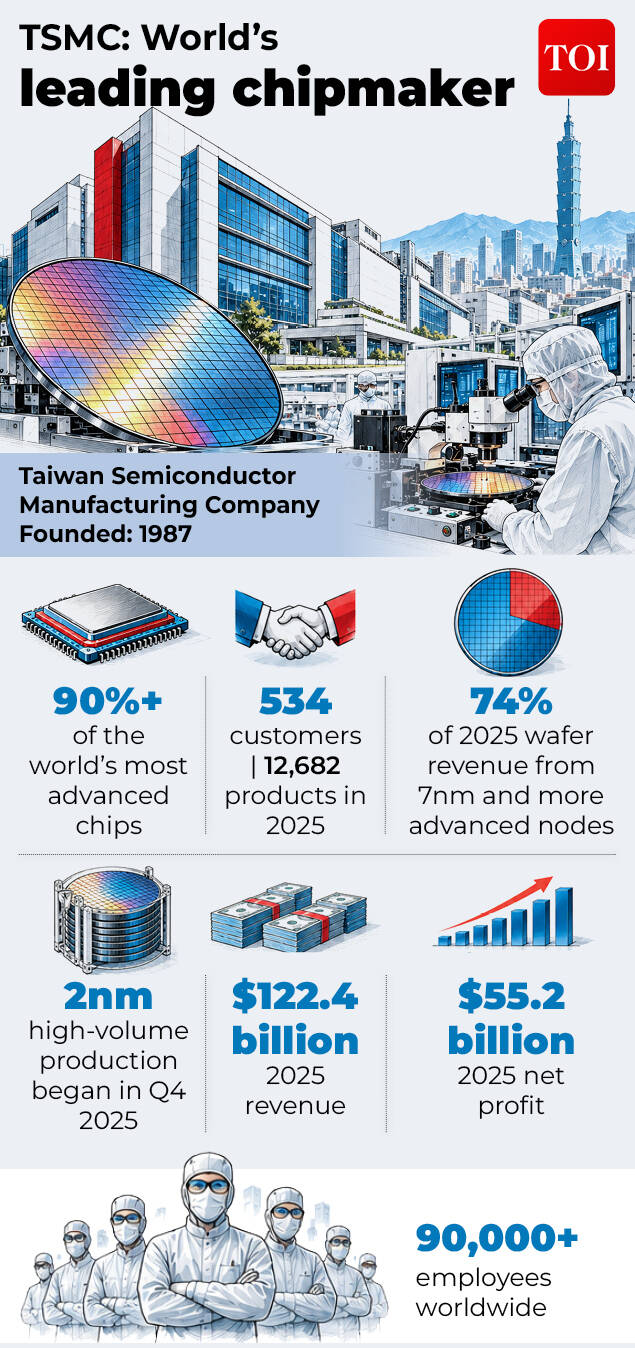
TSMC sits at the centre of Taiwan’s semiconductor ecosystem and the global advanced-chip supply chain
How Taiwan built its semiconductor advantage
Taiwan's position was built over decades.In the 1970s, Taiwanese policymakers recognised that the island could not immediately compete with the US and Japan across the entire technology industry. Instead, it focused on specialised manufacturing capabilities and technology transfer.The Industrial Technology Research Institute, or ITRI, was established in 1973. Taiwan subsequently acquired semiconductor technology from the US through licensing arrangements and trained engineers overseas. The development of the Hsinchu Science Park, established in 1980, added another crucial component.Hsinchu brought together semiconductor companies, research institutions, universities, engineers and suppliers.
Over time, this geographic concentration created an ecosystem in which companies could access skilled workers, equipment, suppliers and technical expertise.The decisive change came in 1987, when Morris Chang founded TSMC.Chang's idea was to separate chip design from chip manufacturing. Instead of designing and selling its own branded chips, TSMC would manufacture chips designed by other companies.The model became known as the pure-play foundry model.TSMC's business model allowed companies such as Nvidia and Qualcomm to concentrate on chip architecture and design without having to build and operate their own advanced fabs. At the same time, TSMC could focus entirely on manufacturing.The model also reduced concerns among customers that their manufacturing partner would compete with them in the chip market. TSMC says its exclusive focus on manufacturing customers' products was central to the pure-play foundry model.That division of labour helped create the modern fabless semiconductor industry and made TSMC a central manufacturing partner for some of the world's most valuable technology companies.
Why TSMC is so difficult to replace
TSMC's advantage is not simply the buildings containing its fabs.A leading-edge semiconductor facility requires enormous capital investment, but a modern fab also depends on years of accumulated process knowledge, engineering expertise, equipment suppliers, chemicals, gases, utilities, logistics and specialist workers.Taiwan developed these capabilities around TSMC over several decades.The result is a dense industrial ecosystem that is difficult to reproduce simply by spending money on a new factory.TSMC is expanding outside Taiwan. It operates manufacturing facilities in Japan and China, has expanded its Arizona operations and is developing a specialty technology fab in Dresden, Germany. But the company continues to invest heavily in Taiwan, including multiple 2nm facilities and advanced packaging capacity.That is why governments seeking greater semiconductor security are generally trying to create additional capacity rather than assuming that Taiwan's entire ecosystem can quickly be recreated elsewhere.
Taiwan's 'silicon shield'
Taiwan's semiconductor dominance has also acquired a geopolitical dimension.The idea of a "silicon shield" was explicitly described by former Taiwanese president Tsai Ing-wen in a 2021 Foreign Affairs article.
The basic argument is that Taiwan's importance to the global economy creates a form of mutual dependence.A major conflict that disrupted Taiwan's chip industry would not hurt Taiwan alone. It would affect economies and companies that rely on its semiconductor output.But the shield is not an absolute guarantee of security.Eyck Freymann, author of Defending Taiwan: A Strategy to Prevent War With China, has argued that the concept can be overstated.
China would not necessarily need to seize TSMC's factories to disrupt the semiconductor supply chain.
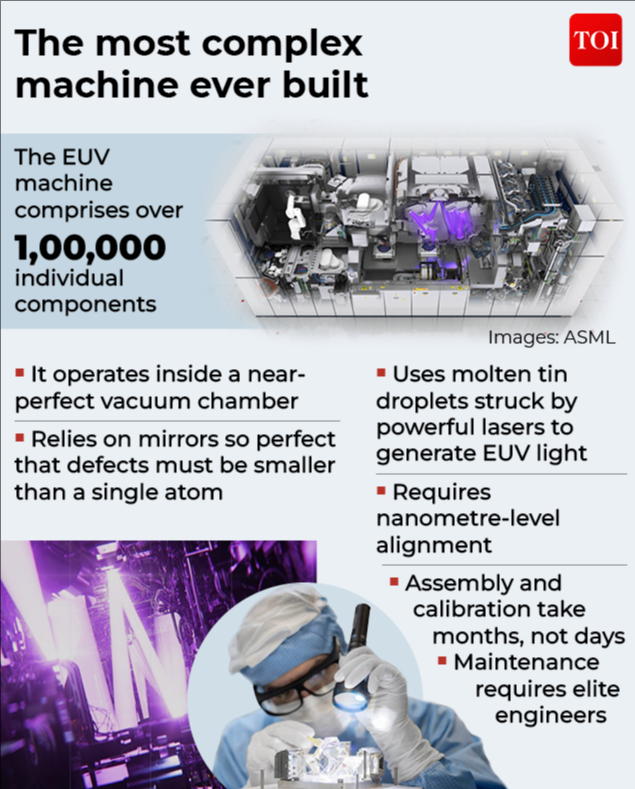
An EUV machine combines precision optics, lasers, mirrors, vacuum systems and thousands of specialised components
A blockade, quarantine or other form of coercion could interfere with the movement of chips out of Taiwan even if the factories themselves continued operating.That distinction is important. Semiconductor production depends not only on fabs but also on electricity, water, equipment, chemicals, logistics, shipping routes and international workers and suppliers.A disruption to those systems could therefore affect output without physically destroying a fab.
China wants semiconductor self-reliance
China's semiconductor strategy is closely linked to its broader technology and national-security objectives.Beijing has invested heavily in reducing dependence on foreign semiconductor technology, while Washington has imposed restrictions on China's access to advanced chips and semiconductor manufacturing equipment.Chinese companies including Semiconductor Manufacturing International Corporation and Huawei have developed domestic capabilities, while Beijing has pushed for greater self-sufficiency across the semiconductor value chain.China has made progress, particularly in mature and increasingly advanced manufacturing, but the leading edge remains difficult because of restrictions on advanced equipment and technology.The contest is particularly important because the most advanced chips depend on highly specialised manufacturing equipment that China has historically had limited access to.
The EUV bottleneck
At the centre of the advanced-chip race is extreme ultraviolet, or EUV, lithography.EUV systems use light with a wavelength of 13.5 nanometres to print extremely small patterns on semiconductor wafers. The technology is critical to producing some of the most advanced generations of chips.This is where the Netherlands enters the semiconductor story.Dutch company ASML is the world's key supplier of EUV lithography systems. ASML does not manufacture chips. It makes the machines used by chipmakers to manufacture them.A modern EUV system combines precision optics, lasers, vacuum systems, mirrors, sensors and thousands of components supplied through a highly specialised international network.
German company Carl Zeiss is central to the optical systems, while suppliers in the US, Japan and elsewhere contribute other components and materials.The result is a semiconductor supply chain in which no single country controls every critical technology.Taiwan provides leading-edge manufacturing. The Netherlands provides critical lithography equipment. The US has major strengths in chip design and related technologies.
Japan supplies important materials and equipment. South Korea dominates parts of the memory market.ASML and TSMC are already working on the next generation of EUV technology. In September 2026, the companies announced an initiative to transition the industry towards 12-inch photomasks for High NA EUV. TSMC intends to use ASML's High NA technology in high-volume manufacturing for advanced nodes from 2030, while the initiative targets a 12-inch mask pilot line by 2031 and advanced-node production readiness by 2033.That relationship shows how difficult it is for any one country to become completely independent in semiconductor technology.
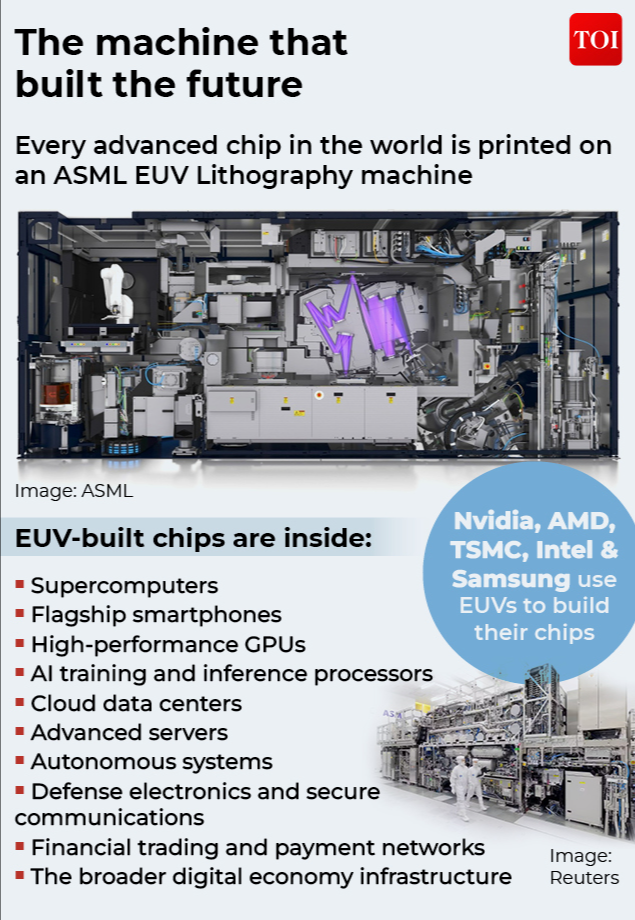
EUV uses 13.5-nanometre light to print incredibly small patterns needed for advanced semiconductor production.
China's EUV challenge
China's attempt to develop its own EUV capability has therefore become one of the most closely watched parts of the semiconductor race.Reuters reported in December 2025 that China had developed a prototype EUV lithography machine at a secure facility in Shenzhen. The machine was reportedly capable of generating EUV light but was not yet capable of producing advanced chips.
Reuters also reported that former ASML engineers had been recruited and that China had used components obtained from older systems and secondary markets.The distinction is important. Producing EUV light is not the same as developing a commercially viable EUV system capable of manufacturing advanced chips reliably and at scale.ASML's position was built over decades of research, engineering and collaboration with a vast supplier network.
China therefore faces the additional challenge of converting research breakthroughs into reliable industrial production.But the effort demonstrates why export controls cannot be viewed simply as a permanent technological barrier. They can restrict access to critical technologies while also encouraging efforts to develop alternatives.
The US wants to reduce its dependence
Washington faces a different version of the same problem.The US has enormous strengths in semiconductor design and technology, but advanced manufacturing has historically been concentrated in East Asia.
As competition with China intensified, that dependence became a national-security concern.The US response has included export controls on advanced semiconductor technology going to China and incentives to expand manufacturing capacity inside the country.The CHIPS and Science Act provided incentives for companies including TSMC to build US manufacturing capacity. TSMC has since expanded its Arizona plans substantially.
In July 2026, the company pledged a further $100 billion investment in Arizona, taking its planned US investment to $165 billion.The objective is not necessarily to eliminate Taiwan's importance. It is to create additional capacity so that a disruption in Taiwan does not automatically become a disruption to the entire global semiconductor industry.But the same problem remains: a fab is only one part of the ecosystem.
Taiwan is also becoming more important to AI
The rapid expansion of artificial intelligence has made Taiwan's position even more important.AI systems require enormous amounts of computing power, and the most advanced AI accelerators depend on leading-edge semiconductor manufacturing and advanced packaging.TSMC is deeply embedded in this supply chain. Its 2025 annual report said advanced technologies, defined as 7nm and more advanced processes, accounted for 74% of its total wafer revenue.Taiwan is also expanding advanced packaging capabilities. In September 2026, construction began on a new advanced packaging industrial park in Kaohsiung anchored by TSMC, with facilities planned for technology validation and talent development.The semiconductor race is therefore no longer only about making smaller transistors. Advanced packaging, memory, lithography, chip design and manufacturing are increasingly interconnected, particularly as AI demand grows.
Taiwan's chips as diplomatic leverage
Taiwan's semiconductor position has also created a new form of economic and diplomatic leverage.In 2025, Taipei announced proposed restrictions on semiconductor exports to South Africa amid a dispute over Taiwan's representative office there. The proposed controls were subsequently suspended after South Africa agreed to negotiations.The measures therefore did not become a lasting export-control regime.
But the episode demonstrated that Taiwan's position in the global chip supply chain can potentially be used as a diplomatic tool.As Wen-ti Sung of the Atlantic Council's Global China Hub said in the material supplied for this story, “By utilizing Taiwan’s position in the global chip supply chain, this looks like Taipei’s attempt at building an autonomous deterrent on the world stage.”He added: “Going forward, other governments will be looking at this example and considering not only Taiwan’s carrots but also its potential sticks.”The episode also showed the limits of such leverage. The immediate economic impact was limited because South Africa represented only a small share of Taiwan's semiconductor exports.
Where India stands
India enters the semiconductor race from a different starting point.Its strongest links have traditionally been chip design, engineering, software and electronics services, while large-scale advanced fabrication has remained a major gap.That is beginning to change.Qualcomm's 2nm chip design tape-out, completed through its engineering centres in Bengaluru, Chennai and Hyderabad, is an example of India's growing role in advanced chip development. But a tape-out is a design milestone, not manufacturing. The 2nm chip itself will be fabricated overseas.According to government data, India accounts for nearly 20% of the global semiconductor chip-design workforce and hosts about 7% of semiconductor-domain global capability centres.The government is attempting to build on that design advantage through the India Semiconductor Mission.Semicon 1.0, approved in 2021 with an outlay of Rs 76,000 crore, created support for semiconductor fabs, compound semiconductors, ATMP/OSAT facilities and chip-design companies. The government says 12 semiconductor manufacturing units have been approved, involving cumulative investment of more than Rs 1.64 lakh crore.
It also says 24 chip-design projects have been approved and more than 300 chip designs have been developed through the wider ecosystem.India is also developing fabrication and packaging capabilities. Tata Electronics' Dholera project in Gujarat is intended to establish domestic silicon fabrication capacity, while projects involving Micron, Tata Electronics, CG Power and Kaynes are expanding assembly, testing and packaging capabilities.The next phase is Semicon 2.0, approved in July 2026 with an outlay of Rs 1,27,500 crore. It expands the focus to six areas: chip design, machines and materials, new fabs, advanced packaging, research and talent.The stakes are rising with domestic demand. India's semiconductor market is projected to reach $110 billion by FY2030 and exceed $200 billion by FY2035. India spent almost $150 billion on semiconductor product imports between FY2017 and FY2025.
India's partnership with the Netherlands matters
India's strategy is not to build every part of the semiconductor chain independently. It is also to connect with established global technology ecosystems.The Netherlands and ASML are important to that strategy because advanced semiconductor manufacturing depends on sophisticated lithography technology.The Tata-PSMC relationship links India's emerging fabrication capacity with Taiwan's manufacturing expertise, while India's engagement with ASML connects it to the Netherlands' semiconductor equipment ecosystem.India is also seeking to build capabilities in equipment, materials, packaging and other specialised parts of the supply chain. Semicon 2.0 explicitly includes machines and materials alongside fabs, design, packaging, research and talent.India is therefore not trying to become another Taiwan overnight. Its immediate advantage is design and engineering, while fabrication, equipment, materials and advanced packaging are still developing.
The semiconductor map is becoming a map of geopolitical power
The global semiconductor industry is now a network of interdependent countries.Taiwan has TSMC and leading-edge manufacturing.The Netherlands has ASML and critical lithography technology.The US has major chip-design companies, software and semiconductor technologies.Japan supplies important materials and equipment.South Korea has enormous strength in memory and advanced manufacturing.China has a vast electronics manufacturing base and is investing heavily in semiconductor self-reliance.India has major engineering and design capabilities and is building manufacturing, packaging and materials capacity.No single country controls the entire chain.That interconnectedness has made advanced chips cheaper and more widely available, but it has also created concentration risks. A disruption at one critical point can affect industries far beyond semiconductors.
The Taiwan question is also a technology question
This is why Taiwan remains central to the US-China relationship.Beijing's claim over Taiwan, Washington's policy towards Taipei, Chinese military activity around the island and Taiwan's own political position are all part of the geopolitical equation. But beneath that lies another contest: control over the technologies that underpin the global economy.Taiwan's semiconductor industry gives the island an outsized position because it became indispensable at one critical point in the global technology chain.TSMC's success was built through decades of industrial policy, technology transfer, engineering expertise, supplier networks and a business model that separated chip design from manufacturing.That concentration now creates both strength and vulnerability.China wants alternatives. The US wants additional capacity. Europe and Japan want more resilient supply chains. India is building its own semiconductor ecosystem.The result is a gradual shift from a highly globalised semiconductor supply chain towards one increasingly shaped by national security and geopolitical considerations.For Taiwan, the challenge is to remain technologically ahead while preserving the ecosystem that made its semiconductor industry so difficult to replicate.For the rest of the world, the challenge is to reduce dependence on any single geographic centre without dismantling the global system that made advanced chips possible.And for India, the opportunity is not necessarily to replace Taiwan, but to become another important link in a semiconductor chain that is increasingly central to economic power, national security and geopolitics.