48 minutes ago
3
48 minutes ago
3

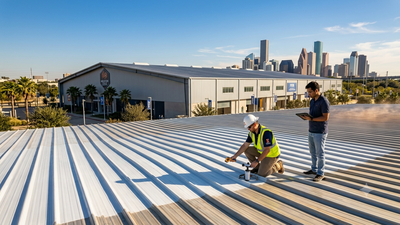
In Houston, the heat is part of the setting. During the FIFA Fan Festival, though, some of the infrastructure around the event had a rather different experience of the Texas summer.
Roofs treated with a thin cooling film stayed dramatically cooler than nearby untreated metal surfaces, even while sitting beneath direct sunlight.The material was not the product of a conventional air-conditioning system or a large energy-consuming installation. As reported by University of Illinois Urbana-Champaign, it came from research led by Lili Cai, a mechanical science and engineering professor at the University of Illinois Urbana-Champaign.
A technology developed in her laboratory had moved well beyond controlled experiments, arriving on public infrastructure in one of the world’s biggest sporting events.
Illinois researchers develop a film that cools surfaces in sunlight
The principle behind the technology is passive daytime radiative cooling. Rather than using electricity to remove heat, the material is designed to shed thermal energy while exposed to sunlight.That distinction matters in places where roofs, walls and other surfaces can become extremely hot.
Conventional cooling can reduce the temperature inside a building, but it requires energy and often places greater demand on electrical systems during periods when temperatures are already high.The Illinois technology takes a different route. Its cooling film can be applied to surfaces that would otherwise absorb substantial amounts of solar radiation. During the Houston deployment, the difference was easy to measure: treated roofs were recorded at more than 40 degrees cooler than neighbouring untreated metal roofs.For a technology still connected to its university research origins, the setting offered a useful test. The material was no longer being assessed only in a laboratory environment. It was sitting on working infrastructure in a city accustomed to intense summer heat, while thousands of people gathered for a major international sporting event.
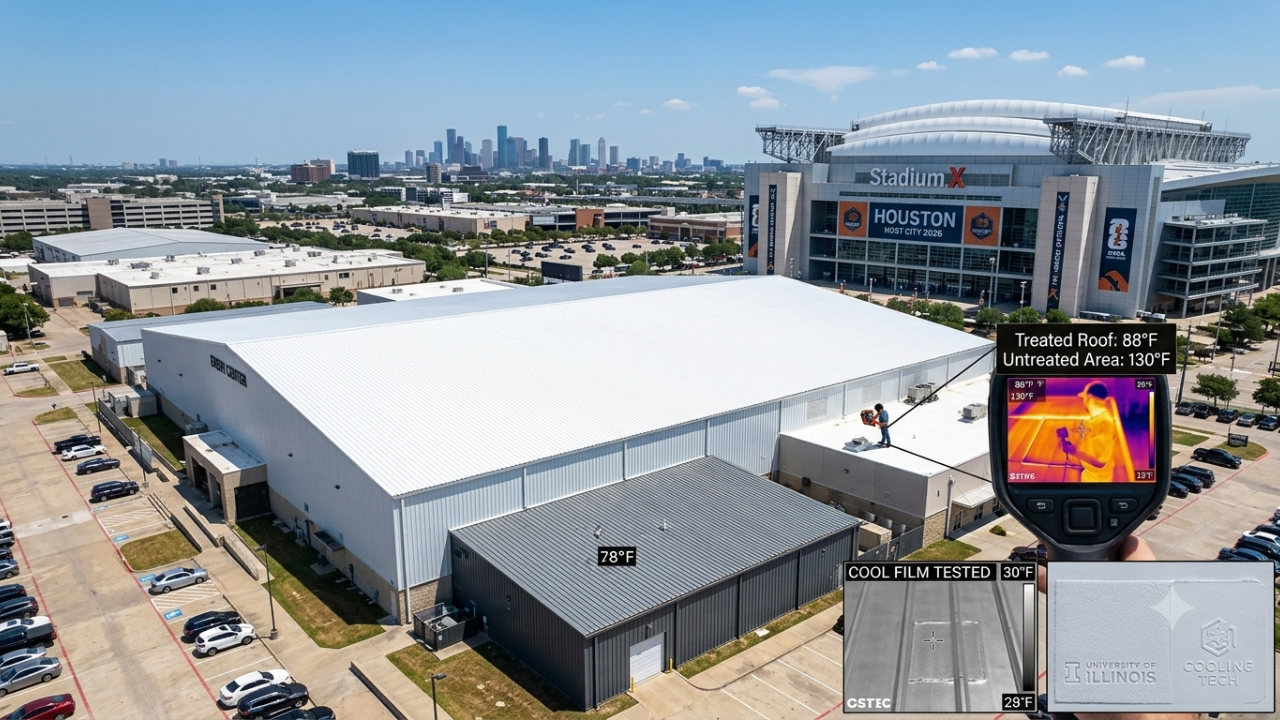
The cooling film that moved from an Illinois lab to Houston roofs
The path from Cai’s laboratory to Houston had taken several years. Research work had to be turned into something that could be manufactured in much larger quantities and handled outside a university setting.That stage involved Yoon Young Choi, a graduate student who worked on scaling the production process for large-area cooling films. Support from the Illinois Innovation Voucher Program helped with the transition, providing a link between laboratory-scale fabrication and the requirements of commercial manufacturing.The technology was eventually taken forward by SolarMantle, a startup spun out of Cai’s research.
Aman Mehta, the company’s principal engineer, was closely involved in manufacturing and the Houston field deployment. He is also a MechSE alumnus who had first encountered the technology as an undergraduate researcher in Cai’s laboratory.
From Illinois research to a cooler FIFA Fan Festival in Houston
SolarMantle worked with the FIFA Sustainability Team and the City of Houston to put the cooling film onto public infrastructure ahead of the FIFA Fan Festival.The choice of Houston was significant for practical reasons rather than simply its association with a global sporting event.
Urban surfaces can retain large amounts of heat, particularly when dark or metallic materials are exposed to prolonged sunshine. Keeping those surfaces cooler can reduce the amount of heat they contribute to their immediate surroundings.Measurements from the installation showed just how large the surface-temperature difference could be. Roofs carrying the cooling treatment were more than 40 degrees cooler than adjacent untreated metal roofs.That does not mean every building would experience a 40-degree reduction in indoor temperature. The measurement concerned the surfaces themselves, and the effect of a cooler roof on an occupied building depends on its construction, insulation, ventilation and other factors. Even so, reducing the temperature of a roof exposed to strong sun can affect the amount of heat transferred into the structure.The demonstration also placed the technology in a setting where reliability and scale mattered.
A material that works in a laboratory has to be manufactured consistently, transported, installed and maintained if it is to become useful beyond research facilities.
Former students helped take the cooling technology into the field
Mehta’s involvement stretches back to his student years. His later role at SolarMantle gave him responsibility for turning the research into a field-ready product and overseeing its use in Houston.Choi’s contribution came at a different stage, focusing on the manufacturing challenge.
Producing a cooling material over a small laboratory sample is one thing; making large-area films suitable for actual buildings presents a different set of engineering problems.For Cai’s group, the Houston installation therefore represented more than a single field test. It showed several stages of research translation working together: fundamental investigation, manufacturing development, commercialisation and deployment.The technology’s journey also illustrates how university research can persist after the original experiments. Students who worked on the research became part of its later development, while a startup provided a route for the material to leave the academic environment.
The cooling film could find a much bigger role beyond Houston
SolarMantle is looking at applications beyond event infrastructure. Commercial buildings, industrial facilities, public infrastructure and data centres are among the areas where passive cooling could have a role.Surfaces that become excessively hot under direct sunlight can increase cooling requirements, particularly in warm climates. If those surfaces can be kept cooler without supplying additional electricity to the cooling system, there may be opportunities to reduce that burden.The technology does not replace every form of conventional cooling, nor does a cooler external surface solve the wider problem of urban heat on its own.
Its value lies in addressing one part of the heat load with a material that operates without continuous electrical power.For Cai’s research team, the Houston deployment marks a point where laboratory work became visible in a very different setting. A cooling film developed through years of research was installed on public infrastructure, tested against the conditions it was designed to address and placed before an international audience at FIFA’s fan festival.