1 month ago
26
1 month ago
26

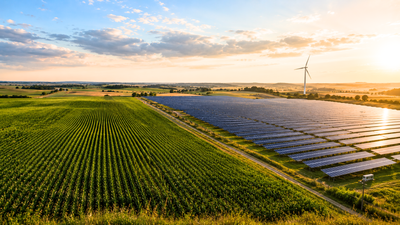
Illinois farmers have long relied on corn and soybean harvests to generate income, but a growing number are now finding an equally profitable opportunity without planting additional crops.
Renewable energy developers are offering long-term leases to build utility-scale solar farms, with payments reaching as much as $2,000 per acre each year. For landowners leasing around 100 acres, that could translate into annual earnings of up to $200,000, providing a reliable source of income that is largely unaffected by volatile crop prices, unpredictable weather or rising farming costs. As the clean energy transition accelerates across the United States, farmland in Illinois is increasingly serving a dual purpose by producing both electricity and financial security for rural communities.
How Illinois farmers are earning up to $200,000 a year through solar leases
The six-figure earnings come from leasing farmland rather than selling it. Utility-scale solar developers typically pay between $1,000 and $2,000 per acre annually to secure land for large solar installations. At the upper end of that range, a farmer leasing 100 acres could receive $200,000 every year. While actual payments vary depending on factors such as location, access to transmission lines and land suitability, these lease agreements provide a predictable income stream that many farmers view as an attractive alternative to relying solely on crop production.
Why solar companies are investing in Illinois farmland
Illinois has emerged as one of the most attractive states for utility-scale solar development because of its vast stretches of flat farmland, favourable sunlight conditions and well-developed electricity transmission network. The state's clean energy policies have also encouraged developers to expand renewable energy projects. Large, contiguous parcels of land allow companies to build efficient solar farms capable of supplying electricity to thousands of homes while helping utilities meet renewable energy targets.
Long-term leases provide steady income for decades
Unlike traditional farming, where annual earnings can fluctuate significantly due to weather events and commodity prices, solar lease payments remain relatively stable throughout the contract period. Most agreements run for 25 to 30 years, with some including extension options. This long-term financial certainty enables landowners to plan investments, support family farming operations and reduce dependence on unpredictable agricultural markets.
Wind energy is also creating new revenue opportunities
Solar is not the only renewable energy sector benefiting Illinois landowners. Wind farms have been operating across parts of central Illinois for nearly two decades. According to figures cited by Compeer Financial, older wind turbine leases in McLean County generally pay around $8,000 to $9,000 per turbine annually, while more recent agreements can generate between $30,000 and $40,000 a year for each turbine.
These higher payments reflect increasing demand for renewable energy projects and evolving lease negotiations.
Renewable energy is changing how farmland is used
Many farmers continue growing crops on the majority of their land while leasing only selected parcels for renewable energy projects. There is also increasing interest in agrivoltaics, where farming activities continue beneath or around solar panels. Sheep grazing, beekeeping, pollinator habitats and certain crop varieties can coexist with solar installations, allowing land to produce both food and clean electricity while maximising its economic value.
Concerns over converting farmland into solar projects
Despite the financial benefits, the expansion of utility-scale solar farms has sparked debate in rural communities. Critics argue that productive farmland should remain focused on food production and express concerns about changes to local landscapes and the long-term impact on agricultural land. Modern lease agreements generally include provisions requiring developers to remove equipment and restore the land once projects reach the end of their operational life, but questions over land use continue to shape local discussions.
Clean energy is becoming a new source of farm income
As renewable energy investment grows across Illinois, solar leasing is becoming an increasingly important part of the rural economy. For many landowners, guaranteed lease payments offer financial stability that traditional farming alone cannot always provide. Although not every farm is suitable for solar development, the opportunity to earn up to $200,000 a year from long-term leases is encouraging more farmers to view clean energy as a valuable addition to their agricultural business rather than a replacement for it.