3 weeks ago
41
3 weeks ago
41

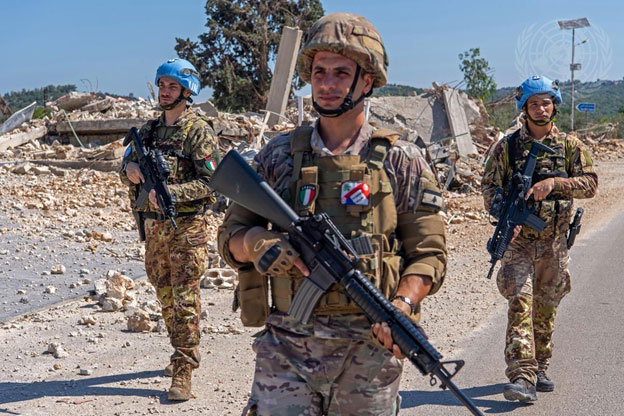 Peacekeepers from Italy serving with the United Nations Interim Force in Lebanon (UNIFIL) on a foot patrol with the Lebanese Armed Forces along the Blue Line in south Lebanon. Credit: UN Photo/Pasqual Gorriz
UNITED NATIONS, August 18 (IPS) - Since the collapse of the ceasefire between Israel and Lebanon announced in June, the humanitarian situation in Lebanon has deteriorated sharply. Marked by high casualties, immense destruction to civilian infrastructure, and widespread displacement, access to essential services has become increasingly strained as the United Nations Interim Force in Lebanon (UNIFIL) is scheduled to end its operations by the end of the year.
Over the course of the summer, UNIFIL has recorded a “near daily presence” of Israeli forces in Lebanese airspace and military activities on the ground. Between August 7 and 8, Israeli forces fired 455 projectiles into south Lebanon, alongside 97 breaches of Lebanese airspace. 229 of these projectiles hit Lebanon on August 8 alone, marking the highest single-day total since June 21.
According to UN Deputy Spokesperson for the Secretary-General, Farhan Haq, the majority of airspace violations involved drones, with smaller numbers attributed to helicopters and fighter jets. In recent weeks, peacekeepers noted a large presence of unguarded weapons, unexploded ordnance, and improvized explosive devices in their areas of operation.
On August 12, the Office for the Coordination of Humanitarian Affairs (OCHA) issued a flash update on the latest humanitarian developments in Lebanon. According to Lebanon’s Ministry of Public Health, there have been at least 4,335 deaths and 12,277 injuries recorded as of August 10, including 355 deaths and 276 injuries since the June 19 ceasefire.
The escalation in bombardment has resulted in immense damage to critical infrastructure, agricultural land, and residential buildings. The August 5 demolition of a well and the August 7 fires at Chaqra and Wadi Saluki water stations in the Nabatieh Governorate have left Lebanese water systems increasingly strained. Furthermore, extensive fires from incendiary strikes have ravaged forests and farmlands in western Bekaa Governorate, resulting in significant losses in land and agricultural yields.
“Demolition of this type raises huge flags about compliance with international humanitarian law,” said UN Human Rights Chief Volker Türk, describing the recent hostilities as a “wholesale destruction” of civilian homes. “I met yesterday a man who told me that he returned to his village in this zone … south of this so-called yellow line. The Israelis were there; they prevented him from going anywhere close to it, and he saw how the village was demolished.”
On August 5, approximately 130 families were newly displaced from Mansouri to Tyre, marking the first displacement order since July 11. OCHA states that approximately 352,793 people remain displaced across Lebanon, including 22,800 displaced civilians in 232 collective shelters, where they face persistent challenges accessing basic services.
In these shelters, limited fuel supply has resulted in the collapse of electricity and water systems, compounding health, hygiene, and safety risks. The vast majority of displaced families lack access to healthcare, medication, and protection services, while relying on cash assistance to survive.
Humanitarian organizations have expressed alarm over the impending conclusion of UNIFIL’s mandate at the end of the year, arriving at a time when lifesaving operations are most urgently needed. Human Rights Watch (HRW) noted that the U.S. and Lebanon strongly opposed extending the mandate. While there is broad support from the other members of the Council, any measures to extend the mandate or delay its termination are subject to a veto from the U.S.
“Pulling the plug on UNIFIL without a robust international force in place would effectively abandon millions of Lebanese civilians to an uncertain and potentially disastrous fate,” said Louis Charbonneau, UN director at HRW. “UN missions may not be a lasting solution, but the peacekeepers are a crucial deterrent against attacks on civilians and human rights abuses.”
IPS UN Bureau Report
© Inter Press Service (20260818054451) — All Rights Reserved. Original source: Inter Press Service