1 month ago
26
1 month ago
26

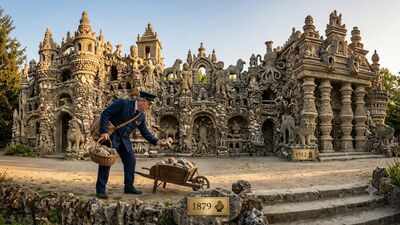
For 33 years, a French rural postman quietly spent his spare time collecting stones from the roadside, turning what began as a chance discovery into one of Europe's most unusual architectural landmarks.
Joseph Ferdinand Cheval, better known as Ferdinand Cheval or Facteur Cheval, started building the Palais Idéal (Ideal Palace) in Hauterives, France, after stumbling across a strangely shaped stone during his postal route in April 1879. Without any architectural training, he worked on the monument until 1912, hauling rocks in a wheelbarrow after walking more than 30 kilometres each day delivering mail.The result was a richly decorated fantasy palace featuring temples, castles, grottoes, animals and mythological figures inspired by nature, illustrated magazines and postcards.
Initially dismissed by many, the self-built monument was later embraced by leading surrealist artists and, in 1969, was designated a French historic monument by Culture Minister André Malraux, securing its place among France's most remarkable cultural landmarks.
How French postman Joseph Ferdinand Cheval's 1879 stone discovery led to the Palais Idéal
Joseph Ferdinand Cheval was 43 years old when an ordinary working day took an unexpected turn in April 1879. While delivering letters through the countryside, he stumbled over a stone whose unusual shape caught his attention.
Instead of leaving it behind, he carried it home.The following day he returned to the same spot and found more stones unlike anything he had noticed before. That simple encounter became the beginning of a project he could hardly have imagined finishing. Cheval later reflected that if nature was capable of producing such remarkable forms, he could use them to build something of his own through masonry and architecture.From that point onwards, collecting stones became part of his daily routine. His postal round stretched for more than 30 kilometres each day, giving him countless opportunities to gather material from fields, paths and riverbanks. At first he carried the stones in his pockets before relying on a wheelbarrow that became one of the enduring symbols of his work.
How postcards and newspapers inspired an extraordinary lifelong vision
Cheval had little reason to believe he would one day become associated with an internationally recognised monument.
Born in 1836 in the small village of Charmes-sur-l'Herbasse, he grew up in a farming family with limited means. His education ended at the age of 12, after which he worked as a baker's apprentice before eventually becoming a rural postman.His profession exposed him to more than country roads. Every day he handled newspapers, illustrated magazines and postcards travelling across France. Those publications introduced distant places, unfamiliar architecture and scenes from around the world to readers who might never leave their villages.Images of temples, castles, mosques and exotic landscapes gradually found their way into his imagination. They were not copied exactly. Instead, they blended together with forms borrowed from nature, local rock formations and his own ideas, creating something that belonged entirely to him.
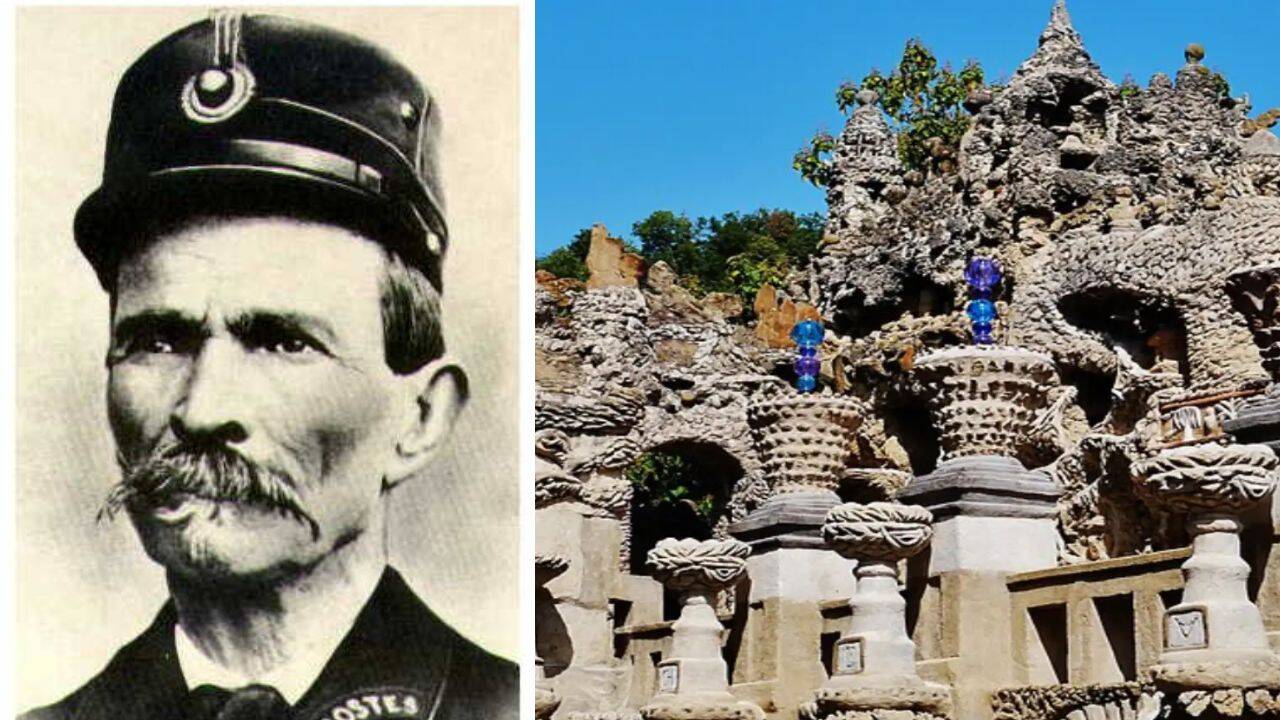
Inside Ferdinand Cheval's 33-year construction project
Construction continued for an extraordinary length of time. Between 1879 and 1912, Cheval spent nearly every spare moment adding to the structure in the garden beside his home.The monument itself records the scale of that effort. An inscription carved into the building states that it required 10,000 days, 93,000 hours and 33 years of hardship. Another declares it to be "the work of one man", a reminder that the palace was completed without teams of builders or trained architects.There was no master plan laid out in advance. New sections appeared as fresh ideas emerged and as more stones were collected.
Mortar, lime and shells joined the natural rock to create walls that seem to grow organically rather than follow conventional building methods.
Why Cheval's palace looks unlike any other building in the world
The finished monument refuses to fit neatly into any architectural category. Elements inspired by different continents sit beside one another without concern for historical accuracy or stylistic consistency.The eastern side of the palace contains one of its earliest features, a fountain known as the Source of Life, watched over by sculpted animals.
Nearby stands an Egyptian-inspired tomb, while a Hindu temple occupies another section of the façade. Hidden within that part of the building is the wheelbarrow Cheval used during construction.Elsewhere, visitors encounter references to medieval castles, Alpine chalets, mosques and civic buildings that resemble structures Cheval had seen in illustrations. Rather than reproducing famous landmarks faithfully, he transformed them into a personal architectural language.
How one palace became a living sculpture
Almost every surface carries decoration. Relief sculptures and carved figures fill walls, niches and corridors, leaving very little plain stone visible.Animals appear throughout the palace. Elephants, bears, pelicans, deer, octopuses, birds and caimans stand alongside wolves, flamingos and dromedaries. Mythological creatures share space with giants, fairies and biblical figures, producing an environment that feels closer to an illustrated storybook than a conventional building.The long interior gallery extends this idea further, surrounding visitors with sculpted wildlife while linking different sections of the monument. Staircases lead upwards to terraces where one object receives particular attention: the stone that first inspired the entire project.
The hidden water system behind the Palais Idéal
Cheval originally intended the palace to be more than a static monument. At its highest point he constructed a water reservoir designed to feed the fountain below, allowing water to flow through parts of the complex.The system eventually had to be abandoned because constant moisture damaged the structure. Even so, traces of that original design remain, offering a glimpse of how the creator imagined the palace functioning during his lifetime.The surrounding garden formed part of the experience as well. Trees, flowering plants and cacti softened the dense stonework, making the monument appear to emerge gradually from its landscape.
The monument that became his life's work
When the palace was finally completed in 1912, Cheval was 77 years old. Yet he did not stop building. His wish had been to be buried inside the palace beside his wife, but the authorities refused permission. Rather than abandoning the idea, he began another ambitious project in the cemetery at Hauterives.For the next eight years he worked on what he called the Tomb of Silence and Endless Rest. Built in the same highly individual style, it became his final creation.
He eventually rested there with members of his family after completing another monument largely through his own labour.
Recognition that arrived much later
For much of Cheval's life, the palace puzzled more people than it impressed. It did not resemble recognised architecture, nor did it belong to any artistic movement familiar to critics of the period.Attitudes began to change during the early twentieth century. Writers, photographers and artists associated with surrealism saw something remarkable in the monument's dreamlike quality.
André Breton visited the site several times and later referred to Cheval as a forerunner of surrealist architecture. Photographs of the palace also appeared in exhibitions beyond France, introducing the structure to a wider audience.Artists including Max Ernst created works inspired by Cheval's achievement, while Pablo Picasso, Jean Tinguely and Niki de Saint Phalle were among those who admired the palace's originality despite its unconventional origins.
How France finally recognised Cheval's masterpiece
The most significant official recognition arrived in 1969. André Malraux, then serving as France's Minister of Culture, decided that the Palais Idéal should receive protection as a historic monument.The decision was far from straightforward. Some officials questioned whether a structure built by a self-taught postman deserved such status. Malraux argued that the palace represented a unique example of naïve architecture and that allowing it to disappear would mean losing something found nowhere else.His decision ensured the building's preservation and secured its place within France's cultural heritage.
The lasting legacy of Ferdinand Cheval's Palais Idéal
More than a century after construction ended, the Palais Idéal remains difficult to classify. It has been compared with the imaginative architecture of Antoni Gaudí and the fantastical imagery associated with Salvador Dalí, although Cheval worked entirely independently from either artist.Its influence reaches into modern art and architecture, where scale models, exhibitions and tributes continue to appear.
Visitors are often struck not only by the appearance of the palace but also by the extraordinary commitment behind it.What stands in Hauterives today is more than an unusual building. It is the physical record of 33 years spent gathering stones one by one, shaped by the persistence of a rural postman who transformed ordinary materials into one of France's most distinctive monuments.