59 minutes ago
4
59 minutes ago
4

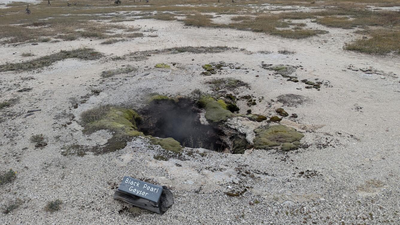
In 1925, a hydrothermal explosion reshaped Yellowstone’s Biscuit Basin (Image Credit: U.S. Geological Survey)
A century-old mystery at Yellowstone’s Biscuit Basin has turned out to be less about a missing geyser and more about a misplaced sign. In 1925, a hydrothermal explosion dramatically altered part of the basin, but because nobody witnessed the event, the details were later pieced together from observations and correspondence.
One particularly confusing clue was a “Black Pearl” sign that ended up about 1,000 feet from the actual geyser it was meant to identify. According to the U.S. Geological Survey’s Yellowstone Volcano Observatory, two letters written in 1926 have now helped reconstruct how the mix-up happened and clarify the history of the area.
An explosion that went unnoticed
The 1925 event was relatively small compared with some of Yellowstone’s much larger hydrothermal explosions, but it still changed the landscape around Biscuit Basin.
According to the USGS, the explosion happened near the Firehole River and tore through the area’s fragile sinter crust. It likely created or enlarged a new thermal pool near Black Diamond Pool.One major problem for anyone trying to document what happened was that nobody saw the explosion when it occurred. By the time people examined the area, they had to rely on what the landscape looked like afterward. That made identifying and naming the new thermal features more difficult.
Where the Black Pearl confusion began
The trouble centred on a sign. Visitors found a weathered sign carrying the name “Black Pearl” close to the area affected by the explosion. The problem was that the feature the sign appeared to identify could not be found there. The real Black Pearl Geyser was located roughly 1,000 feet to the west.The geyser itself was distinctive. It was known for dark, pearl-like spheres of sinter that covered its surface. Meanwhile, the thermal features closer to Black Diamond Pool had their own names.
Wall Pool was to the west, while Black Opal Pool was to the east. At some point, the Black Pearl sign had apparently been moved, creating the impression that a different thermal feature was the famous geyser.
Two letters helped solve the mystery
The mix-up might have remained a minor historical curiosity if not for correspondence preserved in Yellowstone’s archives. In a letter dated August 15, 1926, J. R. Van Pelt, a ranger at Old Faithful, wrote to J. E.
Haynes, acting director of the Yellowstone Park Museum. Van Pelt explained the situation surrounding the previous year's explosion and the misplaced sign.Another letter followed on August 26, 1926. Haynes wrote back to Van Pelt, confirming that some of the signage was out of position and asking that the signs be returned to their appropriate locations. The exchange included discussions involving park officials, painters and earlier naming practices elsewhere in Yellowstone.
What might have seemed like routine administrative correspondence a century ago has now become an important piece of evidence for reconstructing the story.
Why a misplaced sign mattered
At first glance, getting a sign wrong by 1,000 feet may sound like a small mistake. In Yellowstone, however, names and locations are closely tied to the geological record. Thermal features can change, disappear, become dormant or appear in new forms. A name attached to the wrong pool can therefore make it difficult for later visitors and researchers to understand which feature historical records were describing.
The 1925 explosion was already difficult to document because no one witnessed it. Confusing the names afterward added another layer of uncertainty.The episode also reflects how information was recorded and shared in the early 20th century. There were no modern monitoring systems, digital photographs or instant communication. Details often travelled through handwritten letters and personal observations, leaving plenty of room for misunderstandings.
Yellowstone’s hydrothermal landscape keeps changing
The story has gained renewed attention because Biscuit Basin has experienced more recent hydrothermal activity. In July 2024, a hydrothermal explosion occurred at Black Diamond Pool. Such explosions happen when superheated water suddenly turns to steam, breaking apart the rock that confines it. They can leave behind craters, scattered debris and major changes to the surrounding landscape.The area has continued to be monitored. The Yellowstone Volcano Observatory has installed equipment at Biscuit Basin to create a better record of ongoing and future activity.
That modern monitoring is a sharp contrast with what happened in 1925. Scientists now have instruments and cameras that can capture changes as they occur rather than relying mainly on observations made afterward.
A small historical error with a bigger lesson
The misplaced Black Pearl sign is ultimately more than an old naming error. It shows how easily the record of a geological event can become blurred when an event is not directly witnessed. The 1926 letters allowed the USGS to separate the actual Black Pearl Geyser from the feature associated with the misplaced sign and reconstruct what happened after the 1925 explosion.More than a century later, the landscape around Biscuit Basin continues to change. But this time, scientists have modern monitoring equipment in place to document those changes, reducing the chances that another geological event will become tangled in a similar mystery.