4 weeks ago
39
4 weeks ago
39

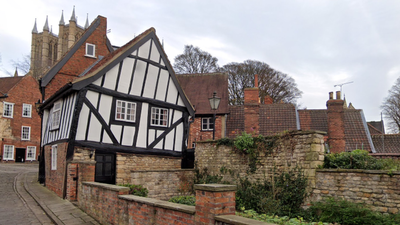
Lincoln's 'Wonky House' set for redevelopment after funding secured
A demolition order issued in late 1933 was meant to remove a row of ordinary brick terrace houses at the top of Michaelgate in Lincoln. Instead, the first blows from the demolition crew revealed something unexpected: a 16th-century timber-framed building hidden behind the brick exterior.
The discovery stopped the demolition of number 40 Michaelgate. Today, the building is known locally as the Crooked House or Wonky House. The Grade II listed property is one of the most photographed historic sites in Lincoln's Cathedral Quarter, behind only Lincoln Cathedral, Lincoln Castle and the Stonebow in popularity. Historical records and the Historic England listing for the building document how it narrowly escaped destruction during the slum clearances of the 1930s.
Demolition order reveals a hidden historic building
During the early 1930s, towns and cities across England began large urban renewal programs to remove older and unhealthy housing. In Lincoln, these projects targeted crowded homes near the industrial riverfront and along the steep cobbled streets leading toward the Cathedral district. Local historical records published by It's About Lincoln show that a demolition order was issued in late 1933 for numbers 34, 36, 38 and 40 Michaelgate.
At the time, number 40 looked like an ordinary brick terrace house. But when workers began removing its outer walls, they discovered heavy timber framing, curved wooden braces and traditional rendered panels hidden behind the later brick facade. After recognising the building's importance, the owner asked the local council to cancel the demolition order. The Minister of Health later approved the building's preservation.
However, under the public health rules of the time, it could no longer be used as a home. The City of Lincoln Council eventually bought the property and carried out restoration work to reveal its original 16th-century character. It remains one of England's oldest buildings owned by a local council.
Centuries of changes
Historic England's national heritage list records that the building has two storeys and two bays, with dressed stone, brickwork and a pantile roof.
Although its main timber structure dates from the 16th century, the building has been changed several times over the following centuries. The street-facing side has a replica plank door, along with sliding sash and casement windows. The south gable end still contains original corner posts and curved diagonal timber braces, as well as a separate doorway.
The building also has unusual features inside. Former residents reported that a chimney breast had been built around an old tree trunk that was already part of the timber structure.
The property is managed in partnership with the National Trust and sits near other historic buildings along Steep Hill, including the 15th-century Harlequin Inn at numbers 21 and 22 Steep Hill.
New threats to the timber structure
Although the building survived the demolition plans of the 20th century, its timber frame has faced new problems in recent years. Heritage Lincolnshire reports that when damaged exterior render was removed in early 2024, conservation workers found widespread damage caused by death-watch beetles.
They also discovered older repairs made with dense cement that prevented the historic timber from breathing properly.
To protect the structure, Heritage Lincolnshire began a major conservation project with the City of Lincoln Council. More than £451,000 was raised from organisations including the Architectural Heritage Fund, Investors in Lincoln, the Michael Cornish Charitable Trust, the Swire Charitable Trust and Historic England.
Tracy Stringfellow, Chief Executive Officer of Heritage Lincolnshire, welcomed the start of the restoration and said the organisation was pleased to help save the iconic Wonky House. She also said the project would eventually create new holiday accommodation in the historic building.City of Lincoln Council also supported the project. Cllr Naomi Tweddle, Portfolio Holder for Inclusive Economic Growth, said that 40-42 Michaelgate was an important part of Lincoln's heritage and that the funding would help protect and restore the buildings while bringing them back into use.
Restoration workers are using traditional limewash on the exposed timber frame to help protect it from future insect damage.
When the work is finished, income from the new holiday accommodation is expected to help pay for repairs to the neighbouring 15th-century Harlequin building. The project will also allow its historic rooms to be opened for community use. From almost being demolished as an ordinary terrace house in 1933 to becoming one of Lincoln's best-known historic buildings, the Wonky House has survived nearly a century of changing uses, repairs and conservation efforts. Its latest restoration aims to ensure that its unusual timber frame remains part of Lincoln's historic streetscape for generations to come.